
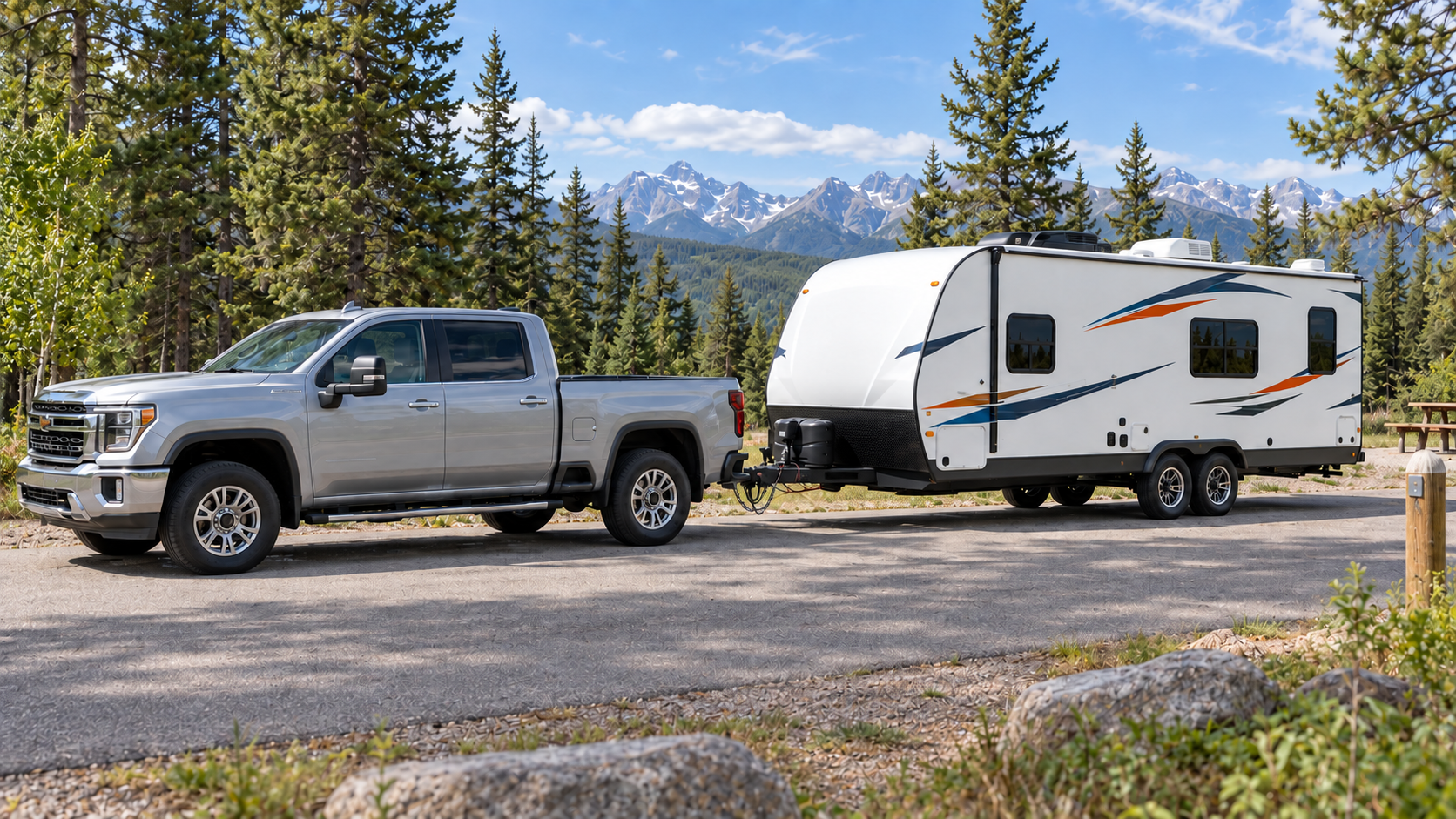
RV towing safety begins long before the vehicle enters the highway. The tow vehicle and trailer must be properly matched, loaded within their ratings, and ready for the road. Once moving, the added weight and length change how the combination accelerates, stops, turns, and handles hills and wind.
A trailer’s published empty weight is not its travelling weight. Water, propane, batteries, accessories, and camping supplies can push a combination beyond a limit even when the brochure’s towing number looks acceptable. Use the ratings for your specific vehicles and equipment, and check actual loaded weights whenever possible.
Start With the Tow Vehicle’s Ratings
A manufacturer may advertise a maximum towing capacity, but that number does not tell the entire story. The vehicle must remain within all applicable ratings at the same time.
Key Weight Ratings Explained
Important terms include:
- Gross Vehicle Weight Rating (GVWR): The maximum permitted weight of the fully loaded tow vehicle.
- Gross Axle Weight Rating (GAWR): The maximum permitted weight carried by each vehicle axle.
- Gross Combined Weight Rating (GCWR): The maximum permitted combined weight of the loaded tow vehicle and loaded trailer.
- Payload capacity: The weight available for passengers, cargo, hitch equipment, and trailer tongue or pin weight.
- Towing capacity: The maximum trailer weight the vehicle may be rated to tow under specified conditions.
Use the owner’s manual, towing guide, certification labels, and other information supplied for the specific vehicle. Passengers, cargo, aftermarket accessories, tools, hitch equipment, and the trailer’s tongue or pin weight all consume payload. Payload or rear-axle capacity may become the limiting factor before the advertised towing capacity is reached.
Never rely on the rating for a similar truck or SUV. Engine, transmission, axle ratio, drivetrain, wheelbase, tires, and factory towing equipment can change what a particular vehicle is rated to pull.
Understand the Trailer’s Weight Ratings
The trailer has limits of its own, including its GVWR, axle ratings, and cargo-carrying capacity. Its unloaded weight does not necessarily account for dealer-installed batteries, propane, solar equipment, food, clothing, tools, water, or other additions.
Tongue weight is the downward load a conventional trailer places on the hitch. Pin weight is the load a fifth-wheel trailer places in the truck bed. Both count against the tow vehicle’s available capacity.
Weigh the combination in its normal travel configuration using an appropriate vehicle scale. Individual axle weights provide more useful information than a single combined total. Check the applicable tire, axle, vehicle, and combined ratings—not just whether the trailer’s total weight is below the advertised towing capacity.
Account for Water and Added Equipment
A full fresh-water tank adds substantial weight, and its location can affect axle and hitch loading. Wastewater adds weight too. A trailer travelling with full holding tanks may handle differently than it did when they were empty.
Count added equipment such as batteries, propane cylinders, generators, solar components, bike racks, spare tires, toolboxes, and cargo trays. Where you install or pack an item matters as much as what it weighs. Cargo placed far behind the trailer axles can reduce tongue weight and contribute to instability; heavy cargo at the front can overload the hitch or tow vehicle.
Reweigh the combination after adding substantial equipment or changing how the trailer is loaded.
Match the Towing Equipment
Match the receiver, hitch, and other towing components to both vehicles and to the actual load. The lowest applicable rating limits the combination. A higher-rated hitch cannot increase the tow vehicle’s payload, axle, or towing capacity.
A weight-distribution hitch may improve how a properly matched conventional trailer and tow vehicle carry tongue weight when selected and adjusted as instructed. It does not increase any vehicle or equipment rating. Sway-control equipment likewise cannot correct overloading or poor cargo placement.
For a component-by-component connection and inspection procedure, see RV Hitch, Coupler, and Safety Chain Inspection Guide. Follow your vehicle and hitch manufacturers’ instructions for the specific setup you use.
Understanding RV Towing Safety and Trailer Sway
Trailer sway is side-to-side movement that can grow rapidly. It may be triggered or worsened by insufficient tongue weight, poor cargo placement, excessive speed, crosswinds, passing trucks, uneven tire pressure, worn components, or incorrect hitch setup.
If sway begins, avoid abrupt steering or braking. Gradually reduce speed while following the instructions for your tow vehicle, brake controller, and sway-control equipment. Stop in a safe location and determine the cause before continuing. Do not assume a sway-control device makes an unstable loading arrangement safe.
Trailer Brakes and Brake Controllers
Trailer-brake requirements vary by location and trailer weight. Check the requirements that apply along your route.
Electric trailer brakes require a compatible brake controller installed and adjusted according to the relevant manufacturers’ instructions. Too little trailer braking can force the tow vehicle to stop most of the trailer’s weight. Too much can lock the trailer wheels and reduce control.
Before entering traffic, perform the recommended low-speed brake test in a safe area. The trailer should brake smoothly without pulling, locking its wheels, or pushing the tow vehicle. Have the system inspected if braking is weak, delayed, uneven, or accompanied by warnings, unusual noises, or excessive heat.
Never continue towing while relying on the tow vehicle’s brakes to compensate for malfunctioning trailer brakes. For more information on towing safety requirements, see Transport Canada’s towing guidance.
Check Trailer Tires and Wheels
Before each trip, inspect every trailer tire, including the spare, for cuts, bulges, cracking, uneven wear, embedded objects, valve-stem damage, and signs of rubbing. Check pressure when the tires are cold and inflate according to the applicable trailer and tire manufacturers’ specifications.
Replace tires based on condition, age, and manufacturer guidance, not tread depth alone. Check that replacement tires and wheels have the correct load capacities and other specifications for the trailer. A tire-pressure monitoring system can provide a useful warning, but it does not replace a physical inspection.
Tighten wheel lugs to the specified torque and recheck them after wheel installation or service at the intervals the manufacturer requires. Do not use an impact wrench as the final torque measurement. For routine tire and wheel maintenance, see our RV Maintenance guides.
Watch the Running Gear
Bearings, axles, springs, shackles, bushings, hangers, and brakes carry the trailer’s weight and absorb road impacts. Before travel and at safe stops, watch for leaking grease seals, damaged dust caps, uneven tire wear, unusual wheel movement, or excessive hub heat.
Service methods and intervals vary by axle. Follow its manufacturer’s instructions and have damaged or uncertain components inspected. Never crawl under a trailer supported only by stabilizers or levelling jacks.
Load and Secure the Trailer
Place heavy items low and secure them against movement. Avoid concentrating excessive weight at the rear, on one side, or in a single compartment.
Before travel, close and latch cabinets and exterior compartments. Secure loose equipment, bicycles, and exterior cargo. Retract steps, awnings, slide-outs, and antennas as required, and check that doors, windows, and vents are ready for travel. Cargo that shifts can change the trailer’s balance or create a hazard inside the RV.
Fifth-Wheel Considerations
A fifth-wheel places pin weight over or near the tow vehicle’s rear axle. Account for the truck’s payload, rear-axle and tire ratings, hitch rating, bed clearance, and combined weight rating.
A short-bed or high-sided truck may require equipment designed to provide adequate cab and bed clearance. Straight-line clearance does not prove the trailer will clear the truck during a tight turn. Use the manufacturer’s coupling and pull-test procedure every time; for detailed coupling steps, see the separate fifth-wheel towing guide.
Complete a Pre-Departure Walk-Around
Pre-Departure Walk-Around Checklist
Before every trip, walk around the entire combination. Confirm that the towing connection has been checked using the appropriate hitch or fifth-wheel procedure. Then focus on the rest of the travel setup:
- Tires are inspected and correctly inflated.
- Wheels and visible running gear show no obvious damage.
- Trailer brakes respond correctly in a low-speed test.
- Required running, brake, and turn-signal lights work.
- Awnings, slide-outs, steps, and stabilizers are retracted.
- Doors, windows, vents, and exterior compartments are closed or secured as required.
- Cargo and exterior accessories cannot shift or detach.
- The route has adequate overhead, side, and turning clearance.
Repeat the walk-around at the first safe stop and after fuel, meal, or rest stops. A quick check may reveal a hot hub, damaged tire, shifted load, or partially open compartment. For a printable pre-trip checklist, see our RV Checklists page.
For the detailed coupler, receiver, safety-chain, breakaway, and electrical-connector checks, use our RV Hitch, Coupler, and Safety Chain Inspection Guide rather than relying on this summary.
Drive With Extra Space
A tow vehicle and trailer need more room to accelerate, stop, turn, and change lanes. Reduce speed for conditions, leave more following distance, brake earlier, accelerate smoothly, and avoid sudden lane changes.
Watch your mirrors frequently and allow extra clearance around curbs, posts, fuel pumps, cyclists, and other vehicles. Factory mirrors may not provide adequate coverage for a wide RV; set up suitable towing mirrors before departure. Cameras can help but do not replace mirrors and direct observation.
Speed limits for towing vehicles may differ by location. Tires and equipment may also have operating-speed limits. Wind, heavy rain, snow, ice, construction, or poor visibility can require a substantial reduction in speed—or postponing the trip.
Handle Hills and Mountain Roads
Driving on Long Grades and Steep Descents
Long grades place additional strain on the engine, transmission, brakes, and cooling system. Select an appropriate gear before descending a steep hill and use engine braking or an approved tow-haul mode when recommended by the vehicle manufacturer.
Do not ride the service brakes continuously. Excessive heat can reduce braking effectiveness and damage components. Monitor temperature gauges and warnings while climbing; if the powertrain overheats, follow the vehicle manufacturer’s instructions and stop safely when necessary.
Plan mountain routes in advance. Check grades, weather, fuel availability, construction, vehicle-length restrictions, and safe places to stop.
Passing and Being Passed
Passing requires more distance than it does without a trailer. Wait if you are unsure that you have enough room to complete the manoeuvre.
When a large vehicle passes, its airflow may push and then pull the trailer. Maintain a steady course and avoid sudden steering corrections. Before returning to a lane after passing, check that the rear of the trailer has cleared the other vehicle—not just the tow vehicle.
Back and Park Carefully
Backing a trailer takes practice. Use a spotter whenever possible and agree on signals before moving. If you lose sight of the spotter, stop immediately. Back slowly, make small corrections, and get out to inspect the area whenever clearance is uncertain.
Choose firm, stable ground when parking. Apply the tow vehicle’s parking brake and chock the trailer wheels before unhitching. Follow the equipment manufacturer’s uncoupling sequence. Do not rely on the tow vehicle’s transmission or the trailer’s breakaway switch to hold a parked trailer in place.
Plan Fuel and Rest Stops
A large RV may not fit into every fuel station or parking area. Choose stops with enough overhead clearance, turning room, and a clear exit. Avoid entering a tight area without knowing how the combination will leave.
Schedule breaks. Fatigue reduces reaction time and judgement, particularly when traffic, crosswinds, mountain roads, or a long day demand sustained attention.
RV Towing Safety: When to Stop
Warning Signs to Pull Over
Pull over safely if you notice sway, a tire-pressure warning, smoke, a burning smell, unusual vibration, weak braking, a brake-controller warning, scraping, abnormal hub heat, shifted cargo, or a partially open slide, awning, door, or compartment.
Do not continue until you have identified and corrected the cause. Get qualified help for structural damage, cracked welds, brake faults, worn bearings, bent axles, suspension damage, repeated sway, or an uncertain towing setup. For help troubleshooting specific problems, see our RV Troubleshooting guides.
Safe towing depends on the entire combination, not one advertised towing number. Weigh and load it carefully, maintain the tires and brakes, complete a walk-around, and adjust your driving for the weight and length behind you.