
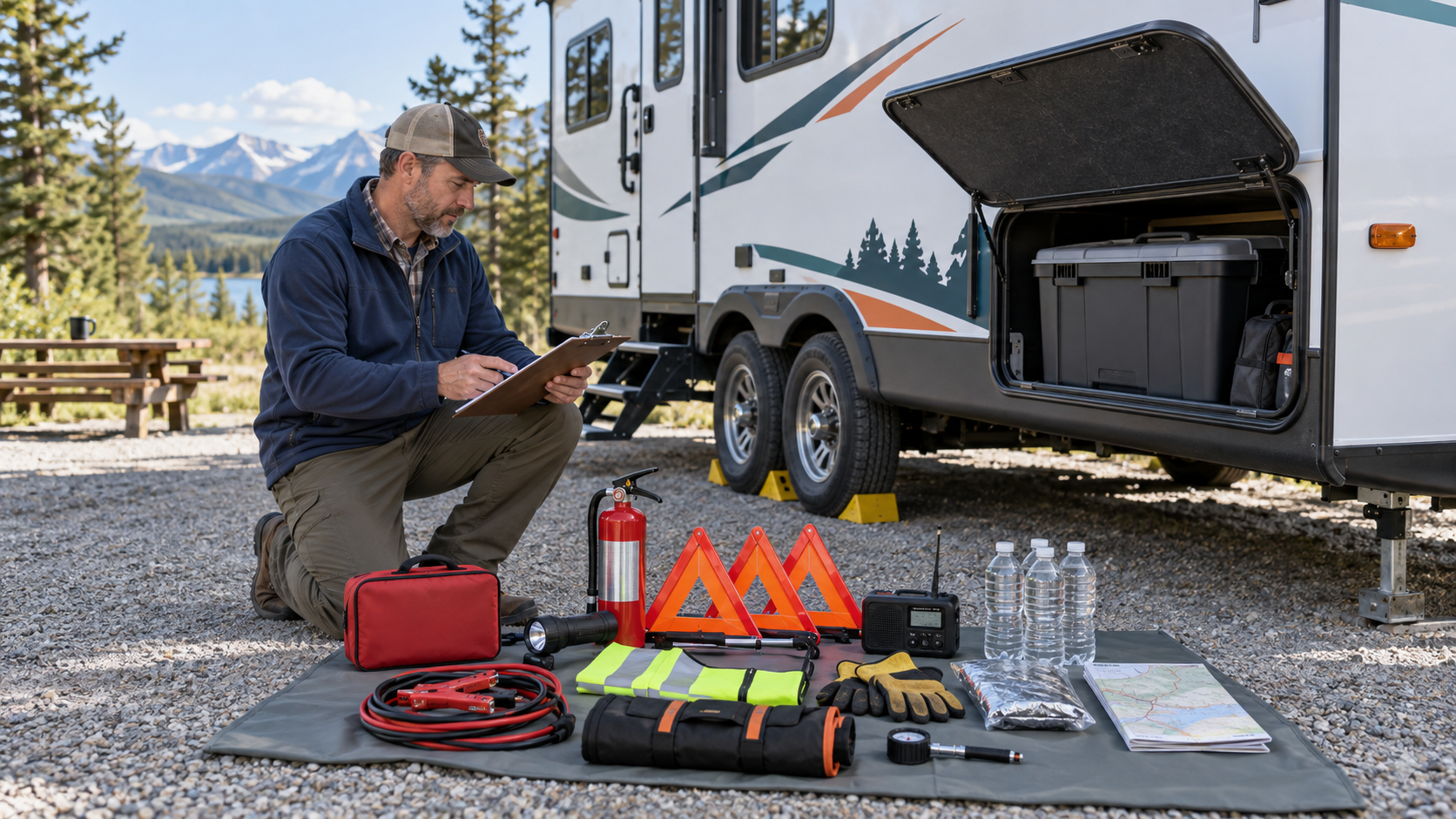
An RV provides shelter, transportation, food storage, water, and electrical power, but it does not eliminate the risks associated with travel. Severe weather, wildfire, mechanical failure, illness, fire, carbon monoxide, road closures, and unexpected evacuations can occur far from familiar services. RV emergency preparedness is about anticipating those risks and having the supplies, information, and plans to respond safely.
Emergency preparation is not about expecting every trip to go wrong. It is about making sure a manageable problem does not become dangerous because essential supplies, information, or plans are missing.
A useful emergency plan should reflect the number of people travelling, their medical needs, any pets, the destination, expected weather, road conditions, available services, and the capabilities of the RV.
Research the Route and Destination
Planning begins before departure. Review the route and identify fuel stops, rest areas, campgrounds, hospitals, repair facilities, steep grades, low clearances, ferry restrictions, and areas where cellular service may be limited.
Check:
- Weather forecasts and warnings
- Wildfire conditions
- Fire bans and restrictions
- Flooding or washout reports
- Highway closures
- Construction zones
- Campground alerts
- Fuel availability
- Emergency-service locations
- Cellular coverage limitations
- Seasonal road conditions
Conditions can change quickly. Check again before departure and while travelling when it is safe to do so.
Do not rely on one navigation application. Some routes suggested for passenger vehicles may be unsuitable for a large motorhome or trailer. Confirm height, length, weight, propane, and seasonal restrictions independently. Because conditions change quickly, check alerts again before departure and during fuel stops.
Share Your Travel Plan
Tell a trusted person where you are going, which route you expect to take, where you plan to stay, and when you expect to return.
Include:
- Names of everyone travelling
- Vehicle and RV descriptions
- Licence-plate information
- Planned route
- Campground or destination
- Expected arrival and return times
- Contact numbers
- Medical or mobility concerns when appropriate
- Instructions for what to do if you fail to check in
Update that person if the route or schedule changes substantially.
A shared plan is especially important when travelling into remote areas where cellular service, fuel, towing assistance, or emergency response may be limited. Because plans change, update your contact person if the route or schedule shifts substantially. If you are travelling into remote areas, share the plan with at least two trusted contacts.
Build an RV Emergency Kit
Your RV should carry enough essential supplies to support everyone for at least several days if services are interrupted. Adjust the kit for the destination, season, trip length, and needs of the travellers.
A basic emergency kit may include:
- Drinking water
- Nonperishable food
- Manual can opener
- First-aid kit
- Required medications
- Flashlights or headlamps
- Spare batteries
- Battery-powered or hand-crank radio
- Portable phone chargers
- Emergency blankets
- Warm clothing
- Rain gear
- Work gloves
- Basic tools
- Reflective warning devices
- Whistle
- Paper maps
- Copies of important documents
- Emergency contact list
- Cash in small denominations
- Personal-hygiene supplies
- Garbage bags
- Pet food and supplies
- Infant or mobility supplies when required
Inspect the kit at the beginning of each season. Replace expired food, medications, batteries, and damaged equipment. For a printable version of the emergency kit list, see our RV Checklists page.
Store emergency supplies where they can be reached quickly. Equipment buried beneath cargo or locked in an inaccessible exterior compartment may not be useful during an evacuation. If you travel with pets, pack their food, water, and medications along with your own supplies.
Carry Water Carefully
Water is essential, but it is also heavy. Carry an amount appropriate for the trip without exceeding the RV’s cargo, axle, tire, or towing limits.
Keep emergency drinking water in food-safe containers. Rotate it according to the container or water-supplier recommendations.
Do not assume that every campground, roadside stop, lake, stream, or private well provides safe drinking water. A basic taste or sediment filter does not necessarily remove harmful microorganisms or chemical contamination.
If local authorities issue a drinking-water advisory, follow their instructions. Use commercially bottled water or water treated by an approved method when necessary. Although water is heavy, carrying enough for several days is essential.
First Aid and Medical Planning
Carry a first-aid kit suited to the number of travellers and the activities planned. Everyone should know where it is stored.
Useful contents may include:
- Adhesive bandages
- Sterile dressings
- Medical tape
- Antiseptic
- Disposable gloves
- Scissors
- Tweezers
- Elastic bandages
- Instant cold packs
- Emergency blanket
- First-aid instructions
- Personal medications
Consider taking recognized first-aid and CPR training. Equipment is most useful when someone understands how to use it.
Carry enough prescription medication for the trip plus a reasonable delay, when possible. Keep medications in labelled containers and store them according to temperature requirements.
Write down:
- Medical conditions
- Allergies
- Medications
- Emergency contacts
- Health-card or insurance information
- Physician and pharmacy contact details
Do not leave temperature-sensitive medications in an RV that may become dangerously hot or cold. If anyone takes prescription medication, carry extra and keep it in labelled containers.
Emergency Communication
A mobile phone is useful but should not be the only communication plan. Batteries fail, networks become overloaded, and remote areas may have no service.
Consider carrying:
- Charging cables
- A 12-volt charger
- A portable power bank
- A battery-powered radio
- A satellite communication device for remote travel
- A whistle
- Paper contact information
Download maps and emergency information before entering areas with limited service. Learn how to obtain local emergency alerts at the destination.
Know the appropriate emergency number for every region through which you travel. In Canada and the United States, 911 is widely used, but service availability and response times vary.
When requesting help, be prepared to provide:
- Your location
- Direction of travel
- Road or highway number
- Nearest intersection or kilometre marker
- Campground and site number
- Vehicle and RV description
- Nature of the emergency
- Number and condition of people involved
- Hazards such as fire, propane, fuel, or traffic
For more on emergency preparedness in Canada, see Public Safety Canada’s emergency preparedness resources. Even if cell service is available, a satellite device or radio provides a backup.
Monitor Weather and Emergency Alerts
Check official weather forecasts and alerts before and during the trip. Pay attention to warnings for:
- Severe thunderstorms
- Tornadoes
- High winds
- Hail
- Heavy rain
- Flash flooding
- Extreme heat
- Wildfire smoke
- Snow or freezing rain
- Extreme cold
An RV is not a safe shelter during every type of severe weather. Lightweight construction, large exterior surfaces, windows, and a high centre of gravity can make it vulnerable to wind, hail, falling trees, and flying debris.
Ask campground staff where the nearest designated storm shelter is located. If none exists, identify a substantial building or safer location before severe weather arrives.
Do not wait until a warning is issued to determine where to go.
Severe Thunderstorms and Tornadoes
If severe weather threatens, secure awnings, outdoor furniture, bicycles, cooking equipment, and other loose objects before conditions become dangerous.
Retract slide-outs if the RV manufacturer recommends doing so and there is enough time to complete the process safely.
During a tornado warning, leave the RV and move to a designated shelter or sturdy permanent building when directed. Avoid windows and follow instructions from local authorities.
Do not shelter beneath the RV or remain outside attempting to protect equipment. Personal safety takes priority over preventing property damage. If a tornado warning is issued, leave the RV and move to a designated shelter immediately.
Wildfire Preparedness
Wildfire conditions can change rapidly, particularly during hot, dry, or windy weather. Check official fire restrictions and wildfire information before travelling into an affected region.
Keep the tow vehicle or motorhome fuelled and ready to leave. Do not allow the campsite to become so complicated that departure would require a lengthy packing process.
Maintain:
- A clear route to the campground exit
- Keys in a known location
- Essential medications together
- Emergency supplies ready to load
- Pets under control
- Phones and communication devices charged
- A map showing more than one evacuation route
An evacuation alert means you should be ready to leave on short notice. An evacuation order means you must leave as directed. Follow official instructions and do not delay to collect nonessential property.
Smoke, falling ash, road congestion, and closed routes can make evacuation difficult. Leave early when authorities advise it or when immediate danger is evident.
Never fly a drone near a wildfire. It can interfere with firefighting aircraft and force aerial operations to stop. Because conditions change quickly, keep the RV fuelled and ready to leave on short notice.
Flooding and Heavy Rain
Avoid campsites in dry creek beds, low areas, flood plains, or locations where the only exit crosses a waterway.
Heavy rain may cause water to rise far from where the rain is falling. Monitor conditions upstream and follow campground warnings.
Never drive or tow through floodwater when its depth, current, or road condition is uncertain. Water can conceal washed-out pavement, debris, and unstable ground.
If water begins rising around the campsite, evacuate immediately when directed. Do not remain to retract equipment or save belongings if doing so delays a safe departure.
After flooding, do not reconnect electrical equipment or use propane appliances that have been submerged until they have been professionally inspected. If water begins rising, evacuate immediately rather than trying to save belongings.
Extreme Heat
An RV can become dangerously hot when air conditioning fails or electrical power is interrupted.
During hot weather:
- Monitor indoor temperature
- Drink water regularly
- Use shade when safe
- Limit strenuous activity
- Check children, older adults, and vulnerable travellers frequently
- Protect pets
- Know where cooling centres or public buildings are located
- Have a plan for loss of shore power
Never leave a person or animal inside an overheated RV. Vent fans and open windows may not provide enough cooling during extreme conditions.
Air conditioners place a heavy demand on electrical systems. Do not improvise electrical connections or overload a household circuit in an attempt to keep them running. If air conditioning fails, move to a cooler location rather than risk heat exhaustion.
Extreme Cold and Winter Travel
Cold weather can freeze plumbing, drain batteries, gel or thicken some fluids, reduce tire pressure, and make roads dangerous.
Carry:
- Warm clothing
- Insulated footwear
- Gloves and hats
- Extra blankets
- Food and water
- A snow brush and scraper
- Traction aids appropriate for the vehicle
- A shovel
- Emergency lighting
- Charging equipment
Never use an outdoor barbecue, camp stove, fuel-burning heater, or generator inside the RV for emergency heat. These devices can cause fire, oxygen depletion, and fatal carbon-monoxide exposure.
If the RV’s heating system fails, move to a safe heated location before conditions become dangerous. If the RV’s heating system fails, relocate to a heated building before conditions become dangerous.
Fire Safety
Every traveller should know the locations of the fire extinguisher, emergency exits, propane shutoff, electrical disconnects, and main exit door.
Before each trip:
- Inspect the fire extinguisher
- Test smoke alarms
- Test propane alarms
- Test carbon-monoxide alarms
- Keep exits unobstructed
- Review escape routes
- Confirm emergency windows open
- Store flammable products safely
If a fire begins, evacuate immediately and call emergency services. RV fires can spread extremely quickly.
Use a fire extinguisher only when the fire is small, an escape route remains open, and you understand how to use the extinguisher. Property can be replaced; people cannot.
Never return to a burning RV to retrieve belongings. Because RV fires spread quickly, evacuate first and call emergency services from a safe location. For more on electrical and system safety, see our RV Maintenance guides.
Propane Emergencies
Propane has an added odour intended to help people detect a leak.
If you smell propane or a propane alarm activates:
- Do not operate electrical switches.
- Do not light flames or smoke.
- Extinguish ignition sources if this can be done safely.
- Evacuate everyone from the RV.
- Close the propane supply only if it is safe to do so.
- Move away from the RV.
- Contact emergency services or a qualified propane technician.
Do not re-enter or use the propane system until the cause has been identified and corrected.
Never use a flame to search for a propane leak, and never bypass a propane detector. If you smell propane, leave the RV and do not re-enter until a professional has confirmed it is safe.
Carbon-Monoxide Safety
Carbon monoxide is a colourless, odourless gas produced by incomplete combustion. Sources around an RV can include generators, engines, furnaces, water heaters, ranges, and nearby equipment.
Symptoms may include:
- Headache
- Dizziness
- Weakness
- Nausea
- Confusion
- Chest discomfort
- Loss of consciousness
If a carbon-monoxide alarm sounds or exposure is suspected, move everyone into fresh air immediately and contact emergency services. Do not remain inside while trying to locate the source.
Test the detector according to its instructions and replace it at the end of its rated service life.
Never operate a generator in an RV, garage, enclosed area, or location where exhaust can enter doors, windows, vents, or neighbouring campsites. Changing wind can redirect exhaust unexpectedly. If an alarm sounds, move everyone outside and do not re-enter until it is safe.
Electrical Emergencies
Disconnect from shore power if it is safe to do so when you notice:
- Smoke
- Sparks
- A burning smell
- Melted wiring
- Scorched plugs
- Dangerous heat
- Water inside electrical equipment
- Repeated breaker or fuse failures
Do not touch the RV if you feel a shock or tingling sensation when contacting its exterior. Keep other people and animals away and obtain qualified assistance.
Never bypass fuses, circuit breakers, ground-fault protection, electrical-management systems, or other safety equipment.
Roadside Breakdowns
If the tow vehicle, motorhome, or trailer develops a problem, move as far from traffic as safely possible. Activate hazard lights and use reflective warning devices according to local requirements.
Remain aware of passing traffic. Standing beside a disabled vehicle on a highway can be more dangerous than the original mechanical problem.
Before leaving the vehicle, consider:
- Traffic speed
- Shoulder width
- Visibility
- Weather
- Road surface
- Nearby barriers
- Fire or fuel hazards
Call roadside assistance or emergency services when necessary. Do not attempt a tire change or repair when the location makes the work unsafe.
Provide the service operator with the RV’s length, height, weight, type, and drivetrain so appropriate towing equipment can be sent. For help identifying mechanical problems, see our RV Troubleshooting guides. Although a repair may seem simple, call for help if traffic or weather makes the work unsafe.
Tire Failure
A tire failure may damage wiring, plumbing, propane lines, flooring, wheel wells, or body panels.
If a tire fails:
- Maintain a firm grip on the steering wheel
- Avoid sudden steering
- Reduce speed gradually
- Move to a safe location
- Activate hazard lights
- Inspect for additional damage only when safe
Do not assume that installing the spare makes the RV safe to continue. Hidden damage may affect brakes, wiring, suspension, or other tires.
Make sure the spare tire has the correct capacity and pressure before each trip. If a tire fails, maintain control and move to a safe location before inspecting the damage.
Mechanical and Brake Problems
Stop safely if you notice:
- Loss of braking
- Brake-controller warnings
- Smoke near a wheel
- Excessive hub heat
- Grinding or scraping
- Severe vibration
- Steering changes
- Trailer sway
- Fluid leaks
- Warning lights
- Loss of engine power
Do not continue driving simply to reach the next town if doing so could worsen the problem or endanger others.
A roadside inspection cannot always reveal internal bearing, brake, tire, or suspension damage. Seek qualified assistance when the cause is uncertain.
Becoming Stranded
If stranded, stay with the vehicle when it is safe because an RV is easier for rescuers to locate than a person travelling on foot.
Conserve battery power, fuel, food, and water. Use emergency lighting and reflective devices to remain visible.
If you must leave because of fire, flooding, traffic, or another immediate hazard, take essential supplies and tell emergency services where you are going.
In cold conditions, keep the exhaust system clear before operating an engine or generator. Snow or debris blocking an exhaust outlet can allow carbon monoxide to accumulate. If you must leave the RV, take essential supplies and tell emergency services where you are going.
Evacuating a Campsite
Keep the RV ready enough to leave if conditions deteriorate.
During an evacuation:
- Follow official routes
- Leave when directed
- Take medications and emergency supplies
- Secure children and pets
- Do not block access roads
- Avoid stopping to photograph the emergency
- Do not take shortcuts onto closed roads
- Inform your emergency contact when safe
- Check in at the designated reception centre when instructed
If there is not enough time to prepare the RV for travel, leave it behind and evacuate in the tow vehicle or as directed by emergency personnel. If there is not enough time to prepare the RV, leave it behind and evacuate as directed.
Emergency Plans for Pets
Include pets in every emergency plan.
Carry:
- Food and water
- Bowls
- Leashes or harnesses
- Carriers
- Waste supplies
- Medications
- Vaccination records
- Identification
- A recent photograph
Keep pets restrained during travel and under control at the campsite. Frightened animals may hide or run during storms, fires, or evacuations.
Confirm in advance which emergency shelters, hotels, or evacuation centres accept animals.
Important Documents
Keep paper or secure digital copies of:
- Driver’s licences
- Vehicle registrations
- Insurance documents
- Roadside-assistance information
- Health information
- Medication lists
- Emergency contacts
- RV make, model, and identification number
- Appliance model and serial numbers
- Pet records
- Reservation details
Protect paper documents in a waterproof container. Avoid storing the only copy inside the RV. Because paper can be lost or damaged, keep digital copies along with the originals.
Practice the Plan
An emergency plan works best when everyone understands it.
Before travelling, discuss:
- How to exit the RV
- Where to meet after evacuating
- Who is responsible for children or pets
- Who will call emergency services
- Where keys and phones are kept
- Where emergency supplies are stored
- How to shut off propane when safe
- How to disconnect power when safe
Practice opening emergency windows and exits according to their instructions. An exit that has not been opened for years may be difficult to use when urgently needed.
Pre-Trip Emergency Checklist
Before departure:
- Review the route and weather
- Check emergency and wildfire alerts
- Share the travel plan
- Inspect the emergency kit
- Refill medications
- Charge communication devices
- Download offline maps
- Test safety detectors
- Inspect the fire extinguisher
- Confirm emergency exits operate
- Check tires, brakes, and fluids
- Inspect propane and electrical systems
- Verify roadside-assistance coverage
- Pack supplies for people and pets
- Identify alternate routes and shelter locations
Final Thoughts
Emergency preparedness gives travellers more time and better choices when conditions change. A stocked kit, reliable information, working safety equipment, and a clear evacuation plan can prevent confusion when a rapid response is required.
Monitor official alerts, keep essential supplies accessible, and never place property ahead of personal safety. If authorities issue an evacuation order, leave promptly and follow the designated route.
Review the plan before every major trip and update it when travellers, destinations, seasons, or medical needs change. A few hours of preparation can make an enormous difference during an unexpected emergency.