
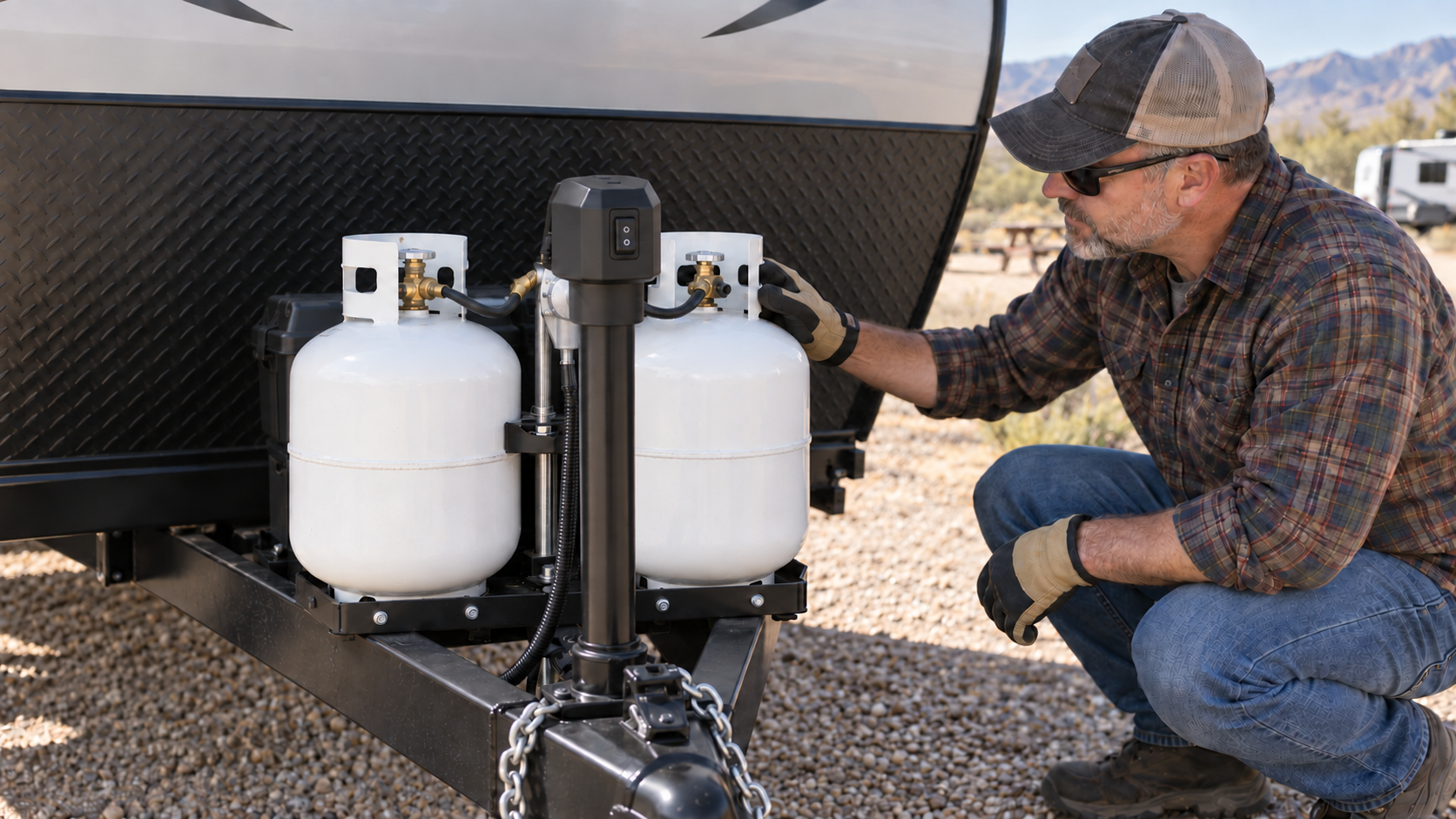
RV propane system safety begins with understanding how the fuel supply works. The propane system supplies fuel to several RV appliances. This guide covers the containers, mounts, valves, hoses, regulator, leak warnings, and maintenance checks that protect that supply. Appliance-specific operating precautions are covered in the companion RV Propane System and Appliance Safety Basics guide.
When properly installed and maintained, an RV propane system is dependable and convenient. However, leaking propane can ignite, and incomplete combustion can produce carbon monoxide. Both hazards require immediate action.
Most RV owners can safely perform visual inspections, keep appliance vents clear and test safety detectors. Repairs involving regulators, gas lines, valves, fittings and appliance combustion systems should be left to a qualified RV or propane technician.
RV Propane System Safety: How It Works
Propane is stored as a liquid under pressure inside a cylinder or permanently mounted tank. As propane leaves the container, it changes into a gas. A regulator reduces its pressure before it travels through the RV’s propane lines to individual appliances.
A typical RV propane system may include:
- One or more removable propane cylinders
- A permanently mounted propane tank
- Cylinder pigtail hoses
- A two-stage pressure regulator
- An automatic changeover regulator
- Metal propane lines
- Flexible appliance connectors
- Individual appliance shutoff valves
- Propane-burning appliances
- A propane-leak detector
- Carbon-monoxide and smoke alarms
The exact arrangement depends on the type and age of the RV. Consult the owner’s manual and appliance documentation before inspecting or operating the system.
Propane Cylinders and Permanently Mounted Tanks
Travel trailers and fifth wheels commonly use removable propane cylinders mounted on the A-frame or in a ventilated compartment. Motorhomes often use a permanently mounted tank secured to the chassis.
These containers are not interchangeable. Removable cylinders are designed to be disconnected for filling or exchange, while permanently mounted tanks normally remain attached to the RV and are filled through an exterior service connection.
Inspect accessible propane containers for:
- Heavy rust or corrosion
- Dents, gouges or bulges
- Fire or heat damage
- A damaged valve
- A missing protective collar
- Loose mounting hardware
- An unreadable certification plate or date marking
- Evidence of leakage
- Damage to the mounting tray or compartment
Do not use a damaged, heavily corroded or expired container. Propane cylinders must be inspected, filled and requalified according to the requirements that apply where they are used.
Never attempt to repair, weld, drill, modify or paint over important markings on a propane container.
Secure Cylinders Correctly
Propane cylinders must remain upright and properly secured in their designated mounting location. The hold-down system should prevent them from shifting, tipping or striking nearby equipment during travel.
Check that:
- The mounting tray is solid
- Hold-down rods and brackets are present
- Fasteners are tight
- Cylinders cannot rotate or tip
- Hoses are not pinched or stretched
- Valves and fittings are protected from impact
- Ventilation openings remain unobstructed
Do not secure cylinders with temporary rope, light-duty straps or improvised hardware. Use the mounting equipment specified for the RV.
A propane compartment must not be used as general storage. Tools and other objects can damage hoses, valves and regulators or block required ventilation.
Understand Automatic Changeover Regulators
Many RVs with two cylinders use an automatic changeover regulator. This allows the system to draw propane from a selected service cylinder. When that cylinder becomes empty, the regulator can begin drawing from the reserve cylinder if both cylinder valves are open.
A selector lever or knob identifies the service cylinder. An indicator commonly changes colour when that cylinder is empty.
The changeover feature can prevent an interruption in appliance operation, but it can also allow both cylinders to become empty without the owner noticing. Check the indicator regularly and refill the empty cylinder promptly.
Before removing a cylinder:
- Turn off propane appliances.
- Close the valve on the cylinder being removed.
- Point the regulator selector toward the cylinder that will remain connected, when required by its instructions.
- Disconnect the empty cylinder according to the manufacturer’s procedure.
- Install its protective cap where applicable.
- Secure the replacement cylinder before reconnecting it.
After reconnection, the system should be checked for leaks using an approved procedure. If you are uncertain how to perform this safely, have a qualified technician reconnect and test the cylinder.
Open Cylinder Valves Slowly
Modern propane cylinders may include excess-flow protection. Opening a cylinder valve too quickly can cause the safety device to restrict propane flow.
When placing a cylinder into service:
- Confirm that all propane appliances are switched off.
- Make sure the connection is secure.
- Open the cylinder valve slowly.
- Allow the system to pressurize.
- Check for leakage using an approved method.
- Operate appliances according to their instructions.
If appliances receive little or no propane after a cylinder change, close the cylinder valve and turn off all appliances. Wait for the system to reset, then reopen the valve slowly.
Repeated low-flow problems, regulator problems or suspected leaks require professional inspection.
Inspect Pigtail Hoses
Pigtail hoses connect removable cylinders to the regulator. They are exposed to movement, sunlight, temperature changes and contamination.
Inspect them for:
- Cracking
- Splitting
- Abrasion
- Stiff or brittle material
- Soft or swollen areas
- Kinks
- Oil contamination
- Corrosion at the fittings
- Damage near crimped ends
- Contact with sharp metal
- Excessive tension
- Evidence of animal damage
A hose can deteriorate internally even when the outside looks acceptable. Replace damaged or questionable hoses with approved components of the correct type and length.
Do not substitute general-purpose air, fuel or hydraulic hose. Propane hoses and fittings must be approved for their intended application.
Inspect the Propane Regulator
The propane regulator reduces container pressure to the lower pressure required by the RV’s appliances. It must be correctly installed, protected and vented.
Inspect the regulator for:
- Corrosion
- Physical damage
- Loose mounting
- Cracked or damaged covers
- Contamination
- Evidence of leakage
- Insect nests
- A blocked vent
- Incorrect vent orientation
The regulator vent must remain unobstructed and normally faces downward or is protected according to the regulator manufacturer’s instructions. Water, dirt and insects can interfere with regulator operation.
Do not insert tools, wire or compressed air into the vent. If the regulator appears damaged, contaminated or incorrectly installed, have it inspected by a qualified technician.
Regulators wear with age. Irregular appliance flames, inconsistent pressure, unexplained appliance shutdowns or unusual regulator noise may indicate a problem, but proper diagnosis requires pressure-testing equipment.
Never Search for a Leak With a Flame
A flame must never be used to locate a propane leak.
Approved leak-detection solution may reveal leakage by forming bubbles at an accessible connection. However, not every connection should be disturbed or tested by an untrained owner.
Do not use household products containing ammonia or other chemicals that may damage brass fittings. Use a leak-detection product approved for propane systems and follow its instructions.
A bubble test does not replace a complete propane-system pressure test. RV propane systems should be professionally tested at the intervals recommended by the RV manufacturer and whenever:
- A gas component has been replaced
- A line or fitting has been disturbed
- The RV has been involved in a collision
- A cylinder mount has been damaged
- A leak is suspected
- An appliance is operating abnormally
- The RV has been stored for an extended period
- The manufacturer requires a scheduled inspection
What to Do If You Smell Propane
Propane is given a distinctive odour commonly compared to rotten eggs or a skunk. If you smell propane inside or around the RV, treat it as a potential leak.
Immediately:
- Do not light a flame.
- Do not smoke.
- Do not operate electrical switches or appliances.
- Do not unplug electrical equipment.
- Do not start a vehicle or generator near the suspected leak.
- Evacuate everyone from the RV and surrounding area.
- Close the propane supply valve only if it can be reached safely from outside.
- Move to a safe location.
- Contact emergency services, the propane supplier or a qualified technician.
- Do not re-enter or use the propane system until it has been inspected and declared safe.
Do not use a phone inside the RV when propane may be present. Even a small spark can ignite accumulated gas.
Propane is heavier than air and may collect in low areas. Keep ignition sources away from the RV, cylinder compartment and surrounding ground.
Understand Carbon Monoxide
Carbon monoxide is a colourless, odourless and poisonous gas produced when fuel does not burn completely. Propane appliances, generators, engines, charcoal grills and campfires can all produce carbon monoxide.
Possible symptoms of carbon-monoxide exposure include:
- Headache
- Dizziness
- Weakness
- Nausea
- Confusion
- Chest discomfort
- Unusual fatigue
- Loss of coordination
- Loss of consciousness
Symptoms may resemble illness, dehydration or fatigue. Several people experiencing similar symptoms at the same time is a serious warning sign.
If a carbon-monoxide alarm sounds or exposure is suspected:
- Move everyone into fresh air immediately.
- Contact emergency services.
- Seek medical attention as directed.
- Turn off fuel-burning equipment only if it can be done safely.
- Do not re-enter the RV until the source has been identified and corrected.
Never ignore or disable a carbon-monoxide alarm because you suspect a false alarm. For more industry safety guidance, see the RV Safety & Education Foundation.
Test Propane and Carbon-Monoxide Detectors
RV propane detectors are generally mounted low because propane can collect near the floor. Carbon-monoxide detectors are installed according to their manufacturer’s requirements. Some RVs use a combination detector.
Test every detector using its test button at the interval specified by its manufacturer. Confirm that:
- The alarm sounds clearly
- Indicator lights operate normally
- Vent openings are clean
- The detector is firmly mounted
- The manufacturing or replacement date is readable
- The unit has not reached the end of its service life
- Battery-powered detectors have fresh batteries
- Hardwired detectors are receiving 12-volt power
The test button checks the detector’s electronics and alarm circuit. Do not test a propane detector by releasing propane near it.
Many RV propane detectors operate directly from the house battery. Disconnecting the battery or switching off the battery disconnect may disable the detector. Understand how your detectors receive power before storing or occupying the RV.
Detectors have a limited service life. Replace them according to the manufacturer’s expiration date or replacement instructions, even if they still respond to the test button.
Keep Appliance Vents Clear
Propane appliances require adequate combustion air and a clear path for exhaust gases. Exterior vents may serve the furnace, water heater or refrigerator.
Inspect accessible vents for:
- Mud-dauber or wasp nests
- Spider webs
- Leaves
- Rodent nesting
- Dust and debris
- Snow or ice
- Bent louvers
- Soot
- Heat damage
- Items stored against the vent
- Aftermarket covers that restrict airflow
Turn off the appliance and allow it to cool before cleaning around its vent. Use only methods permitted by the appliance manufacturer.
Do not insert brushes, wire or compressed air deeply into burners, flues or combustion assemblies unless the manufacturer specifically identifies it as owner maintenance. Improper cleaning can damage components or disturb the burner adjustment.
Recognize Abnormal Combustion
A properly operating propane appliance should burn cleanly and exhaust safely. Warning signs of a combustion problem include:
- Black soot near an exterior vent
- A strong exhaust smell
- Yellow, unstable or unusually large flames
- Repeated ignition failures
- Delayed ignition or a small explosion when lighting
- Rumbling, popping or roaring
- Flame lifting away from the burner
- Heat damage around the appliance
- A carbon-monoxide alarm
- An appliance repeatedly shutting down
- Eye irritation, headaches or nausea while the appliance operates
Turn off the appliance and propane supply if any of these conditions occur. Do not continue restarting it or adjust its burner, regulator or gas valve yourself.
Soot is not normal. It indicates incomplete combustion or another serious operating problem that requires professional service.
Using Propane Appliances Safely
This guide concentrates on propane containers, mounting, valves, pigtail hoses, regulators, leak checks, and professional system inspections. For cooktop, furnace, water-heater, and refrigerator warning signs and owner-level operating precautions, see RV Propane System and Appliance Safety Basics.
Never use the cooktop or oven for space heating. Turn off an appliance that develops soot, delayed ignition, an abnormal flame, or a propane smell, and have its combustion system inspected by a qualified technician.
Travelling With Propane
Rules governing propane during travel vary by location, transportation method and facility. Some tunnels, ferries, bridges, fuel stations and enclosed structures restrict propane use or require cylinder valves to be closed.
Before travelling:
- Learn the rules along the route
- Follow the RV and appliance manufacturers’ instructions
- Secure all cylinders
- Inspect the mounting system
- Close valves where required
- Turn off appliances where required
- Confirm that pilot flames are extinguished before refuelling
- Never operate a propane appliance where open flames are prohibited
Propane appliances should be shut off before entering a fuel station. Open flames and ignition sources must not be present during refuelling.
Do not assume that a refrigerator must remain on propane while travelling. Food can often remain cold for several hours when the refrigerator is already chilled and its doors remain closed.
Transporting Removable Cylinders
When transporting a removable propane cylinder separately from the RV:
- Keep it upright
- Secure it against movement
- Protect its valve
- Provide ventilation
- Keep it away from excessive heat
- Do not leave it in a closed vehicle
- Follow applicable transportation limits and regulations
- Take it directly to its destination
Never transport a cylinder in the passenger compartment when another safe, legal option is available. Do not carry a cylinder that is leaking, damaged or overdue for required requalification.
Propane Storage Safety
When the RV is stored, follow its manufacturer’s instructions for the propane system.
Depending on the storage arrangement, preparation may include:
- Turning off all propane appliances
- Closing cylinder or tank valves
- Inspecting containers and mounts
- Protecting fittings from contamination
- Keeping required ventilation open
- Removing cylinders only when permitted and appropriate
- Storing removable cylinders upright in an approved outdoor location
- Keeping propane away from ignition sources
- Testing the system before returning it to service
Never store propane cylinders inside the RV, a dwelling, basement or another unventilated enclosed space.
Do not cover regulator vents or propane-compartment openings while winterizing or protecting the RV from pests.
When to Contact a Qualified Technician
Contact a qualified RV or propane technician for:
- Any suspected propane leak
- A failed propane-system pressure test
- Regulator replacement or adjustment
- Damaged propane piping
- Hose or fitting replacement when proper testing cannot be performed
- Gas-valve problems
- Burner adjustment
- Appliance combustion problems
- Soot around an appliance vent
- Repeated ignition failure
- Delayed ignition
- A damaged cylinder mount
- Collision damage near propane equipment
- A persistent propane-detector alarm
- A carbon-monoxide incident
- Any modification to the propane system
Propane systems require specialized pressure-testing equipment and knowledge. A connection that appears tight can still leak, and an appliance that ignites can still produce unsafe combustion. For help identifying specific problems, see our RV Troubleshooting guides.
RV Propane Safety Checklist
Before each trip:
- Inspect propane cylinders or the mounted tank
- Confirm that cylinders are upright and secure
- Inspect accessible hoses
- Check the regulator and vent
- Make sure appliance vents are clear
- Test propane and carbon-monoxide detectors
- Confirm that detectors have not expired
- Check applicable travel restrictions
At the campsite:
- Inspect the propane area before opening a valve
- Open cylinder valves slowly
- Watch for unusual appliance operation
- Keep exterior vents unobstructed
- Keep ignition sources away from propane equipment
- Never use the cooktop or oven for space heating
- Respond immediately to any alarm or propane odour
During storage:
- Turn off appliances
- Close propane valves as directed
- Keep cylinders secured or store them appropriately
- Maintain required ventilation
- Protect hoses and fittings from damage
- Keep regulator vents open
- Arrange professional testing if a leak or operating problem is suspected
For a printable version of the maintenance schedule, see our RV Checklists page.
RV Propane System Safety: Key Takeaways
Safe propane use begins with observation. Inspect containers, mounts, hoses, regulators and appliance vents regularly. Test the safety detectors, learn how the system normally operates and investigate any change in smell, sound, flame or performance.
Never search for a leak with a flame, bypass an alarm or continue operating an appliance that produces soot. When a concern involves pressure, piping, regulators or combustion, stop using the system and contact a qualified professional.
Propane makes an RV comfortable and self-sufficient, but it deserves respect. A few careful checks and a prompt response to warning signs can prevent a minor problem from becoming an emergency.