
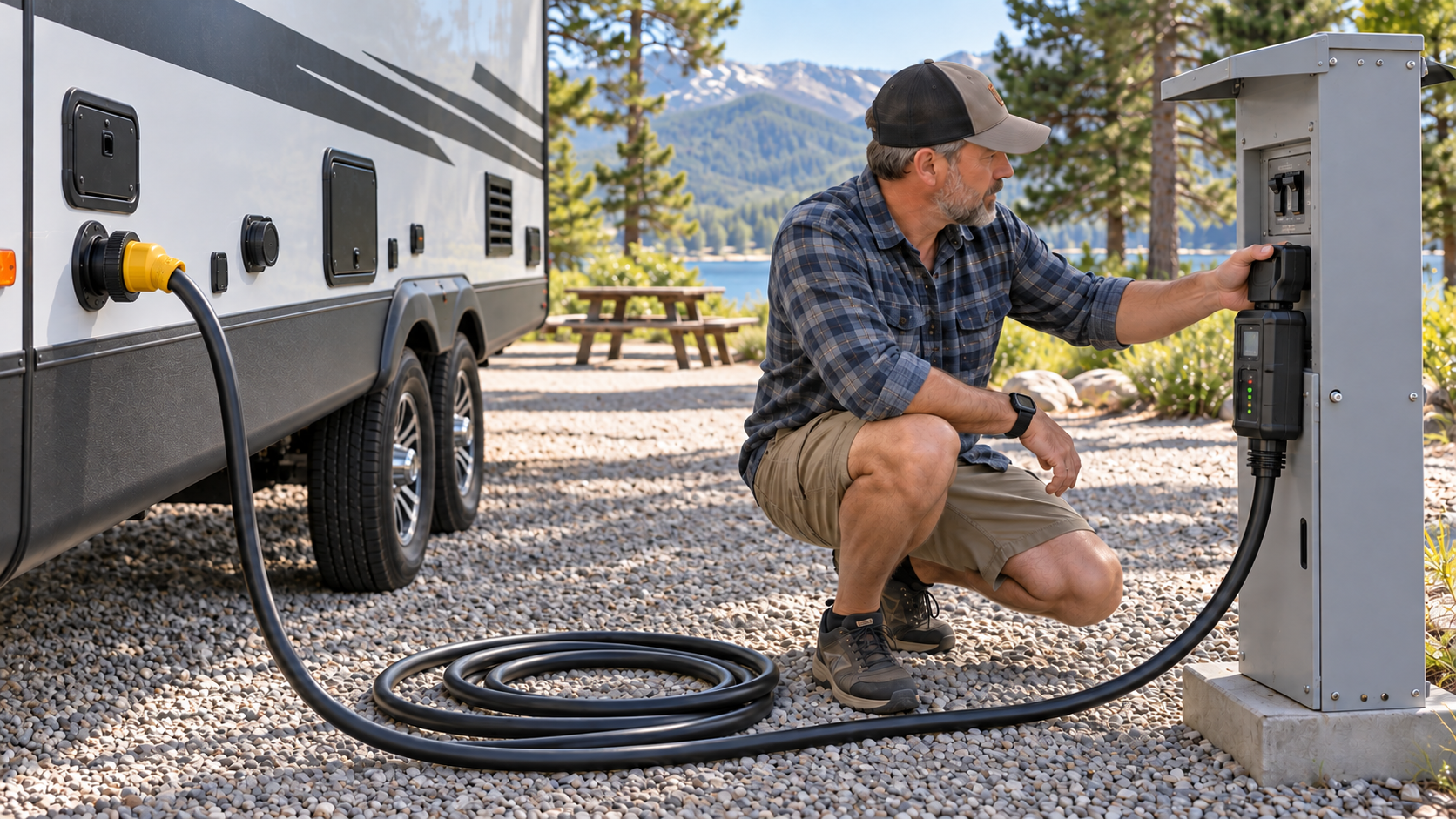
RV shore power safety starts with a few simple checks. Plugging in seems easy: connect the cord, switch on the pedestal breaker, and enjoy the campsite. But a worn receptacle, damaged plug, incorrect adapter, or electrical fault can interrupt a trip or create a fire or shock hazard. A few checks before and after connecting can help you recognize trouble before it damages the RV.
This guide covers ordinary owner-level inspections and safe connection habits at a campsite. For an explanation of the RV’s breakers, converter, GFCI protection, and other electrical components, see Understanding Your RV Shore-Power System. Follow the instructions for your RV, cord, electrical management device, and campsite pedestal. Leave pedestal repairs and internal RV wiring to qualified professionals.
Confirm the Service and Equipment You Need
Check the RV’s electrical label and its original shore-power cord before choosing a pedestal receptacle. Most RVs are equipped for 30-amp or 50-amp service. A household outlet can provide limited power to some RVs when the RV and connecting equipment permit it, but it is not equivalent to full campsite service.
Use only a properly rated cord and an adapter approved for the specific RV-to-receptacle connection. An adapter changes the connector arrangement; it does not increase the power available from the pedestal. A 50-amp RV connected to a 30-amp receptacle is limited by that 30-amp supply. Never alter a plug or defeat its grounding connection to make it fit. For more on how your RV’s electrical system works, see our Understanding RV Electrical Systems guide.
Inspect the Cord, Plug, and RV Inlet
With the cord disconnected, examine its accessible length for cuts, crushed areas, damaged insulation, exposed conductors, or previous repairs. Check both plug ends for loose or bent contacts, corrosion, discolouration, melting, scorch marks, or a burnt smell.
Inspect the RV inlet as well. The connector must fit and lock or secure as its manufacturer directs. Do not force a mismatched connector. A loose inlet, damaged contact, or water intrusion needs attention before use.
If the cord winds onto a reel, follow the reel manufacturer’s instructions for operating it under load. Route the cord away from standing water, vehicle traffic, sharp edges, doors, and steps. Keep portable connections protected as their manufacturers direct.
Check the Campsite Pedestal
Inspect the pedestal from the outside before plugging in. Confirm that it has the appropriate receptacle and that its cover, outlet, and breaker appear intact. Do not use an outlet that looks loose, broken, scorched, heavily corroded, or wet inside.
Do not remove the pedestal cover or reach into its enclosure. Ask campground staff for another site or have the pedestal checked by a qualified person if it looks unsafe.
An electrical management system or suitable tester may detect wiring faults or unsafe voltage before power reaches the RV. Use it according to its instructions. A basic surge protector and a full electrical management system may offer different functions; check your device’s specifications rather than assuming they are equivalent.
Connect in the Correct Order
Follow the procedure specified for your equipment. A common routine is:
- Turn off major electrical loads inside the RV, such as air conditioners and electric water-heating elements.
- Confirm that the pedestal breaker for the receptacle you intend to use is off.
- Connect an approved surge protector or electrical management device, if equipped, as its manufacturer directs.
- Seat and secure the shore-power cord at the RV inlet and pedestal. Tighten any locking ring as instructed; do not leave a connector partially inserted.
- Check that the cable has enough slack and cannot drag, be crushed, or lie in standing water.
- Turn on the pedestal breaker.
- Let any electrical management device complete its checks and connection delay.
- Bring major RV loads back on one at a time.
To disconnect, turn off major RV loads, switch off the pedestal breaker, then remove the connectors by gripping their bodies rather than pulling on the cable. Store the cord according to its manufacturer’s instructions.
If the pedestal breaker immediately trips or will not stay on, do not keep resetting it. Turn off the loads and find the cause with appropriate professional help.
Use Adapters Within the Supply’s Limits
A correctly rated 30-to-50-amp RV adapter may allow a 50-amp RV to connect to a 30-amp campsite. It does not make that pedestal a 50-amp service. Several air conditioners, a microwave, an electric water heater, and other large loads running together can overload the available supply.
Similarly, use only an adapter specifically intended for a 30-amp RV connected to a 50-amp RV pedestal. Do not use improvised wiring, altered plugs, or an adapter made for a different type of receptacle. Avoid unnecessary chains of adapters, which add connections that can loosen, get wet, or overheat.
If using a suitable household 15- or 20-amp circuit, limit RV loads to what the circuit and your connecting equipment can safely supply. It is not a substitute for operating the RV as though it had full 30- or 50-amp campsite service.
Treat Extension Cords as a Last Resort
Use the RV’s original shore-power cord when it can reach a suitable receptacle. If an extension is necessary, it must be intended and rated for the service, current, length, and outdoor conditions. Follow both the RV and cord manufacturers’ instructions.
A long or undersized extension can contribute to voltage drop and overheated connections. Do not join several light-duty household cords, put connections in puddles, or leave an operating cord tightly coiled unless its manufacturer permits that use. If you cannot reach the pedestal with suitable equipment, request another site rather than improvising a long cable run. For more electrical safety information, see the Electrical Safety Foundation.
Watch the Connection While Power Is in Use
After power has been in use for a while, look and smell around accessible plugs, adapters, and the RV inlet without opening an enclosure. Unusual heat, buzzing, melting, smoke, or a burnt-plastic smell means something is wrong.
Turn off RV loads and the pedestal breaker if it is safe to do so. Disconnect only when safe, report pedestal damage to the campground, and have damaged RV equipment inspected before reconnecting.
An electrical management device may disconnect the RV when it detects unsafe voltage or another fault. Do not repeatedly bypass its protection simply to keep an appliance running. A tripping pedestal GFCI or breaker also needs investigation; moving to an unprotected outlet is not a repair.
For the meaning of voltage warnings, breakers, GFCI trips, and faults within the RV, see Understanding Your RV Shore-Power System.
RV Shore Power Safety: Campsite Checklist
Before and during use, confirm:
- The pedestal provides the correct service or you have an approved adapter for that exact connection.
- The plug, cord, RV inlet, and accessible receptacle show no looseness, corrosion, burning, or physical damage.
- The pedestal breaker is off while making or breaking the connection.
- The cord cannot drag, be crushed, or lie in standing water.
- Any extension is properly rated and permitted for the setup.
- The RV connector is seated and secured as its manufacturer directs.
- Any electrical management device completes its checks normally.
- Large loads are kept within the capacity of the actual supply.
- No connector becomes unusually hot or gives off a burning smell.
Stop using the connection if you find a melted connector, repeated breaker trips, an electrical shock, an unsafe-voltage warning, or evidence of water inside the pedestal or inlet. Campground electrical equipment belongs to the campground and a qualified electrician; damaged RV equipment belongs with a qualified RV technician or electrician familiar with RV systems.
Shore power should not require you to tolerate a hot plug or work around a protective device. Inspect before connecting, respect the supply’s limits, and disconnect when something is wrong.