
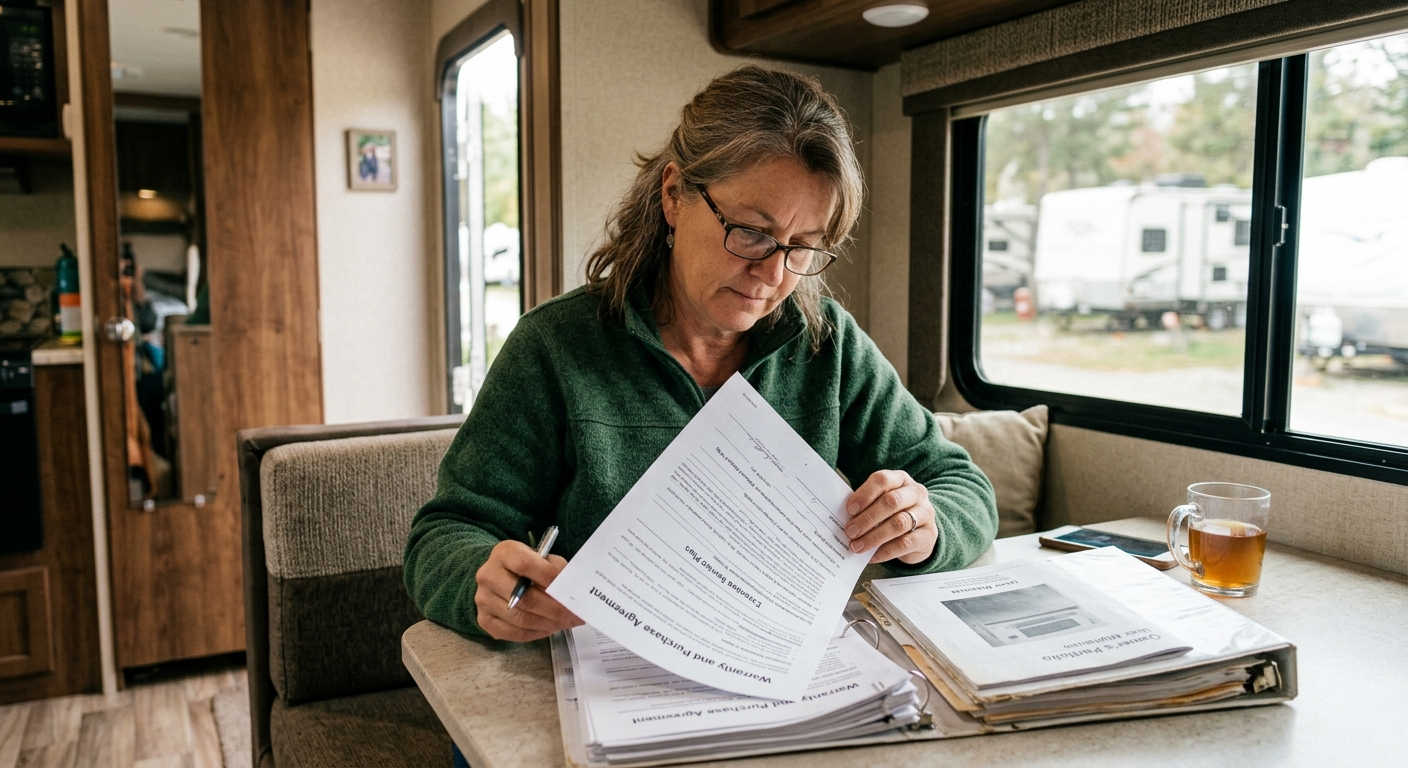
An RV warranty can feel reassuring at the point of sale. But RV warranties differ significantly from automotive warranties, and the coverage is often narrower than new owners expect. Two of the most common misunderstandings involve exterior sealant and adjustments — both of which are typically covered for only a short period, often around 90 days.
Understanding what a warranty covers — and what it does not — helps you plan for maintenance, avoid denied claims, and avoid unpleasant surprises in the first year of ownership.
This guide explains how RV warranties work, what typically is and is not covered, and how to protect your coverage. It is not a substitute for reading the actual warranty documents or speaking with the manufacturer, but it helps you ask the right questions before and after purchase.
Why RV Warranties Are Different
An RV is not a single manufactured product. It is an assembly of components from many suppliers:
- The chassis is built by a chassis manufacturer (Ford, Freightliner, Mercedes-Benz, Ram, etc.)
- The RV body and living area are built by the RV manufacturer
- Appliances are built by third parties (Dometic, Norcold, Suburban, Atwood, etc.)
- Tires, axles, and suspension come from yet other suppliers
- Electronics, solar, and generators come from additional manufacturers
Each of these may have its own separate warranty. Coverage periods, terms, and claim procedures can vary widely.
This is different from a car, where one manufacturer typically covers the whole vehicle. With an RV, you may need to file claims with multiple companies depending on the component. For more industry guidance on RV construction and safety standards, see the RV Industry Association.
The Main Warranty Types
RV Manufacturer Warranty
The RV manufacturer (the company that built the living area and assembled the RV) provides a warranty covering the structure and workmanship of the RV body. This is sometimes called the “coach warranty.”
Typical coverage:
- Structural components
- Roof and sidewall integrity
- Cabinetry and interior finish
- Electrical and plumbing systems installed by the manufacturer
- Slide-out mechanisms
- Windows and doors
Typical duration: 1 to 3 years, sometimes longer for structural components.
Critical exception: Exterior sealant and adjustments are commonly covered for a much shorter period — often only 90 days from the date of first retail purchase. After that window, water intrusion caused by failed sealant is the owner’s responsibility. This is one of the most important warranty terms to understand before you buy.
Chassis Manufacturer Warranty
For motorhomes, the chassis manufacturer provides a separate warranty on the engine, transmission, driveline, brakes, steering, and related components. This often resembles an automotive warranty.
Typical duration: 3 to 5 years or a specified mileage, whichever comes first.
Appliance Warranties
Each appliance has its own warranty from its manufacturer. This includes:
- Refrigerator
- Furnace
- Water heater
- Air conditioner
- Cooktop and oven
- Microwave
- Generator
- Inverter or converter
Typical duration: 1 to 3 years, sometimes longer for specific components.
Tire Warranty
Tires are usually warranted by the tire manufacturer, not the RV manufacturer. Coverage typically addresses defects, not normal wear or damage from road hazards.
Extended Warranties (Service Contracts)
An extended warranty is often not a warranty at all — it is a service contract sold by a third party. Coverage, terms, exclusions, and claim procedures vary widely.
Some extended warranties are useful. Others are expensive and exclude the most common failures. Read the contract carefully before purchasing one.
The 90-Day Sealant Window
This is one of the most consequential warranty terms for RV owners, and it is often not fully explained at the point of sale.
Most RV manufacturers warrant exterior sealant — the caulking around roof seams, windows, doors, vents, and other openings — for a limited period, commonly 90 days. Some manufacturers extend this slightly. A few do not cover it at all.
What this means in practice:
- During the first 90 days, the manufacturer will typically reseal or repair defects in the factory sealant.
- After 90 days, the owner is responsible for inspecting and maintaining all exterior sealant.
- Water intrusion caused by failed sealant after the warranty period is generally not covered — even if the failure causes extensive damage inside the wall or floor.
- Many warranties explicitly exclude water damage caused by failure to maintain seals.
This is why RV manufacturers recommend sealant inspection every 90 days to 6 months — and why documenting that inspection is important if you ever need to file a water-damage claim later.
What to do:
- Inspect the roof and exterior seals immediately after purchase.
- Ask the dealer exactly how long the sealant warranty lasts.
- Document sealant condition with photos and dates.
- Maintain sealant proactively rather than waiting for a leak.
- Keep a record of every inspection and resealing.
The 90-Day Adjustment Window
Adjustments — the process of aligning doors, windows, slide-outs, cabinet latches, and other movable components after the RV has settled and been used — are often covered for a similarly short period, commonly 90 days.
What this typically includes:
- Entry door alignment
- Cabinet and drawer alignment
- Slide-out alignment and adjustment
- Window latch and seal adjustment
- Interior trim alignment
- Awning adjustment
What this typically does not include:
- Adjustments after the 90-day window
- Adjustments caused by damage, misuse, or overloading
- Adjustments related to components outside the manufacturer’s warranty
The first 90 days is when most “settling” adjustments are needed. After that, realignment is generally the owner’s responsibility.
What to do:
- Use the RV during the first 90 days so any needed adjustments appear.
- Request all necessary adjustments from the dealer before the warranty window closes.
- Keep a written list of every adjustment requested and completed.
- Follow up in writing to confirm what was done.
What Is Typically Covered
Most RV warranties cover:
- Manufacturing defects
- Structural failures not caused by misuse
- Workmanship issues from the factory
- Component failures under normal use
- Leaks caused by failed factory sealant (within the 90-day window)
Coverage typically applies only when:
- The RV has been maintained according to the manufacturer’s schedule
- The failure was not caused by neglect, misuse, or accident
- The repair is performed by an authorized service center
- The owner has documented the issue properly
What Is Typically Not Covered
Warranties commonly exclude:
- Exterior sealant maintenance after the initial 90-day period
- Adjustments after the initial 90-day period
- Routine maintenance (oil changes, filter replacements, sealant touch-ups)
- Wear items (tires, brake pads, batteries, belts, hoses)
- Damage from accidents, collisions, or road hazards
- Damage from misuse, overloading, or neglect
- Water damage caused by failure to maintain seals
- Cosmetic issues (minor scratches, fabric wear, discolouration)
- Damage from weather events (hail, falling branches, flooding)
- Damage from unauthorized modifications
- Damage from improper towing or hitching
- Consequential damage (e.g., a failed water heater causing floor damage)
- Problems caused by using incompatible parts or fluids
- Storage-related damage
- Damage from pests or rodents
Some warranties also exclude “full-time living” use, meaning coverage may be void if the RV is used as a primary residence.
The Importance of Documentation
Most warranty claims are denied not because the failure is excluded, but because the owner cannot prove the RV was maintained properly.
To protect your coverage:
- Keep every receipt and invoice
- Record every service performed, with date and mileage or hours
- Maintain a written maintenance log
- Photograph anything unusual before repair work begins
- Photograph sealant condition during regular inspections
- Keep the original manuals and warranty documents
- Note any communication with the manufacturer or dealer
- Follow the manufacturer’s inspection and maintenance schedule exactly
If you are buying used, ask for the maintenance records. A missing history may affect warranty coverage. For more on keeping RV maintenance records, see our RV Maintenance Schedule and Recordkeeping guide.
Understanding Warranty Timing
Warranty coverage usually begins on the date of first retail purchase — not the date of manufacture. An RV that has sat on a dealer lot for a year may still have nearly full warranty coverage when you buy it new.
Coverage periods may vary:
- Some components are covered from the RV purchase date
- Some start from the chassis purchase date
- Some start from the appliance manufacture date
- Sealant and adjustment coverage often begins on the same date but lasts only 90 days
Read each warranty separately. Do not assume every component has the same coverage start date or duration.
What Voids a Warranty
Common actions that can void part or all of a warranty:
- Failing to perform scheduled maintenance
- Failing to inspect and maintain exterior sealant
- Using unapproved parts or fluids
- Modifying the RV beyond manufacturer approval
- Overloading or exceeding weight ratings
- Damage from improper storage
- Unauthorized repairs
- Using the RV in ways the manufacturer did not intend
- Neglecting a problem after discovering it
Some actions void only specific coverage. For example, installing an aftermarket solar system may void the electrical warranty but not the structural warranty. For more on staying within weight limits, see our RV Weight Ratings guide.
What to Do When Something Goes Wrong
If a problem appears while the RV is still under warranty:
- Document the issue. Photograph it, record the date, and note any symptoms.
- Stop using the RV if it is unsafe. Safety comes before warranty procedure.
- Contact the manufacturer or dealer before starting repairs. Some warranties require pre-authorization.
- Do not authorize unauthorized repairs. Using an unauthorized service center can void coverage.
- Keep all documentation. Emails, phone notes, and receipts matter.
- Follow up in writing. A written record is stronger than a phone conversation.
When a warranty claim is denied, ask for the denial in writing, including the specific reason and the warranty clause being cited. Should the denial seem incorrect, you can escalate to the manufacturer, a consumer protection agency, or, in some cases, a legal professional.
Warranty vs. Insurance
Warranties and insurance are different things.
A warranty covers manufacturing defects for a limited period.
Insurance covers damage from accidents, theft, weather, and liability. It applies regardless of whether the RV is under warranty.
You need both. A warranty does not cover a collision, and insurance does not cover a defective water pump.
Should You Buy an Extended Warranty?
Consider an extended warranty (service contract) if:
- The RV is older or has higher mileage or hours
- You want predictable costs for major repairs
- The contract covers systems you cannot afford to replace
- The provider has a solid reputation and clear claim procedures
Avoid extended warranties that:
- Have vague exclusions
- Require repairs at inconvenient locations
- Exclude the most common failure types
- Have a poor reputation for paying claims
- Cost more than the likely repairs over the coverage period
- Push you toward a specific dealer
Read the contract carefully. Ask what is excluded, what the claim process is, and how long the coverage lasts.
RV Warranty Coverage: Checklist
Before purchase:
- Read the RV manufacturer warranty in full.
- Confirm the exact sealant warranty period.
- Confirm the exact adjustment warranty period.
- Review each appliance warranty.
- Confirm the chassis warranty for motorhomes.
- Check the tire warranty.
- Understand the coverage start dates.
- Note the maintenance requirements.
- Ask what voids coverage.
After purchase:
- Inspect exterior sealant within the first month.
- Schedule any needed adjustments before 90 days.
- Keep every maintenance and inspection record.
- Follow the maintenance schedule exactly.
- Document any issue promptly.
- Contact the manufacturer or dealer before repairs.
- Read every service contract before signing.
- Keep the original documents together in one place.
When to Get Help
Professional advice may be useful when:
- A warranty claim is denied and you believe it was valid
- The coverage terms are unclear
- You are considering an extended warranty
- The RV has significant repair needs
- The dealer or manufacturer is unresponsive
For help identifying specific problems, see our RV Troubleshooting guides.
A consumer protection agency, an RV industry association, or a legal professional can help in some cases. In most situations, however, clear documentation and patient follow-up resolve warranty issues without escalation.
RV Warranties: Key Takeaways
An RV warranty is one part of the ownership picture — not a guarantee against every problem. Understanding the coverage, maintaining the RV properly, and documenting everything helps ensure that claims are honored when they are needed.
The 90-day sealant and adjustment window is the most important timing detail most new owners do not learn until it has passed. Inspect seals early, request adjustments promptly, and keep records of everything.
Before purchase, read the warranty documents carefully and ask questions. After purchase, treat maintenance records as part of your warranty protection. The paperwork matters as much as the repair.