
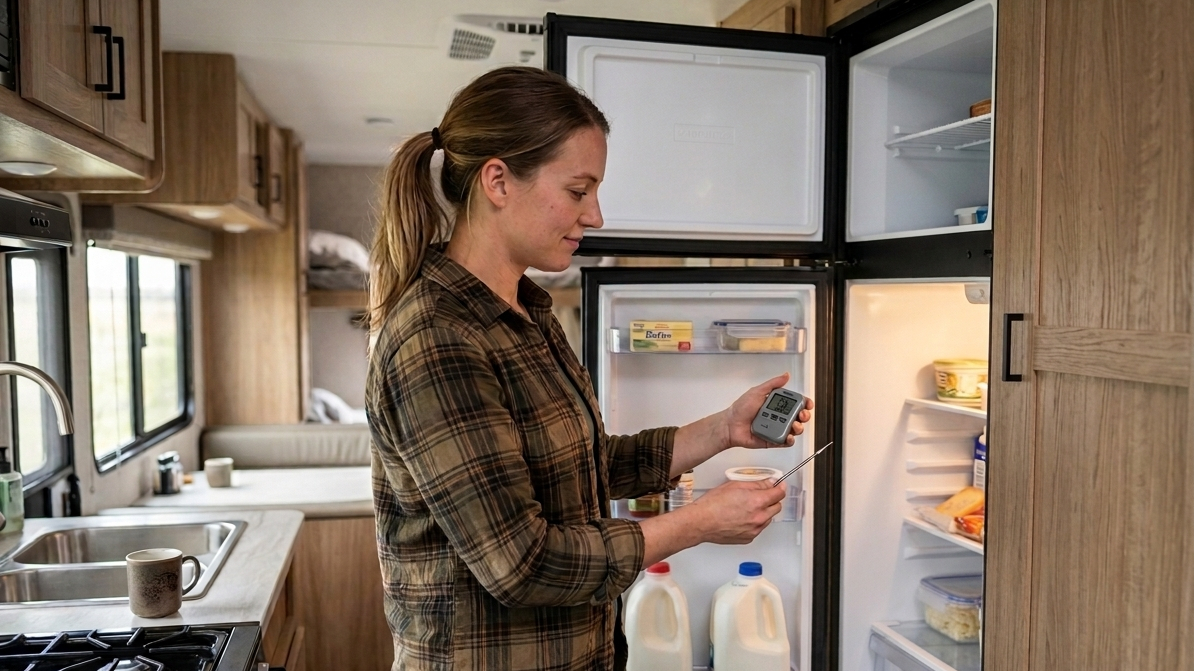
An RV refrigerator that stops cooling can ruin a trip. Food spoils, the interior warms, and you may not know whether the problem is minor or serious. RV refrigerators are different from household refrigerators, and the troubleshooting approach depends on which type you have.
This guide explains how to diagnose a refrigerator that is not cooling, what to check first, and when to call for professional service. It is not a substitute for the manufacturer’s manual, but it helps you understand the likely causes and rule out simple problems before seeking help.
Identify Your Refrigerator Type First
There are two main types of RV refrigerators, and their troubleshooting is very different.
Absorption Refrigerators
Absorption refrigerators use heat — from propane, 120-volt AC, or 12-volt DC — to drive a cooling process that relies on a sealed ammonia-water system. They are common in older RVs and some current models.
Key characteristics:
- Silent operation (no compressor)
- Require the RV to be reasonably level when parked
- Need 12-volt power for the control board on most models
- Can cool on propane, AC, or DC depending on the model
- Contain a sealed system that cannot be recharged by the owner
Compressor Refrigerators
Compressor refrigerators work like a household refrigerator. They use an electrically driven compressor to circulate refrigerant. They are increasingly common in newer RVs.
Key characteristics:
- Run on 12-volt DC, 120-volt AC, or both
- Do not need to be level
- Quieter startup than older models but may hum
- More efficient in warm weather than absorption units
- Require adequate battery capacity if running on 12 volts
Before diagnosing, confirm which type you have. Look at the model label inside the refrigerator or in the owner’s manual.
Start With the Simplest Checks
Before assuming a major failure, verify the basics.
1. Is the refrigerator turned on?
Some models have a main power switch that is easy to bump. Confirm it is on and the display is lit.
2. What power source is selected?
Absorption refrigerators usually have an AUTO mode that selects between propane and AC. If the mode has been changed manually, or if one source has failed, the refrigerator may not cool.
3. Is the propane supply available?
For propane operation, confirm the tank valve is open, the regulator is working, and other propane appliances operate. If the cooktop won’t light, the refrigerator won’t either.
4. Is 12-volt power available?
Even propane absorption refrigerators typically need 12-volt power for the control board. Check the battery, the disconnect switch, and the refrigerator fuse.
5. Is the RV level?
Absorption refrigerators need the RV reasonably level when parked. Operating one far out of level can affect circulation and cooling. Compressor refrigerators do not need to be level.
6. Has the refrigerator been running long enough?
Absorption refrigerators can take 4–8 hours to cool from ambient temperature. Starting one and checking after 30 minutes is not a fair test. A compressor refrigerator usually cools faster.
7. Is the door sealing properly?
A poor door gasket allows cold air to escape. Check the seal around the entire door. A dollar bill should resist when pulled out with the door closed. If it slides out easily, the seal is not making contact.
Check the Temperature Properly
Do not judge cooling by the display or by feel. Use a thermometer.
- Place an appliance thermometer in the main compartment.
- Target 4°C (40°F) or below for the food compartment.
- Target −18°C (0°F) or below for the freezer.
- Check after several hours of operation, not minutes.
If the thermometer shows the correct temperature, the refrigerator is working even if the display or your hand suggests otherwise.
If the Refrigerator Runs on Propane but Not Electric (or Vice Versa)
This is a common diagnostic clue.
Runs on propane but not AC:
- Check the shore power connection and the RV breaker
- Confirm the refrigerator’s AC circuit is powered
- Check the AC heating element (may require a technician)
Works on AC but not propane:
- Check the propane supply
- Check for air in the propane line after a tank change
- Inspect the burner area for debris or insect nests
- Confirm the igniter is working (you should hear clicking)
- Look for soot around the burner
Works on neither:
- The problem is likely in the control board, thermostat, or sealed cooling system
- Professional diagnosis is usually required
Check the Exterior Ventilation
Absorption refrigerators require unobstructed exterior ventilation to release heat.
Inspect:
- The lower vent panel on the outside of the RV
- The upper vent or roof vent
- The space behind the refrigerator for debris, insect nests, or obstructions
- The baffle that directs airflow through the compartment
What to look for:
- Wasp or mud-dauber nests
- Leaves, dust, or debris
- Damaged or missing vent covers
- Soot or heat discolouration
- Blocked airflow
Poor ventilation is one of the most common causes of poor cooling. If the vent is blocked, the refrigerator cannot release heat and cooling performance drops.
Clean the vent area carefully. Do not insert tools into the burner or flue area. For more on appliance ventilation, see our RV Appliance Maintenance guide.
Check the Burner and Flue (Absorption Only)
For propane absorption refrigerators, the burner and flue need periodic cleaning.
Signs of a dirty burner or flue:
- Soot around the burner
- Yellow or unstable flame
- Poor cooling on propane
- Unusual odours
- Repeated ignition failure
Cleaning the burner and flue is often best left to a technician. It involves working with propane and requires care to avoid damaging components. If you are comfortable with basic maintenance, consult the manual for the specific procedure.
Never adjust the propane pressure or the burner without the proper equipment and training.
Check the Thermistor and Control Board
Most absorption refrigerators use a thermistor attached to the cooling fins inside the refrigerator. It tells the control board the current temperature. If it fails or is dislodged, cooling may stop or become erratic.
Check:
- The thermistor is securely attached to the fin
- The wiring is intact
- The position matches the manufacturer’s specification
A faulty thermistor or control board typically requires professional diagnosis and replacement.
If the Refrigerator Is Getting Power but Not Cooling
If the refrigerator is on, the display is lit, and the correct power source is selected but the interior stays warm, consider these possibilities:
Absorption refrigerator:
- Failed heating element (AC mode)
- Clogged burner or flue (propane mode)
- Blocked ventilation
- Level issue
- Faulty thermistor or control board
- Sealed cooling system failure (requires replacement, not repair)
Compressor refrigerator:
- Low battery voltage (if running on 12-volt)
- Failed compressor
- Failed thermostat or control board
- Refrigerant leak
- Blocked condenser airflow
Some of these are owner-checkable. Others require professional service.
Check the Battery Voltage (12-Volt Models)
Compressor refrigerators running on 12-volt power are sensitive to voltage.
Check:
- Battery state of charge
- Battery terminal condition
- Fuse and wiring at the refrigerator
- Voltage at the refrigerator while it is running
If voltage drops significantly under load, the refrigerator may struggle to cool. Check the battery condition and wiring before assuming the refrigerator has failed.
Look for Odours or Leaks
Ammonia smell (absorption refrigerators):
- Indicates a leak in the sealed cooling system
- Stop using the refrigerator immediately
- Ventilate the area
- Arrange professional service or replacement
Yellow residue around the cooling unit:
- Also indicates a sealed-system failure
- Usually means the refrigerator needs replacement
Unusual electrical or burning smells:
- Turn the refrigerator off immediately
- Inspect the plug, cord, and outlet for damage
- Do not continue operating the refrigerator until the cause is found
Do not attempt to repair a sealed absorption cooling system yourself. It contains ammonia and hydrogen gas under pressure and requires specialized equipment. For more industry safety guidance, see the RV Safety & Education Foundation.
Check the Door Seal and Gaskets
A worn or damaged door seal allows cold air to escape and warm air to enter.
Check:
- The gasket is clean and free of debris
- The seal makes contact all the way around
- The door latches firmly
- The hinge is not bent or worn
- The door does not sag
Test with a piece of paper:
Place a strip of paper between the gasket and the frame, close the door, and pull. There should be resistance. If the paper slides out easily, the gasket is not sealing.
Replace the gasket if it is cracked, stiff, or no longer making contact. This is a relatively easy and inexpensive repair.
Consider Ambient Temperature
RV refrigerators cool less effectively when the outside temperature is very high or the RV is in direct sun.
Helpful measures:
- Park in shade when possible
- Keep the RV closed during the hottest part of the day
- Reduce how often the door is opened
- Do not place warm food inside
- Confirm the refrigerator vent is receiving adequate airflow
Absorption refrigerators in particular lose effectiveness in high heat. Some models operate well below their rated cooling capacity at temperatures above 32°C (90°F).
What to Do With Food
If the refrigerator has not cooled for several hours and the interior is warm:
- Move perishable food to a cooler with ice or another refrigerator
- Do not repeatedly open the refrigerator door to check
- Do not rely on the refrigerator to cool food from room temperature
- Discard any food that has been above 4°C (40°F) for more than 2 hours
Do not wait for the refrigerator to “catch up” before moving food.
When to Call a Technician
Contact a qualified RV technician or appliance technician when:
- The refrigerator produces an ammonia smell
- Yellow residue is visible around the cooling unit
- The burner or flue needs cleaning
- The control board or thermistor is faulty
- The heating element has failed
- The compressor does not start
- The refrigerator has been failing repeatedly after cleaning and cooling checks
- The sealed cooling system has failed
- You are unsure how to safely inspect the propane burner
A technician can confirm the problem and advise whether repair or replacement makes more sense. For older absorption refrigerators with a failed cooling unit, replacement is often more cost-effective than repair. For help identifying other RV problems, see our Common RV Problems and Troubleshooting guide.
Preventing Future Cooling Problems
Regular maintenance prevents most cooling problems.
- Keep the exterior vents clear
- Clean the door gasket and inspect it for damage
- Level the RV when parked with an absorption refrigerator
- Run the refrigerator on a regular basis, even when stored
- Check the burner and flue periodically
- Confirm 12-volt power is adequate
- Avoid overloading the refrigerator
- Do not block interior airflow with tightly packed food
For more on routine refrigerator maintenance, see our RV Refrigerator Maintenance post.
RV Refrigerator Not Cooling: Checklist
If the refrigerator is not cooling, confirm:
- The refrigerator is turned on and the display is lit.
- The correct power source is selected.
- Propane is available and other appliances operate.
- 12-volt power is available and the fuse is intact.
- The RV is level (for absorption models).
- The refrigerator has had adequate time to cool.
- The door seal is intact and the door latches firmly.
- Exterior vents are unobstructed.
- The burner and flue are clean (for propane operation).
- The thermistor is attached and its wiring is intact.
- Ambient temperature is not exceeding the refrigerator’s capacity.
- Food has been moved if the interior is not cooling.
RV Refrigerator Not Cooling: Key Takeaways
An RV refrigerator that stops cooling usually has a diagnosable cause. Start with the simple checks — power source, level, ventilation, door seal, and time. Most problems can be narrowed down without tools.
If the refrigerator produces an ammonia smell, shows yellow residue, or fails to cool after the basics have been checked, call a technician. Sealed absorption cooling systems cannot be repaired by owners, and compressor faults require professional diagnosis.