
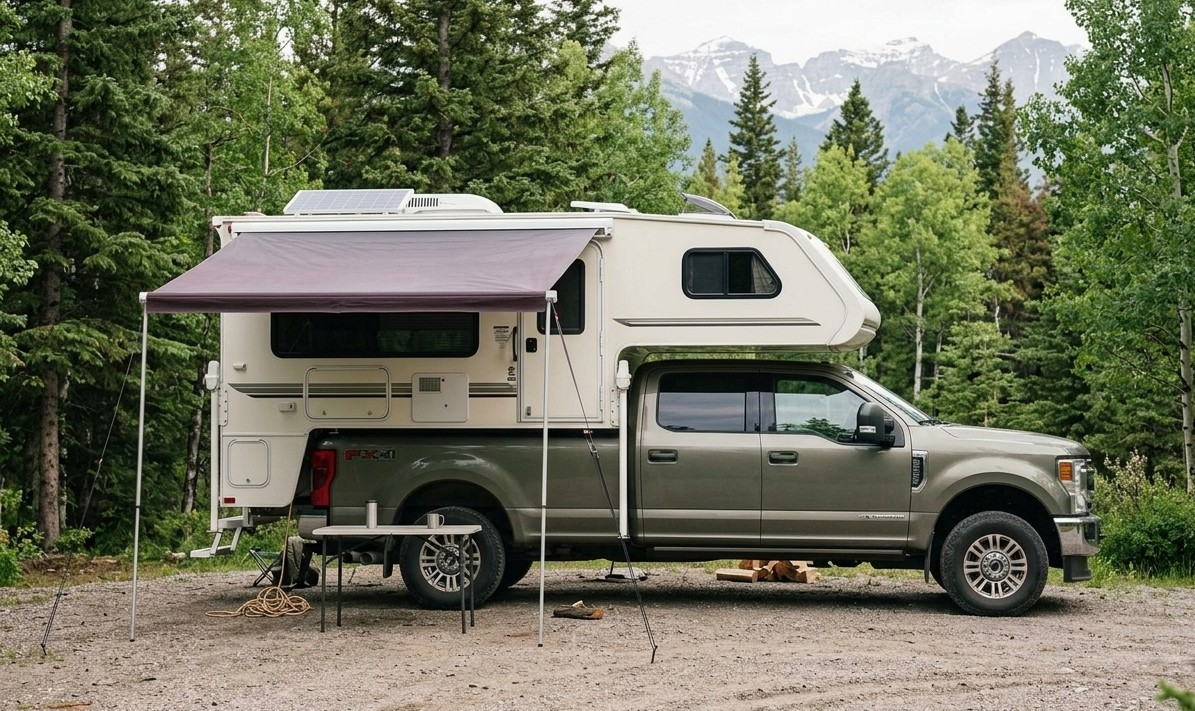
This truck camper buying guide covers what you need to know before purchasing one of the most compact and maneuverable RV types. A truck camper sits in the bed of a pickup truck and offers a self-contained living space that can go almost anywhere the truck can. For some owners, it is the best possible choice. For others, it is the wrong fit entirely.
This guide explains what truck campers are, who they suit, how to match a camper to a truck, what to inspect before buying, and the trade-offs that come with this type of RV. It is not a substitute for the manufacturer’s manuals or a professional inspection, but it helps you understand the decision.
What Is a Truck Camper?
A truck camper is a removable living unit that mounts in the bed of a pickup truck. It may be a simple shell with a bed and basic amenities, or a fully equipped unit with a bathroom, kitchen, heating, and air conditioning.
Truck campers fall into two broad categories:
Slide-in campers. The most common type. The camper slides into the truck bed and is secured with tiedowns. It overhangs the cab and sometimes the rear of the truck.
Pop-up campers. A subset of slide-in campers with a folding roof. Lighter and more aerodynamic for travel, with lower interior height when deployed.
Some specialized variants exist, including chassis-mounted campers and expedition-style units, but slide-in and pop-up designs dominate the market. Because the camper is removable, the truck can be used separately when the camper is off.
Who a Truck Camper Suits
Truck campers work well for:
- Solo travelers or couples
- Owners who want to explore remote areas
- Owners who want to tow a boat, trailer, or ATV behind the truck
- Owners who want to camp in places larger RVs cannot reach
- Owners who value a compact, maneuverable setup
- Owners who already own an appropriate truck
They suit less well:
- Families with more than two people (unless the camper has bunk options)
- Owners who want significant interior living space
- Full-time travelers who need extensive storage
- Owners without a properly rated truck
The single biggest mistake new buyers make is underestimating truck requirements. More on that below. If the truck cannot carry the camper safely, no other consideration matters.
Truck Camper Advantages
Maneuverability. A truck camper can go almost anywhere a pickup truck can — narrow forest roads, remote trailheads, tight campsites, and uneven terrain that would stop a motorhome or trailer.
Compact footprint. Fits in a standard parking space. Easy to store in a driveway.
No trailer to tow. Towing a trailer behind the truck camper is possible, but the camper itself is not a towed vehicle. This simplifies maneuvering and campsite setup.
Fast setup. Once parked, there is little to do. No levelling, no slide-outs, no hitch work.
Four-wheel drive capability. With a 4×4 truck, a camper can reach places most RVs cannot.
Off-grid friendly. Many campers are well-suited to boondocking, with propane appliances and modest electrical needs.
Because the camper is compact, it can reach places larger RVs cannot.
Truck Camper Disadvantages
Limited space. Even the largest truck campers are compact. Storage is minimal.
Payload matters. Every truck camper consumes significant truck payload. Most half-ton trucks cannot safely carry large truck campers.
Loading and unloading. Removing and reinstalling the camper takes time, equipment, and care.
Driving characteristics. A loaded truck camper raises the truck’s center of gravity and affects handling, braking, and cornering.
Wet baths and small tanks. Freshwater, grey, and black tanks are small. Showers may be wet baths (shower and toilet in one space).
Climbing in and out. Most truck campers require climbing a ladder or stepping up into the cab-over bed.
Fuel economy. A camper adds wind resistance and weight, reducing fuel economy.
Weather exposure. Slide-in campers are more exposed to weather than enclosed motorhomes. Pop-ups are more exposed still.
Although the camper is maneuverable, space and storage remain limited.
Matching a Camper to a Truck
This is the most important part of truck camper ownership, and where most mistakes happen.
Payload is the limiting factor. Every truck has a payload capacity — the weight it can carry, including passengers, fuel, cargo, and the camper itself.
A truck camper’s wet weight (with water, propane, batteries, and gear) can easily be 2,000–4,000 pounds or more. A half-ton truck with 1,500 pounds of payload cannot safely carry most truck campers.
You need to check:
- Your truck’s payload capacity (from the door jamb label)
- The camper’s wet weight (not the dry weight)
- The weight of passengers, cargo, fuel, and any towing equipment
- The rear axle rating (GAWR)
- The tire load rating
Truck classifications:
- Half-ton (F-150, Silverado 1500, Ram 1500): Suitable only for lightweight pop-up campers or small hard-side models. Payload is often the limiting factor.
- Three-quarter-ton (F-250, Silverado 2500, Ram 2500): Suitable for most slide-in campers. Payload is significantly higher.
- One-ton (F-350, Silverado 3500, Ram 3500): Suitable for the largest truck campers, including those with slide-outs.
Some campers are designed for specific truck configurations. Always confirm compatibility with the camper and truck manufacturers. If payload is exceeded, the combination is unsafe even if the camper fits in the bed. For more on weight ratings and payload, see our RV Weight Ratings guide.
Single vs. Dual Rear Wheels
Trucks with dual rear wheels (DRW) offer more stability, higher payload, and better handling with a heavy camper. They are strongly recommended for larger truck campers.
Single rear wheel (SRW) trucks are adequate for lighter campers but may feel unstable with a heavy load. If you plan to carry a large camper, DRW is often the safer choice. If the camper is heavy, dual rear wheels provide more stability and higher payload. For more on tire load ratings, see our RV Tire Safety guide.
Suspension and Handling Upgrades
Many truck camper owners add suspension upgrades to handle the weight and improve stability:
- Air bags or helper springs to support the rear axle
- Upgraded shocks for better control
- Sway bars to reduce body roll
- Heavy-duty tires rated for the load
- Tiedown systems specifically designed for truck campers
These upgrades improve handling but do not increase the truck’s rated payload or axle ratings. The legal and safety limits remain the same. Although air bags improve handling, they do not increase the truck’s rated payload.
Tiedown Systems
Truck campers are secured to the truck with a tiedown system. Common types:
- Belt-style tiedowns — attach to the truck bed or frame
- Frame-mounted tiedowns — stronger, better for heavy campers
- Spring-loaded tiedowns — allow some movement for flex
The tiedown system must be rated for the camper’s weight and installed correctly. Improperly secured campers can shift, damage the truck, or separate in an accident. Because the camper is not permanently attached, the tiedown system must be rated and installed correctly.
What to Look For in a Camper
When evaluating a truck camper, consider:
Floor plan:
- Cab-over bed (most common)
- Dinette or seating area
- Kitchen with stove, sink, and refrigerator
- Bathroom (wet bath or separate)
- Storage throughout
Amenities:
- Furnace
- Air conditioner (requires significant power)
- Water heater
- Refrigerator (propane, 12-volt, or 120-volt)
- Toilet and shower
- Solar pre-wiring
- Battery bank
Construction:
- Frame material (aluminum, wood)
- Exterior material (fiberglass, aluminum)
- Insulation (important for cold-weather use)
- Roof construction
- Slide-out mechanisms (if equipped)
Weight:
- Dry weight
- Wet weight (with water, propane, batteries)
- Center of gravity (affects handling)
Tank capacities:
- Freshwater
- Grey water
- Black water
- Propane
Before comparing specific models, decide which features matter most for your travel style.
New vs Used Truck Campers
New campers offer warranty coverage, the latest features, and no unknown history. They cost significantly more and depreciate quickly.
Used campers offer lower prices and less depreciation but require careful inspection. Water damage, roof sealant failure, and appliance wear are common issues.
A used camper from a careful owner, maintained properly, can be an excellent value. A neglected camper can be a money pit. If you buy used, inspect carefully and confirm the camper has no hidden water damage.
Inspecting a Used Truck Camper
If buying used, inspect carefully:
Exterior:
- Roof sealant and seams
- Sidewalls for delamination
- Windows and seals
- Storage compartment doors
- Tiedown attachment points
- Jacks (if equipped)
- Awning (if equipped)
Interior:
- Ceiling and walls for water stains
- Cabinets and drawers for moisture
- Flooring for soft spots
- Appliances operation
- Plumbing leaks
- Electrical system
- Battery condition
- Furnace and water heater
Structure:
- Floor integrity
- Wall and roof framing
- Cab-over bed support
- Overall condition
Water damage is the single most common and expensive problem. Because water damage is the most expensive problem, inspect the roof and interior thoroughly. Inspect carefully. For a full inspection checklist, see our Buying a Used RV guide.
For more industry guidance on RV construction and safety standards, see the RV Industry Association.
Loading and Unloading
Loading a truck camper requires:
- A flat, firm surface
- Camper jacks in good condition
- Correct alignment between truck and camper
- Adequate clearance
- Careful movement
Some owners load and unload frequently. Others leave the camper on the truck year-round. The choice depends on how the truck is used otherwise.
If you plan to remove the camper regularly, invest in quality jacks and consider a camper dolly for storage.
Insurance and Registration
Truck camper insurance varies. Some policies cover the camper as part of the truck; others require a separate policy. Check with your insurer.
Registration requirements vary by province and state. Some require the camper to be registered separately; others do not.
Truck Camper Buying Checklist
Before purchase, confirm:
- The truck’s payload and rear-axle ratings are adequate for the camper’s wet weight.
- The camper’s wet weight is known (not just dry weight).
- Tiedown system is rated for the camper.
- Suspension upgrades (if needed) are appropriate.
- The floor plan suits your travel style.
- Tank capacities match your camping plans.
- Appliances operate correctly.
- The camper has been inspected for water damage.
- Documentation and title are clear.
- Insurance and registration requirements are understood.
Truck Camper Buying: Key Takeaways
A truck camper is a specialized RV that suits a specific kind of travel. It offers maneuverability, simplicity, and access to remote places. But it requires a properly rated truck, careful payload management, and realistic expectations about space.
The single most important factor is payload. Match the camper to the truck before anything else. If the truck cannot safely carry the camper, no other consideration matters.
For the right owner, a truck camper is the best RV choice available. For the wrong owner, it is a compromise that never quite works. Understanding your needs and your truck’s limits is the key. Because payload is the limiting factor, match the camper to the truck before anything else.