
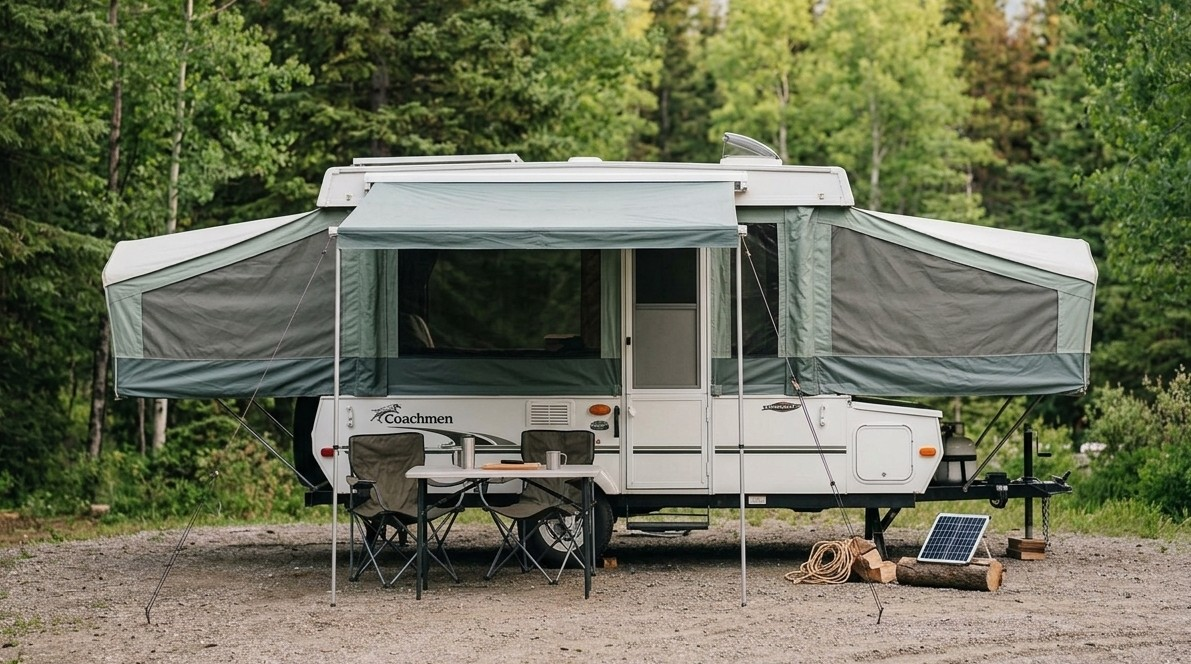
This tent trailer buying guide covers what you need to know before purchasing one of the most affordable and lightweight RV types. A tent trailer — also called a pop-up camper or folding trailer — folds down for towing and pops up at the campsite. It weighs far less than a conventional travel trailer and can be towed by many mid-size SUVs and smaller trucks.
For the right owner, a tent trailer is an affordable and flexible entry into RV ownership. For others, the setup time, canvas construction, and limited amenities make it the wrong fit.
This guide explains what tent trailers are, who they suit, how to match one to a tow vehicle, what to inspect before buying, and the trade-offs that come with this type of RV. It is not a substitute for the manufacturer’s manuals or a professional inspection, but it helps you understand the decision.
What Is a Tent Trailer?
A tent trailer is a folding camper with a solid base, a telescoping or folding roof, and canvas or synthetic walls that extend when the trailer is set up. The beds typically slide out on either end, providing sleeping space without increasing the towing length.
The trailer tows low and compact, then expands at the campsite into a space that can sleep four to eight people, depending on the model.
There are two broad types:
Standard tent trailers. The most common type. Manual or assisted lift systems raise the roof. Beds slide out from the ends.
High-wall tent trailers. Taller walls and a higher roof. More interior space, larger appliances, and sometimes a hard-sided bathroom. Heavier and more expensive than standard models.
Some higher-end models include hard-sided slide-outs or expandable sections, but the defining feature remains the folding canvas construction. Because the trailer folds down, it tows lower and stores more easily than a conventional trailer.
Who a Tent Trailer Suits
Tent trailers work well for:
- First-time RV buyers
- Families with children
- Owners with smaller tow vehicles
- Owners who want an affordable entry into RVing
- Campers who value a tent-like experience with more comfort
- Owners with limited storage space for a larger RV
They suit less well:
- Owners who want to camp in extreme cold
- Owners who want quick setup
- Owners who need full bathroom facilities
- Full-time travelers
- Owners who want significant interior living space
- Owners who camp in areas with heavy rain or wind
If you camp in cold or stormy weather, a hard-sided trailer may suit you better.
Tent Trailer Advantages
Light weight. Many tent trailers weigh under 2,500 pounds and can be towed by mid-size SUVs, minivans, and smaller trucks.
Affordability. New tent trailers are significantly cheaper than conventional travel trailers. Used models are often very affordable.
Compact storage. When folded, a tent trailer fits in a standard garage in many cases. Storage is easier than most other RV types.
Low towing profile. The folded trailer is aerodynamic, improving fuel economy over a conventional travel trailer.
Sleeps many people. Slide-out beds provide sleeping space that would require a much larger trailer to match.
Open, airy feel. The canvas walls and large windows make the interior feel connected to the outdoors.
Easy towing. The low profile and light weight make towing less demanding than larger trailers.
Because the trailer is lightweight, it can be towed by smaller vehicles and uses less fuel.
Tent Trailer Disadvantages
Setup and takedown time. Setting up a tent trailer takes 15–45 minutes, depending on the model and experience. Takedown is similar.
Weather sensitivity. Canvas walls are vulnerable to heavy rain, wind, and cold. Some owners avoid camping in wet or windy conditions.
Limited insulation. Tent trailers are not well-suited to cold-weather camping. Furnaces help but do not make them four-season.
Limited amenities. Many models lack a full bathroom. Showers and toilets may be minimal or absent.
Moisture issues. Canvas can develop mildew if stored wet. Regular drying is essential.
Setup in the rain. Setting up or taking down in rain means a wet canvas that must be dried before storage.
Mechanical complexity. The lift system and slide-out beds require maintenance and can fail.
Noise. Canvas does not block campground noise as well as hard-sided trailers.
Although setup takes time, many owners accept it for the space and outdoor feel.
Matching a Tent Trailer to a Tow Vehicle
Tent trailers are lighter than conventional travel trailers, but they still require a properly rated tow vehicle.
Check:
- The trailer’s loaded weight (with water, propane, and gear)
- The tow vehicle’s towing capacity
- The tow vehicle’s payload capacity
- The hitch rating
- Tongue weight (typically 10–15% of trailer weight)
- The trailer’s GVWR
Many tent trailers can be towed by SUVs and minivans rated for 3,500 pounds or more. Some smaller models can be towed by vehicles rated for 2,000 pounds, but those are limited.
Do not assume that a tent trailer can be towed by any vehicle with a hitch. Check the ratings. If the loaded weight exceeds the tow rating, the combination is unsafe even if the trailer seems small. For more on weight ratings and payload, see our RV Weight Ratings guide.
Tent Trailer Construction
Tent trailers vary widely in construction quality.
Frame: Steel or aluminum. Aluminum is lighter and resists rust better.
Body: Aluminum or fiberglass panels over a wood or composite frame. Check for water damage around the seams.
Canvas: The most important part of a tent trailer. Modern canvas is often a synthetic material like Sunbrella or acrylic-coated fabric. It resists mildew, UV damage, and water better than older cotton canvas.
Roof: Often a single-piece aluminum or fiberglass panel. Some models have roof-mounted air conditioning, which adds weight and complexity.
Beds: Slide-out beds with mattresses. Look for thick, supportive mattresses and secure support mechanisms.
Lift system: Manual crank, cable-assisted, or powered. Cable systems require regular inspection and maintenance.
Because canvas is the most vulnerable component, inspect it carefully before purchase.
What to Look For in a Tent Trailer
Floor plan:
- Sleeping capacity
- Dinette or seating area
- Kitchen with sink and stove
- Storage (interior and exterior)
- Bathroom (in some models)
Amenities:
- Furnace
- Refrigerator (propane or 12-volt)
- Water heater
- Water pump and tank
- Toilet (portable or cassette, in some models)
- Shower (exterior, in some models)
- Air conditioning (in some models)
- Awning
Construction:
- Canvas condition
- Lift system type and condition
- Roof condition
- Floor condition
- Frame condition
- Water tightness
Weight:
- Dry weight
- Loaded weight (with water, propane, gear)
- Tongue weight
- GVWR
Tank capacities:
- Freshwater
- Grey water (often minimal in tent trailers)
- Propane
Before comparing models, decide which features matter most for your travel style.
New vs Used Tent Trailers
New tent trailers offer warranty coverage, the latest canvas and construction, and no unknown history. They cost more but are still affordable compared to other RV types.
Used tent trailers offer lower prices but require careful inspection. Canvas condition, lift system function, and water damage are the main concerns.
A used tent trailer in good condition can be an excellent value. A neglected one can require significant work — especially if the canvas has mildew or the lift system is failing. If you buy used, check the canvas and lift system before committing. For more industry guidance on RV construction and safety standards, see the RV Industry Association.
Inspecting a Used Tent Trailer
If buying used, inspect carefully:
Exterior:
- Roof for cracks, holes, or water damage
- Canvas for mildew, tears, or stiffness
- Seams and stitching
- Lift system cables and pulleys
- Frame for rust or damage
- Tires and wheels (including date codes)
- Tiedown or hitch components
Interior:
- Floor for soft spots or water damage
- Cabinets and drawers for moisture
- Mattresses for mildew or stains
- Appliances operation
- Plumbing for leaks
- Electrical system
- Battery condition
Setup:
- Raise and lower the roof through a full cycle
- Slide out and retract the beds
- Check the canvas for gaps or misalignment
- Confirm the door closes and seals properly
Water damage is the biggest risk. Inspect the floor, roof, and storage areas carefully. For a full inspection checklist, see our Buying a Used RV guide.
Setup and Takedown
Setup involves:
- Parking and levelling
- Chocking wheels
- Unhitching the tow vehicle
- Raising the roof
- Sliding out beds
- Deploying the canvas
- Connecting water and power if available
- Setting up the awning and outdoor space
Takedown reverses the process. Expect 15–45 minutes each way, depending on model and experience.
Wind and rain can make setup or takedown difficult and unpleasant. Plan accordingly.
Canvas Care and Maintenance
Canvas is the defining feature of a tent trailer and requires ongoing care.
- Dry thoroughly before closing to prevent mildew.
- Clean regularly with mild soap and water.
- Treat with approved waterproofing products when needed.
- Inspect seams and stitching for wear.
- Repair small tears before they grow.
- Store dry and ventilated when possible.
Mildew is the most common problem and is difficult to remove once it sets in. Preventing it is much easier than removing it. Because mildew is difficult to remove, dry the canvas before closing the trailer. For more on preventing mould and mildew, see our RV Mould and Mildew Prevention and Removal guide.
Lift System Maintenance
The lift system raises the roof and must operate smoothly.
- Inspect cables for fraying or wear.
- Lubricate pulleys and pivots as directed.
- Check for uneven lifting.
- Replace worn components before failure.
- Do not force a binding lift system.
A failed lift system can prevent setup or takedown entirely. Regular inspection and maintenance matter. If the lift system binds, stop and inspect it before forcing it further.
Insurance and Storage
Tent trailers are usually less expensive to insure than larger RVs. Coverage options depend on the insurer.
Storage is easier than most RVs because the trailer folds down. Many fit in a garage or driveway. Covered or indoor storage extends the life of the canvas.
Tent Trailer Buying Checklist
Before purchase, confirm:
- The tow vehicle’s ratings match the trailer’s loaded weight.
- The trailer’s GVWR and tongue weight are within the tow vehicle’s limits.
- The canvas is clean, flexible, and free of mildew.
- The lift system operates smoothly through a full cycle.
- The roof and floor show no signs of water damage.
- The beds slide out and retract correctly.
- The door closes and seals properly.
- Appliances operate correctly (if equipped).
- Tires are within age and condition limits.
- Documentation and title are clear.
- Storage, insurance, and ongoing costs are understood.
For a printable version of this checklist, see our RV Checklists page.
Tent Trailer Buying: Key Takeaways
A tent trailer is an affordable, lightweight, and flexible entry into RV ownership. It offers more space than a truck camper, weighs less than a travel trailer, and can be towed by many mid-size vehicles.
The trade-offs are real: setup time, weather sensitivity, and limited amenities. For the right owner — one who values the outdoor feel, travels in good weather, and does not mind the setup — a tent trailer is an excellent choice.
Inspect carefully, match the trailer to the tow vehicle, and plan for canvas maintenance. A well-maintained tent trailer can provide years of comfortable camping.