
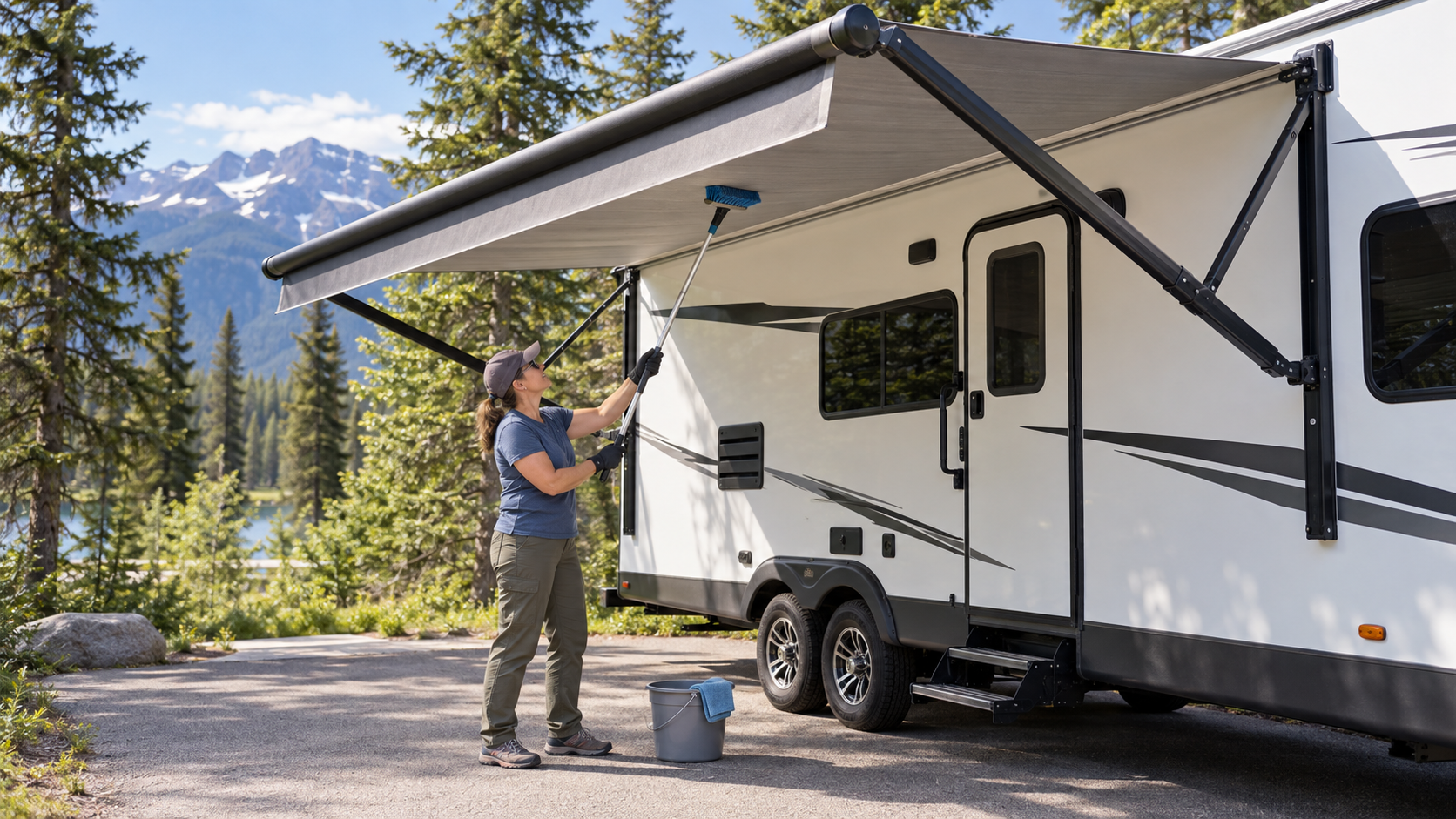
An RV awning provides shade and shelter, but its large fabric surface can catch wind, collect water, and place considerable force on its arms and mounting points. Regular RV awning maintenance helps prevent damage from dirt, moisture, sunlight, improper adjustment, or hurried operation.
RV awnings include manual and powered designs, different support-arm arrangements, and several types of fabric. Maintenance and emergency-retraction procedures vary, so identify the awning manufacturer and model before adjusting, lubricating, or disassembling anything.
Routine inspection, careful cleaning, and prompt retraction during changing weather can prevent many common failures.
RV Awning Maintenance: Identify Your Awning
Before performing maintenance, determine whether the awning is manual or powered and identify its operating system. Your RV may also have separate window, door, or slide-out awnings that use different components.
Common awning fabrics include:
- Vinyl
- Acrylic
- Woven or laminated synthetic materials
- Manufacturer-specific fabrics
Vinyl and acrylic fabrics require different cleaning and care methods. A product that is suitable for one material may stain, weaken, or remove protective treatments from another.
Consult the awning documentation to identify:
- Fabric type
- Approved cleaners
- Recommended inspection intervals
- Permitted lubricants
- Rain and wind limitations
- Travel-locking requirements
- Manual-retraction procedure
- Replacement-part information
Record the manufacturer and model number where it will remain accessible if the awning fails while extended.
Inspect Before Operating
Walk around the RV before extending the awning.
Check for:
- Trees, posts, vehicles, and other obstructions
- Branches above the awning
- Strong or gusting wind
- Snow, ice, or accumulated water
- Loose fabric
- Bent or damaged arms
- Objects leaning against the RV
- Compartment doors that could strike the arms
- People or pets in the operating area
Remain clear of the arms, roller, hinges, and other pinch points. Do not allow anyone to stand directly beneath a moving awning.
Watch both ends as the awning extends. Stop immediately if one side hesitates, the fabric rolls unevenly, an arm binds, or the mechanism makes an unfamiliar noise.
Safe Awning Operation
Follow the manufacturer’s operating procedure. Do not pull, push, or force an arm while the awning motor is running unless the instructions specifically require assistance.
When extending a powered awning, hold the control only as directed. Release it if the awning reaches its intended position or if movement becomes uneven.
For a manual awning:
- Release all travel locks
- Loosen required knobs or clamps
- Use the pull strap correctly
- Keep control of the roller
- Secure the arms in their operating positions
- Set the permitted pitch
- Confirm that all required locks are engaged
A spring-loaded roller can move suddenly. Maintain control of the pull strap and keep fingers away from the roller and arm joints.
Before retracting either type, clear chairs, tables, lights, tie-downs, and other accessories from beneath it. Confirm that nothing has been clipped or fastened to the fabric.
Wind and Weather Protection
An extended awning can be damaged by a sudden gust even when the weather initially appears calm. Wind can bend the arms, tear the fabric, loosen wall mounts, or pull structural material from the RV.
Retract the awning:
- Before strong or gusting wind
- Before severe weather
- When leaving the campsite
- Before going to sleep when conditions are uncertain
- Whenever the manufacturer’s operating limit may be exceeded
Tie-downs do not make an awning stormproof. They can transfer wind loads directly into the arms, brackets, and RV wall.
Automatic wind sensors are useful, but they are not a substitute for supervision. Power loss, sensor settings, mechanical resistance, or rapid weather changes may prevent automatic retraction.
When uncertain, retract the awning.
Rain and Water Accumulation
Water collecting on awning fabric creates substantial weight. It can stretch the material, bend the roller, damage the arms, or pull mounting brackets loose.
Some awnings permit one side to be lowered to encourage runoff. Others have an automatic dumping feature that temporarily lowers one arm when water accumulates. Follow the manufacturer’s instructions before changing the pitch.
Never assume an automatic dump feature will protect an unattended awning. Heavy rain can arrive faster than water drains, and debris may prevent runoff.
If water has pooled:
- Keep people away from the awning
- Do not stand beneath the low area
- Do not push upward sharply from below
- Follow the manufacturer’s procedure for safely removing the load
- Inspect the fabric, roller, arms, and mounts afterward
Do not retract an awning while it holds a large volume of water.
Inspecting the Fabric
Fully extend the awning in calm, dry conditions and inspect both sides.
Look for:
- Tears and punctures
- Frayed edges
- Worn stitching
- Cracking or peeling
- Thin areas
- Stretching
- Discolouration
- Mould or mildew
- Tree sap and bird droppings
- Loose fabric near the roller
- Damage where the fabric attaches to the RV
- Areas that roll unevenly
Pay particular attention to the fabric closest to the RV. This portion may remain exposed to sunlight and weather when the awning is retracted.
Small defects can spread quickly under tension. Use only repair methods and materials approved for the fabric. Replace severely weakened material instead of relying on an extensive temporary patch.
Cleaning the Awning
Choose a cleaner approved for the exact fabric. Do not assume household bleach, strong detergent, solvents, or abrasive cleaners are safe.
A typical cleaning process may include:
- Park in a location where cleaning runoff is permitted.
- Extend the awning in calm weather.
- Remove loose dirt with a soft brush or gentle rinse.
- Apply the approved cleaner as directed.
- Use a soft brush or cloth where permitted.
- Rinse thoroughly.
- Clean both sides when required.
- Allow the fabric to dry completely before prolonged storage.
Do not use a pressure washer unless the awning manufacturer specifically permits it. High-pressure water can damage the fabric, force water into seams, and remove protective coatings.
Avoid aggressive scrubbing. Acrylic fabrics may rely on a water-resistant treatment that can be affected by improper cleaning.
Drying and Preventing Mildew
Whenever practical, allow the awning to dry before retracting it. Storing wet fabric for an extended period encourages staining, odours, and mildew.
Sometimes an awning must be retracted wet because of wind, travel, or changing weather. Extend it again as soon as conditions permit and allow both sides to dry.
Mildew may grow on dirt and organic residue even when the fabric itself does not support growth. Regular cleaning and complete drying reduce the risk.
Do not store the awning damp for weeks or months.
Inspecting Arms and Hardware
Examine the awning structure while it is fully visible and safely stationary.
Inspect:
- Upper and lower wall brackets
- Support arms
- Hinges and pivot points
- Roller tube
- End caps
- Fasteners
- Travel locks
- Adjustment knobs
- Gas struts
- Springs
- Wiring
- Motor housing
- Fabric attachment rails
- Sealant around mounting points
Look for bent metal, cracks, corrosion, loose fasteners, missing hardware, damaged wiring, movement at the wall, or uneven arm positions.
Do not tighten mounting fasteners blindly. A fastener that spins or will not tighten may indicate damaged backing material or water intrusion inside the wall.
Movement at an awning mount requires prompt inspection. The awning can apply enough leverage to damage the RV structure.
Lubrication
Lubrication requirements vary between awning systems. Some pivot points may require a specific dry lubricant, while other components must remain clean and dry.
Before applying anything, confirm:
- Whether lubrication is required
- Which points may be lubricated
- The approved product
- The required quantity
- The recommended interval
Do not spray oil across the fabric, roller, motor, electrical connections, or RV wall. Excess lubricant can attract dirt, stain fabric, and contaminate braking or locking components.
Never lubricate a component simply because it squeaks. A noise may indicate misalignment, bending, loose hardware, or internal damage.
Powered-Awning Electrical Checks
A powered awning requires adequate battery voltage. Low voltage can cause slow operation, incomplete retraction, clicking, or a motor that stops under load.
If the awning does not move:
- Confirm that the RV battery is charged
- Check the battery disconnect
- Inspect the correct fuse or circuit breaker
- Confirm that required switches or interlocks are set correctly
- Listen for motor or relay operation
- Look for damaged or disconnected wiring
- Check the controller for visible fault indicators
Do not replace a fuse with a higher-rated one. A fuse or breaker that repeatedly opens indicates an electrical or mechanical problem.
Stop operating the awning if wiring becomes hot, produces an odour, sparks, or shows damaged insulation. For more on 12-volt systems and battery care, see our RV Battery Maintenance post.
Common Awning Problems
The awning rolls unevenly
Stop operation and inspect for fabric that has shifted, debris on the roller, uneven arm movement, damaged mounting points, or a bent roller tube.
Repeatedly extending and retracting it may worsen the problem.
The fabric sags
Confirm that the awning is extended and adjusted according to its instructions. Sagging may result from stretched fabric, improper roller tension, mounting movement, or accumulated water.
Do not attempt to adjust spring tension without the required tools and procedure.
One arm moves differently from the other
Stop immediately. An obstruction, bent arm, damaged joint, failed gas strut, loose mount, or motor problem may cause uneven movement.
Do not force the slower arm into position.
The motor runs but the awning does not move
A failed connection, damaged drive component, stripped gear, or roller problem may have separated the motor from the mechanism. Release the switch to avoid further damage.
The awning will not retract completely
Check for obstructions, fabric rolling incorrectly, bent arms, low voltage, damaged hardware, or accessories attached to the awning.
Do not travel until the awning has been fully retracted and secured.
The awning makes unusual noises
Popping, grinding, scraping, or repeated clicking may indicate binding, loose hardware, misalignment, internal wear, or motor trouble.
Stop and inspect the system before using it again.
Water leaks where the awning attaches to the RV
Inspect the mounting rail, brackets, fasteners, and surrounding sealant. Water may enter behind the rail and travel inside the wall before becoming visible.
Surface caulking may not correct failed sealing material behind a loose rail. Evidence of water intrusion requires a complete assessment.
Manual Emergency Retraction
Locate the emergency-retraction instructions before the awning fails. Powered awnings may use a motor release, manual crank point, direct motor connection, or another model-specific procedure.
Keep any required tool accessible when travelling.
Before attempting manual retraction:
- Identify the exact awning model.
- Read the manufacturer’s instructions.
- Disconnect power when directed.
- Clear everyone from the arms and roller.
- Control the awning throughout the procedure.
- Secure it in the travel position.
Awning springs and gas struts store considerable energy. Do not remove end caps, release spring tension, or disassemble the roller without proper training and equipment.
If the awning cannot be secured safely, do not drive the RV. Contact a mobile RV technician or roadside service.
Preparing for Travel
Before moving the RV, confirm that:
- The awning is completely retracted
- The fabric is rolled evenly
- Both arms are seated
- Travel locks are engaged where provided
- Adjustment knobs are secured
- The pull strap is stored
- Wiring is clear
- Nothing protrudes from the RV
- Window and door awnings are secured
Inspect the awning again after rough-road travel or any impact.
Storage and Winter Care
Before seasonal storage:
- Clean the fabric with an approved product
- Allow it to dry completely
- Inspect seams and attachment points
- Check the arms, mounts, and travel locks
- Retract the awning fully
- Secure it for travel and storage
- Record unresolved damage
- Follow the manufacturer’s seasonal-maintenance instructions
Do not allow snow or ice to accumulate on an extended awning. Never extend a frozen awning or use open flame, boiling water, or sharp tools to free it.
Inspect the stored RV periodically for storm damage, moisture, pests, and snow load. For the complete cold-weather routine, see our How to Winterize an RV guide.
Routine Awning Maintenance Schedule
Before each trip
- Confirm the awning is fully retracted
- Check arms, locks, and fabric
- Verify that nothing is loose or protruding
Before each use
- Check weather and wind
- Inspect the operating area
- Watch both arms while extending
- Confirm the fabric rolls correctly
Monthly during regular use
- Inspect fabric, seams, arms, mounts, and wiring
- Check for loose hardware
- Clean dirt and organic residue
- Use only approved maintenance products
After heavy use or severe weather
- Inspect the fabric and roller
- Check arms and wall brackets
- Look for movement, bending, or water intrusion
- Confirm smooth operation before the next trip
Before storage
- Clean and dry the fabric
- Inspect all mounting points
- Retract and secure the awning
- Arrange repairs before leaving the RV unattended
For a printable version of this schedule, see our RV Checklists page.
When to Contact a Qualified Technician
Professional service is appropriate when:
- An arm or roller is bent
- Fabric is badly torn or separating
- A mounting bracket moves
- Fasteners will not tighten
- Water has entered around the mounting rail
- The awning extends or retracts unevenly
- A motor repeatedly trips electrical protection
- Wiring is damaged or overheating
- A spring, gas strut, or internal mechanism requires service
- The awning cannot be secured for travel
- Manual retraction cannot be completed safely
Awning springs, rollers, motors, and support arms can move suddenly and cause serious injury. Stop using the system when its movement becomes unpredictable. For more industry safety guidance, see the RV Safety & Education Foundation.
Final Thoughts
Most awning damage can be reduced through careful operation and early retraction. Keep the fabric clean and dry, inspect the arms and mounting points, and never rely entirely on sensors or tie-downs during poor weather.
Use products and procedures approved for the exact awning. If the fabric rolls unevenly, hardware shifts, or the mechanism begins to bind, stop operating it before a minor problem becomes an expensive repair.