
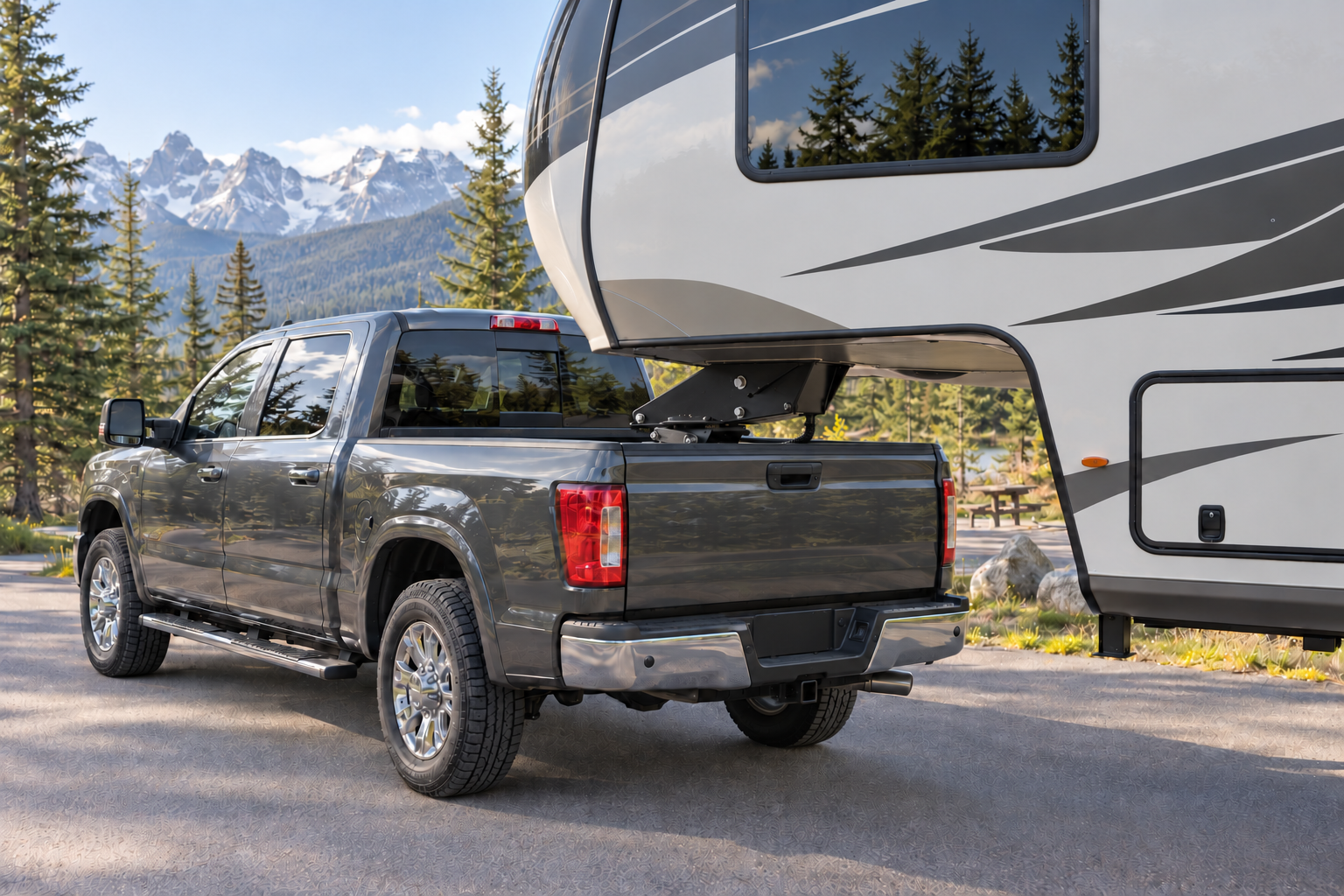
Fifth wheel towing is often more stable than towing a conventional travel trailer because the hitch places the connection over or slightly ahead of the truck’s rear axle. That stability does not eliminate risk. A fifth wheel is tall, heavy, slow to stop, and capable of striking the truck cab during a tight turn if the combination is not set up and driven correctly.
Safe fifth-wheel towing begins before the truck moves. Confirm the truck’s ratings, inspect the hitch and trailer, couple correctly, adjust the brake controller, and allow extra room for every turn and stop. Never rely on appearance alone to decide whether a truck can safely tow a particular trailer.
Understand the Weight Ratings
The truck must be able to carry the trailer’s loaded pin weight as well as passengers, cargo, the hitch, and anything else in the truck. Payload capacity is frequently the limiting rating for a fifth-wheel combination, even when the advertised trailer weight appears to fall within the truck’s maximum tow rating.
Check the truck and trailer labels and owner’s manuals for the following ratings:
- GVWR: The maximum permitted loaded weight of the truck or trailer.
- GAWR: The maximum permitted load on an individual axle.
- GCWR: The maximum permitted combined weight of the loaded truck and trailer.
- Payload capacity: The weight the truck can carry, including passengers, cargo, hitch equipment, and pin weight.
- Tire load rating: The maximum load each tire can support at its specified cold inflation pressure.
Use the trailer’s realistic loaded weight rather than its dry or shipping weight when planning the combination. Water, propane, batteries, food, tools, and personal belongings can add substantial weight. Weigh the fully loaded truck and trailer at a certified scale and compare the measured truck, trailer, axle, and combined weights with every applicable rating. Do not exceed the lowest rating in the system. For more on weight ratings and loading, see our RV Weight, Loading and Towing Safety guide.
Inspect the Fifth-Wheel Hitch
The hitch must be rated for the trailer and installed according to the hitch, truck, and vehicle manufacturer’s instructions. Before every trip, inspect the hitch base, mounting system, head, pivot points, locking jaws, release handle, pins, clips, and visible fasteners.
Look for looseness, cracks, deformation, missing retainers, damaged welds, heavy corrosion, or unusual wear. Confirm that removable hitch legs or anchors are fully seated and locked. Lubricate the hitch plate, pivot points, and locking mechanism only as directed by the hitch manufacturer. Some hitches use a greased plate, while others permit a compatible lube plate.
If the truck uses a sliding hitch, understand exactly how its travel and locking mechanism work. A manual slider must be returned to its towing position and positively locked before road travel. An automatic slider must move freely and remain within its inspection and maintenance requirements.
Check the Kingpin and Pin Box
Inspect the trailer’s kingpin and pin box before coupling. The kingpin should be clean, properly lubricated where required, and free from cracks, gouges, deformation, or excessive wear. Check the pin box structure and mounting bolts for damage or movement.
The trailer should sit high enough that the lower surface of the pin box will contact the hitch plate and rise slightly as the truck backs underneath it. This creates light upward pressure and helps prevent high hitching, a dangerous condition in which the kingpin rests above the closed jaws instead of being captured by them.
Fifth Wheel Towing: Hitch the Trailer Correctly
Use the hitch and trailer manufacturers’ instructions as the controlling procedure. A typical coupling sequence is:
- Park the truck and trailer on firm, reasonably level ground.
- Chock the trailer wheels securely on both sides before raising or lowering the landing gear.
- Open the hitch jaws and place the release handle in its coupling position.
- Lower or raise the trailer until the pin box will make light contact with the hitch plate as the truck backs under it.
- Align the truck squarely with the kingpin and back slowly. Avoid coupling at a severe angle unless the hitch manufacturer specifically permits it.
- Continue backing until the kingpin enters the hitch throat and the jaws close completely around it.
- Place the truck in park, apply the parking brake, and shut off the engine before inspecting the connection.
- Confirm visually that the jaws are closed around the narrow shank of the kingpin—not below the kingpin head—and that the hitch plate and pin box sit together without a suspicious gap.
- Confirm the release handle has returned to its locked position, then install its safety pin, lock, or retaining clip.
- Connect the trailer’s electrical cable and attach the breakaway cable to a secure truck attachment point that is independent of the hitch release mechanism. Do not loop the breakaway cable around the kingpin or attach it where it can snag or pull during normal turns.
Never place hands between the hitch plate and pin box while positioning or checking the connection.
Perform a Pull Test
Keep the trailer wheels chocked and lower the landing gear until the feet remain close to the ground without carrying the full trailer load. Manually activate the trailer brakes with the brake-controller lever, release the truck’s parking brake, and gently pull forward against the locked trailer brakes.
The hitch should hold the trailer securely. Stop immediately if the kingpin shifts, the jaws release, or the connection looks questionable. Reapply the parking brake and inspect the entire coupling before continuing. A pull test supplements the visual inspection; it does not replace it.
After a successful test, raise the landing gear completely, secure the crank or controls, remove the wheel chocks, and confirm that steps, doors, awnings, antennas, vents, and exterior compartments are secured for travel.
Check Bed-Rail and Cab Clearance
Maintain adequate clearance between the underside of the fifth-wheel overhang and the top of the truck’s bed rails throughout normal suspension movement and changes in road angle. Too little clearance can allow contact when entering a steep driveway, crossing uneven ground, or travelling over a dip.
Also verify clearance between the front of the trailer and the truck cab. Short-bed trucks may require a sliding hitch, rotating pin box, or another manufacturer-approved solution. Do not assume a contoured trailer nose will prevent cab contact. Test turning clearance cautiously on open, level ground with a spotter, and never force the combination into an extreme angle.
Set Up and Test the Trailer Brakes
The truck’s brake controller must be compatible with the trailer brakes and adjusted for the trailer’s loaded condition. Follow the controller and trailer manufacturers’ procedures. Before entering traffic, perform a low-speed brake test in a safe area to confirm that the trailer brakes engage smoothly and provide useful braking without locking.
Recheck brake response whenever trailer weight, road conditions, or brake performance changes. Weak, erratic, delayed, or grabbing brakes require investigation before highway travel. The manual control can help control certain trailer movements, but it should not be used to conceal a mechanical brake, tire, suspension, loading, or hitch problem.
Allow More Room to Stop
A loaded fifth wheel requires considerably more stopping distance than the truck alone. Increase following distance, look far ahead, and begin slowing early. Avoid abrupt steering or braking inputs, especially on wet, icy, gravel, or downhill surfaces.
Select a suitable gear before descending a long grade and use the truck’s tow/haul mode, engine braking, or exhaust brake as recommended by the vehicle manufacturer. Do not ride the service brakes continuously. If speed continues to build or braking performance fades, pull over safely and allow the brakes to cool. Never exceed the truck or trailer manufacturer’s operating limits.
Make Wide, Controlled Turns
The trailer wheels follow a shorter path than the truck’s front wheels. This off-tracking can pull the trailer over curbs, signs, medians, or nearby vehicles. Approach corners slowly, move far enough into the intersection to create room, and watch both sides of the trailer throughout the turn.
The rear of the trailer may swing outward in the opposite direction at the beginning of a turn. Check mirrors for cyclists, pedestrians, fuel pumps, posts, and parked vehicles before steering. Do not enter a space unless there is enough room to complete the entire manoeuvre without backing into traffic.
Back Up With a Spotter
Survey the site on foot before backing. Look for branches, roof edges, posts, utility pedestals, picnic tables, ditches, soft ground, and low obstacles that may disappear beneath the truck or trailer.
Agree on clear hand signals with one spotter and keep that person visible in a mirror. Stop immediately if the spotter disappears from view. Back slowly and use small steering corrections; large inputs can create a sharp angle quickly. Pull forward and reset as often as necessary. If no spotter is available, use GOAL: get out and look.
Manage Wind and Trailer Movement
Crosswinds, passing trucks, uneven pavement, sudden steering, excessive speed, poor loading, worn suspension components, and improper tire pressure can all affect stability. Reduce speed before conditions become difficult and hold the steering wheel firmly without making abrupt corrections.
If the combination begins moving unpredictably, ease off the accelerator, keep the truck pointed straight, and avoid sudden braking or steering. Apply the trailer brakes manually only if recommended for the situation and safe to do so. Pull over and inspect the tires, hitch, suspension, load, and weather conditions before continuing. Persistent instability is a warning, not a normal characteristic to tolerate.
Inspect the Combination During the Trip
Stop shortly after departure and inspect the combination once it is safe to do so. Recheck the hitch handle and retainer, electrical connection, breakaway cable, landing gear, tires, wheels, and visible suspension components. Feel near each wheel and hub without touching potentially hot parts; a noticeably hotter wheel can indicate a bearing, brake, or tire problem.
Repeat the walk-around at fuel, food, and rest stops. Investigate unusual heat, odours, noises, vibration, handling changes, tire-pressure warnings, or electrical faults immediately.
Fifth-Wheel Pre-Departure Checklist
Before moving the truck, confirm:
- The truck and trailer remain within all weight, axle, payload, hitch, and tire ratings.
- The hitch is secured to the truck and all pins or anchors are locked.
- The kingpin is fully captured by the closed jaws.
- The hitch release handle is locked and retained.
- The pin box sits properly against the hitch plate.
- A pull test has been completed.
- The electrical connector is secure and has enough slack for turns without dragging.
- The breakaway cable is attached independently to the truck and will not bind or drag.
- Running lights, brake lights, turn signals, and trailer brakes operate correctly.
- The landing gear is fully raised and secured.
- The wheel chocks have been removed.
- Tires are inspected and inflated to the correct cold pressure.
- Lug-nut torque has been checked at the intervals specified by the wheel and trailer manufacturers.
- Doors, steps, awnings, vents, antennas, and compartments are secured.
- The travel route provides enough height, width, weight, and fuel-stop clearance.
For a printable version of this checklist, see our Complete RV Pre-Trip Inspection Checklist.
Know When to Call a Professional
Have the truck, hitch, or trailer inspected by a qualified technician if you find cracks, loose mounting points, damaged jaws, a bent kingpin or pin box, abnormal tire wear, overheated hubs, weak trailer brakes, electrical faults, suspension damage, or persistent instability. Hitch installation, structural repair, brake work, and weight-distribution problems require correct specifications and competent service.
A fifth wheel that is properly matched, coupled, maintained, and driven can provide stable and predictable towing. The final responsibility still rests with the driver: verify the connection, respect every rating, slow down, and create more room than the combination appears to need. For help identifying specific problems, see our RV Troubleshooting guides. For more industry safety guidance, see the RV Safety & Education Foundation.