
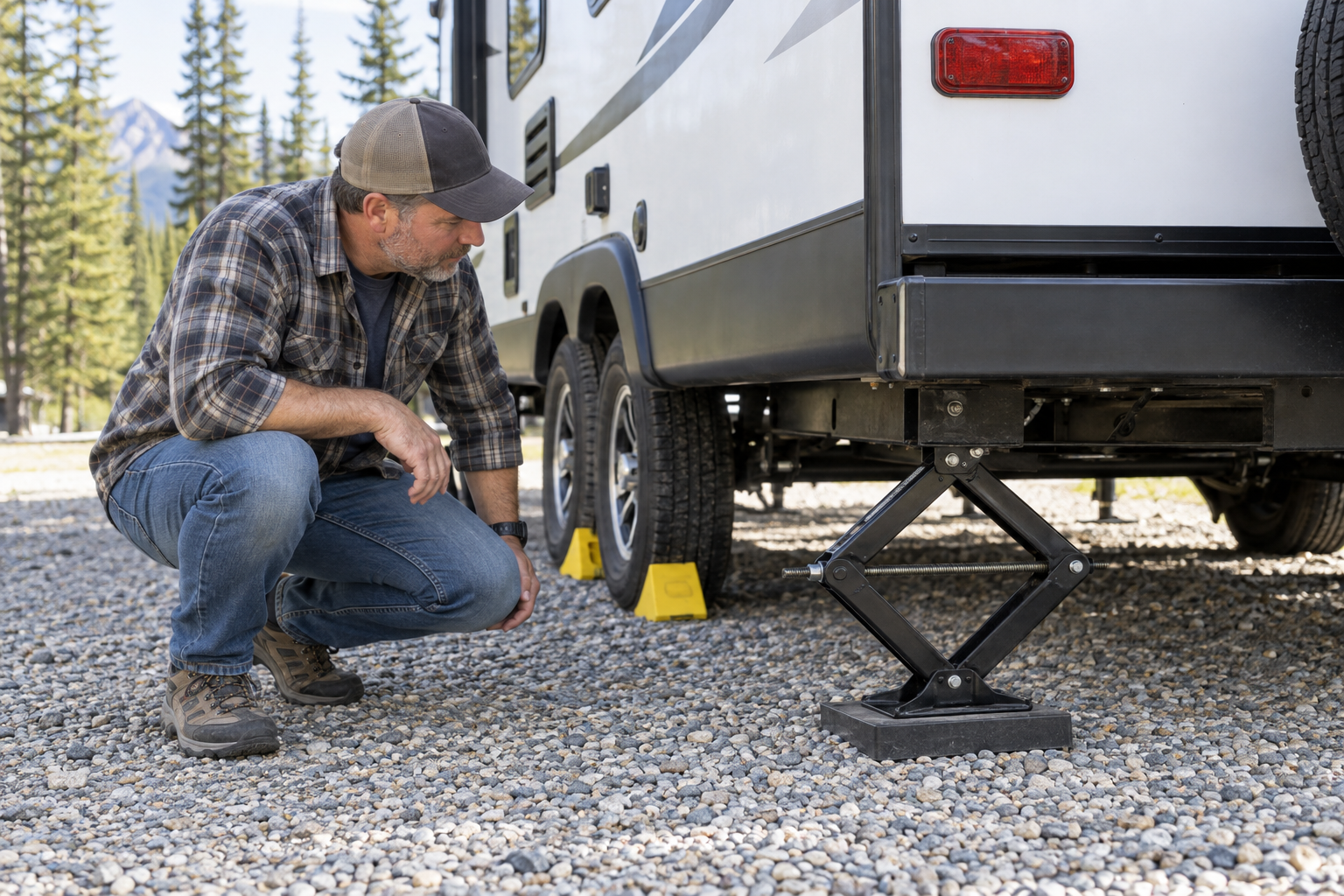
RV levelling jack maintenance matters because these systems make an RV more comfortable, help doors and appliances operate correctly, and reduce movement while people walk inside. Depending on the RV, the system may include manual scissor jacks, electric stabilizers, fifth-wheel landing gear, hydraulic levelling jacks, or a combination of these components.
Although these systems may look similar, they do not all perform the same job. Using a stabilizer as a lifting jack, operating landing gear on unstable ground, or ignoring a hydraulic leak can damage the RV and create a serious safety hazard.
This guide explains how to inspect, maintain, and troubleshoot the most common RV levelling and stabilizer systems. Always follow the instructions for your particular RV and jack system because operating procedures, lubricants, lifting capacity, and emergency-retraction methods vary.
Levelling Jacks and Stabilizer Jacks Are Different
A levelling jack is designed to raise or lower part of an RV so the vehicle can be levelled. Hydraulic motorhome levelling systems and fifth-wheel front landing gear are common examples.
A stabilizer jack is primarily designed to reduce movement after the RV has already been levelled. Most manual scissor jacks and electric stabilizer systems fall into this category.
Unless the manufacturer specifically states otherwise, stabilizer jacks should not be used to:
- Lift an RV for tire or suspension work
- Raise the wheels off the ground
- Correct a severely unlevel campsite
- Support an RV while someone works underneath it
- Carry the full weight of the trailer
- Replace properly rated lifting equipment or jack stands
Trying to level a trailer by extending one stabilizer far enough to lift the frame can bend the jack, damage its mounting brackets, twist the frame, or affect doors and slide-outs.
Level a travel trailer from side to side with approved blocks beneath the tires. Level it from front to back with the tongue jack. Once the trailer is level and the wheels are securely chocked, extend the stabilizers according to the manufacturer’s instructions.
A fifth wheel is normally levelled from side to side with blocks beneath the tires and from front to back with its landing gear. Rear stabilizers are then extended to reduce movement.
Motorhomes equipped with hydraulic or electric levelling jacks may use those systems to level the coach, but only within the limits and procedures established by the manufacturer.
Identify the System Before Servicing It
Before applying lubricant, checking fluid, or attempting a manual override, identify the equipment installed on the RV. Look for a manufacturer and model number on the jack, motor, hydraulic pump, controller, or operating panel.
Common systems include:
- Manual scissor stabilizer jacks
- Manual drop-leg stabilizers
- Electric front or rear stabilizer systems
- Fifth-wheel electric landing gear
- Fifth-wheel hydraulic landing gear
- Motorhome hydraulic levelling jacks
- Motorhome electric levelling jacks
- Automatic levelling systems with electronic controls
Keep a copy of the correct operating and service manual in the RV. A manual-retraction procedure for one system may damage another, even if the components look similar.
Work Safely Around RV Jacks
Park on firm, reasonably level ground before inspecting or operating a jack system. Apply the parking brake when applicable, place the transmission in the position specified by the vehicle manufacturer, and chock the wheels.
Keep people, pets, tools, cords, and loose clothing away from moving jacks and linkages. Watch each jack while it moves whenever possible.
Never crawl underneath an RV that is supported only by its levelling or stabilizer jacks. A hydraulic failure, electrical problem, shifting footpad, soft surface, or accidental control input could allow the RV to drop.
If the RV must be raised for service, use the lifting points and procedures specified by its manufacturer. Support it with properly rated equipment before working underneath it. For more on how we approach RV safety, see our Safety Disclaimer.
Inspect the System Regularly
Inspect the jack system at the beginning of the season, before a long trip, and whenever its operation changes.
Look for:
- Bent jack legs or scissor mechanisms
- Cracked or damaged mounting brackets
- Loose or missing mounting hardware
- Distorted footpads
- Excessive rust or corrosion
- Damaged electrical wiring
- Loose electrical connections
- Worn switches or control panels
- Leaking hydraulic hoses or fittings
- Oil on hydraulic cylinders or beneath the RV
- Uneven extension or retraction
- Abnormal grinding, clicking, or squealing
- Components hanging lower than normal
- Damage caused by road debris or contact with the ground
Check that removable pins and clips are present and fully engaged. Replace damaged retaining hardware with parts of the correct type and rating rather than improvised bolts or wire.
Surface rust may be manageable, but heavy scaling, cracks, bent metal, damaged welds, or elongated mounting holes require professional evaluation.
Manual Scissor-Jack Maintenance
Manual scissor jacks use a threaded screw to open and close the jack. Dirt, road salt, rust, and dried lubricant can increase resistance and accelerate wear.
With the jack unloaded and positioned safely, remove loose dirt from the screw and pivot points. Apply only the lubricant recommended by the jack manufacturer. A dry-film lubricant may be preferred in exposed areas because heavy grease can hold sand and road grit.
Inspect:
- The full length of the screw
- Pivot bolts and rivets
- Mounting plates and welds
- The footpad
- The drive socket
- The scissor arms
Operate the jack through part of its travel and watch for wobbling, binding, or uneven movement. Do not continue forcing a jack that becomes difficult to turn. A bent arm, damaged screw, dry pivot, or misaligned mount may be causing the resistance.
Avoid using a high-torque impact wrench unless the manufacturer permits it. An impact tool can overextend the jack, damage the screw, or apply more force than the mounting structure can withstand.
Extend the jack only until it makes firm contact with the pad and stabilizes the trailer. It does not need to lift the trailer.
Electric Stabilizer Maintenance
Electric stabilizers may use one motor to move both legs through a gearbox, drive screw, and cross-shaft. Other systems use separate motors or independent jacks.
Inspect the motor housing, wiring, connectors, mounting brackets, drive screws, cross-shaft, and both jack legs. Make sure wiring is secured away from moving parts and protected from road debris.
If the system has exposed screws or pivot points, clean and lubricate them only as directed by the manufacturer. Do not spray lubricant into a motor, brake, sealed gearbox, or electrical connector unless the product instructions specifically permit it.
Operate the system while watching both sides. The legs should move smoothly without severe twisting or hesitation. Stop if one side moves while the other remains stationary. Continuing to operate it may damage the cross-shaft, gearbox, drive screw, or mounting brackets.
Fifth-Wheel Landing-Gear Maintenance
Fifth-wheel landing gear supports the front of the trailer and raises or lowers it during hitching and levelling. Because it carries substantial weight, problems should be addressed promptly.
Inspect:
- Both landing-gear legs
- Inner drop legs and adjustment holes
- Footpads
- Retaining pins
- Motor and gearbox
- Cross-shaft and couplers
- Wiring and electrical connections
- Hydraulic hoses and cylinders, if equipped
- Mounting brackets and welds
Remove dirt from exposed inner legs before retracting them. Lubricate the system according to the manufacturer’s instructions. Do not assume that grease intended for a scissor jack is suitable for landing gear.
Make sure both footpads rest on firm, appropriately sized pads. If one pad sinks farther than the other, the fifth wheel can lean and place uneven stress on the landing gear.
If one electric landing-gear leg moves while the other does not, stop operating the system. A failed shear pin, disconnected cross-shaft, damaged gearbox, or internal leg problem may be responsible. Continuing to run the motor can twist the trailer or damage the operating leg.
Hydraulic Levelling-System Maintenance
Hydraulic levelling systems use a pump, reservoir, hoses, valves, and cylinders to raise and support the RV within the system’s rated limits.
Inspect the visible portions of the system for:
- Wet hydraulic fittings
- Cracked, swollen, or chafed hoses
- Damaged cylinders
- Pitted or corroded cylinder rods
- Bent footpads
- Loose mounting hardware
- Fluid beneath the pump or jacks
- Wiring damage near the hydraulic pump
- Abnormal pump noise
A thin film on a cylinder rod does not always mean the system is leaking, but dripping fluid, a wet hose, a growing stain, or a falling reservoir level requires investigation.
Check hydraulic fluid only in the position specified by the manufacturer. Many reservoirs must be checked with all jacks fully retracted, but this is not universal. Adding fluid while the jacks are extended can overfill the reservoir when they retract.
Use only the approved fluid. Mixing incompatible fluids or substituting a thicker product in cold weather may damage seals or affect system performance.
Clean exposed cylinder rods as the manufacturer directs. Do not use abrasive materials that could scratch the polished surface. Dirt or corrosion carried past a seal can cause leakage. For more on suspension and underbody inspection, see our RV Suspension Maintenance guide.
Use Jack Pads on Soft Ground
Even a properly operating jack can sink into soil, gravel, hot asphalt, or thawing ground. Place suitable jack pads beneath the feet to spread the load.
Jack pads should be:
- Large enough for the expected load and surface
- Made from material suitable for the jack system
- Flat and in good condition
- Positioned fully beneath the foot
- Stable before weight is applied
Do not build a tall, unstable stack of loose boards. If substantial blocking is required, reposition the RV or follow the manufacturer’s approved blocking procedure.
Winter conditions require extra caution. A footpad may freeze to the ground or become buried in snow and ice. Clear the area before retracting the jack. Do not keep operating the system if the pad is frozen in place.
Jack Will Not Extend or Retract
If a jack does not move, begin with the simple checks.
Confirm that:
- The RV battery disconnect is on
- The house batteries have adequate voltage
- Battery terminals are clean and secure
- The parking brake or ignition interlock is in the required position
- The system’s fuse is intact
- Any manual-reset circuit breaker has not tripped
- The control panel is powered
- The emergency stop is not engaged
- Wiring connectors are fully seated
Low battery voltage is a common cause of slow operation, relay clicking, controller errors, and hydraulic-pump problems. Measure battery voltage rather than relying only on an interior indicator panel.
If a fuse blows again after replacement, stop. Installing a larger fuse can damage the wiring or create a fire hazard. A motor overload, shorted wire, seized mechanism, failing pump, or internal electrical fault may be present.
Motor Clicks but the Jack Does Not Move
A clicking solenoid or relay usually means the control circuit is attempting to operate, but it does not prove that adequate power is reaching the motor.
Possible causes include:
- Weak batteries
- Corroded battery terminals
- Loose ground connections
- A tripped breaker
- A damaged motor
- A seized screw or gearbox
- An overloaded jack
- A poor high-current cable connection
Stop if the motor, wiring, or breaker becomes hot. Repeatedly pressing the switch can overheat the motor and wiring without correcting the underlying problem.
If an electric stabilizer is under excessive load, relieving that load according to the manufacturer’s procedure may allow it to retract. Do not place yourself beneath the RV or near a component that could move suddenly.
System Moves Slowly or Unevenly
Slow operation may be caused by low voltage, poor electrical connections, cold hydraulic fluid, excessive mechanical resistance, or an overloaded jack.
Uneven movement may indicate:
- One footpad is sinking
- A jack leg is bent
- A drive screw is dirty or damaged
- A cross-shaft or coupler is loose
- A landing-gear shear pin has failed
- One hydraulic cylinder or valve is malfunctioning
- The RV is positioned beyond the system’s operating range
Stop before the frame begins to twist. Retract the system if it can be done safely, reposition the RV, and inspect the equipment.
Hydraulic Jacks Drift Down
A hydraulic jack that slowly extends during travel or retracts while supporting the RV may have an internal or external leak, a valve problem, air in the system, or another hydraulic fault.
Check for visible fluid around the cylinder, hose connections, manifold, pump, and reservoir. Do not place your hands around a pressurized hydraulic leak. High-pressure fluid can penetrate skin and cause a medical emergency.
A jack that will not remain retracted can contact the road and must be addressed before driving. Follow the manufacturer’s approved emergency procedure or have the RV serviced.
Automatic Levelling Errors
Automatic systems depend on proper battery voltage, controller calibration, sensors, and firm ground. An error does not always mean a jack has failed.
Before recalibrating anything:
- Record the error message or flashing-light pattern.
- Confirm battery voltage is adequate.
- Check that all jacks are clear of obstructions.
- Verify the RV is within the system’s allowable starting angle.
- Consult the manual for that exact controller.
Do not recalibrate the level sensor simply because the RV feels unlevel. Incorrect calibration can cause the system to reproduce the wrong position every time it operates.
If automatic levelling tries to lift wheels off the ground, stop and consult the RV and levelling-system instructions. Repositioning the RV or placing approved blocks beneath the tires may be necessary.
Emergency Manual Retraction
Many electric and hydraulic systems include a manual-retraction or override procedure. The procedure may involve a hand crank, drill adapter, valve, pump, solenoid, or controller sequence.
Locate the instructions and required tools before a failure occurs. Store the tools somewhere accessible even when the slides are closed and the jacks are down.
Never guess which hydraulic valve to open or apply a drill to an unidentified shaft. Turning the wrong component can damage the system or cause the RV to move unexpectedly.
After using an emergency override, have the reason for the failure corrected before relying on the system again.
Preparing the Jacks for Storage
Before storing the RV:
- Clean dirt and road salt from exposed components
- Retract the jacks fully unless the manufacturer directs otherwise
- Inspect wiring, hoses, footpads, and mounting brackets
- Lubricate approved points
- Confirm hydraulic jacks remain retracted
- Protect exposed electrical connections as instructed
- Store removable pads clean and dry
- Maintain the batteries needed to operate the system
During long-term storage, inspect periodically for hydraulic drift, corrosion, sinking pads, rodents, and low battery voltage.
RV Levelling Jack Maintenance: Checklist
Before using or servicing the system, confirm:
- You know which jacks level the RV and which only stabilize it.
- The RV is parked on firm ground with the wheels properly chocked.
- Footpads and blocks are stable and correctly positioned.
- Jack legs, screws, brackets, and mounting hardware are undamaged.
- Electrical cables and connectors are secure.
- Hydraulic hoses, fittings, and cylinders are not leaking.
- Battery voltage is adequate.
- Both sides of linked systems move together.
- Jacks retract completely before travel.
- Warning lights turn off as expected.
- Manual-retraction instructions and tools are available.
- No one goes beneath an RV supported only by its jack system.
For a printable version of the maintenance checklist, see our RV Checklists page.
When to Call a Professional
Stop using the system and arrange for qualified service if you find:
- Bent jack legs or stabilizer arms
- Cracked brackets, welds, or frame components
- Repeatedly blown fuses or tripped breakers
- Burnt wiring or overheated motors
- Hydraulic fluid spraying or dripping
- A jack that will not remain retracted
- A hydraulic system that cannot hold the RV
- One landing-gear leg that does not move
- Grinding, severe binding, or metal deformation
- An automatic system that repeatedly operates incorrectly
- Any condition that could allow the RV to fall or shift
Structural damage, internal hydraulic repairs, high-current wiring problems, and major landing-gear failures are not good places for trial-and-error repairs. For help identifying specific problems, see our RV Troubleshooting guides. For more industry safety guidance, see the RV Safety & Education Foundation.
RV Levelling Jack Maintenance: Key Takeaways
RV levelling and stabilizer systems work reliably when they are kept clean, inspected regularly, and used only for their intended purpose. The most important distinction is simple: levelling equipment may be designed to raise part of the RV, while stabilizers usually are not.
Use firm pads, maintain the batteries, inspect mounting points and moving components, and stop when a jack binds, leaks, or moves unevenly. Learning the system’s emergency-retraction procedure before a failure can also prevent a disabled jack from delaying an entire trip.