
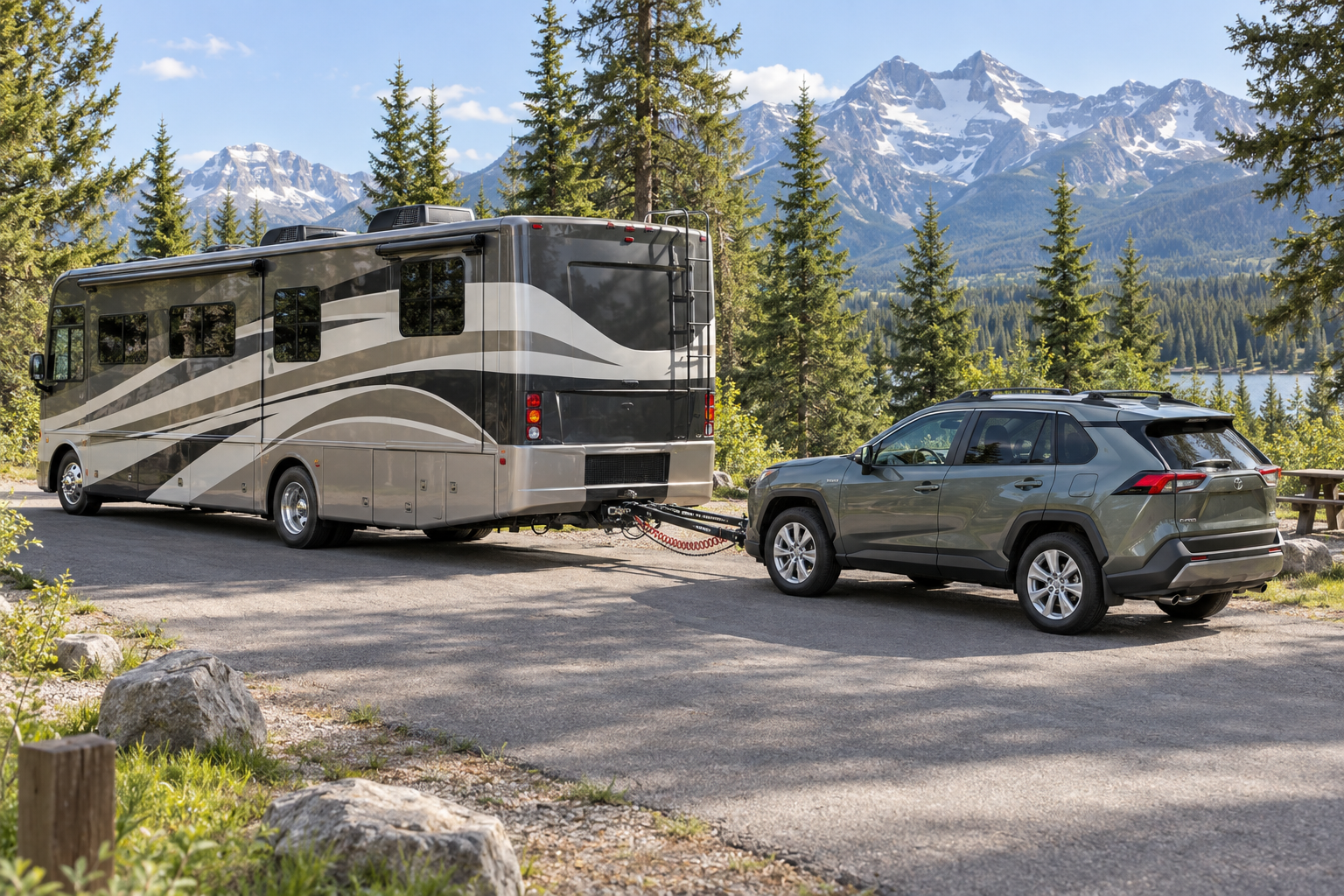
Learning to tow a vehicle behind a motorhome makes local travel easier after you park, but it also changes stopping distance, turning room, loading, and the equipment you must check before leaving. The three common methods—flat towing, a tow dolly, and a car-hauling trailer—have different compatibility requirements. Choose the method that suits your exact vehicle and motorhome rather than assuming any car can be pulled with all four wheels on the ground.
Tow a Vehicle Behind a Motorhome: Choosing Your Method
Flat towing (four wheels down) uses a tow bar attached to a vehicle-specific baseplate, plus safety cables, towing lights, and a supplemental braking system. It can be convenient at a campsite, but the towed vehicle’s manufacturer must explicitly permit recreational four-wheels-down towing for its exact model year, drivetrain, and transmission. The required neutral-tow steps, speed restrictions, battery or fuse procedures, and running requirements vary. Never infer compatibility from another trim or model year.
Tow dolly towing carries one axle of the car. Whether the other axle can roll on the road still depends on the vehicle maker’s instructions. Check the dolly’s capacity, tire and brake requirements, wheel straps, safety chains, and loading procedure. Follow its manual for the vehicle’s parking brake, transmission position, and any steering-wheel requirements; those details are not universal.
Trailer towing carries all four car wheels off the road. It can accommodate vehicles that must not be flat or dolly towed, provided the trailer, motorhome, hitch, and loading equipment are correctly rated. It also adds trailer weight, tongue weight, storage needs, brakes, tires, and tie-downs.
If your vehicle manual disallows a method, do not try to make it work through a general online tip or by simply selecting neutral. Incorrect towing can damage the transmission, transfer case, or driveline. For more on hitch and safety chain inspection, see our RV Hitch, Coupler and Safety Chain Inspection guide.
Verify Every Weight Rating
Find the motorhome’s receiver rating and the limits stated by its manufacturer, including maximum permitted towed load, gross combined weight rating (GCWR), and gross vehicle and axle weight ratings (GVWR and GAWR). Check the tow bar, baseplate, dolly, trailer, coupler, chains or cables, and any adapters for their applicable ratings. The lowest relevant rating controls.
Use actual loaded weights. The car may contain luggage or equipment; a trailer’s empty weight is only part of its total load. For a dolly or trailer, include its own weight and account for tongue weight carried by the motorhome. Weigh the loaded motorhome and the combination at a scale, then compare axle and combined loads with the applicable limits. Do not rely solely on an RV brochure’s headline towing number. For more on weight ratings and loading, see our RV Weight, Loading and Towing Safety guide.
Fit the Equipment Correctly
For flat towing, use a vehicle-specific baseplate and a tow bar approved for that baseplate or for a manufacturer-approved adapter. Inspect mounts, receiver, shank, pins, retainers, tow-bar arms, and attachment tabs for wear or damage. Keep the tow bar within the height range allowed by its manufacturer; an extreme angle can affect handling and stress the connections. Never compensate for a mismatch with unapproved receiver extensions or stacked adapters.
Connect two properly rated safety cables or chains to the secure attachment points specified for the motorhome and towed vehicle. Arrange them according to the equipment manual so they allow full turns without dragging, binding, or contacting sharp edges. Do not clip both ends to parts that could disconnect together.
For a dolly or trailer, use the correct hitch ball and coupler sizes and ratings, lock the coupler, connect safety chains and electrical wiring, and check tire pressure and tie-downs. Follow the dolly or trailer maker’s brake and breakaway-system instructions.
Use Supplemental Braking and Working Lights
A car being flat towed must have a properly installed, adjusted, and functioning supplemental braking system where required by law and by the equipment and motorhome manufacturers. Rules differ by jurisdiction, so verify requirements along your route rather than assuming one province or state sets them all. Supplemental braking also helps manage the added mass; do not treat the motorhome’s own brakes as a substitute for a required system.
Attach the supplemental brake’s breakaway cable to an independent, secure motorhome attachment point as instructed by its manufacturer. Give it enough slack for turns without letting it drag or snag. Confirm the breakaway pin is seated and test the system using the product’s procedure. Do not deliberately pull it while moving to test it.
Check running lights, brake lights, and turn signals at the rear of the towed car or trailer. Confirm that the towed vehicle’s original brake-light operation does not interfere with the installed lighting system. Troubleshoot a failed signal before travel rather than relying on the motorhome’s rear lamps.
Prepare the Vehicle Exactly as Its Manual Directs
Flat towing usually requires a model-specific sequence for the transmission, transfer case, ignition, steering, battery, and parking brake. Perform it in order, check the indicated status, and document the procedure on a card kept with the tow equipment. Verify that the steering is free to follow turns if the vehicle’s instructions require it. Release the parking brake when directed. Some vehicles require periodic engine running or have a towing speed limit; follow those conditions exactly.
After connecting, move forward gently in a safe, open area. Verify that the tow-bar arms lock as designed, the car wheels turn and track correctly, and no cable or brake hose stretches or drags. Stop and recheck the system after a short distance.
Drive With Extra Space
Allow more distance for braking and longer gaps when merging. The motorhome’s rear end may swing outward as a turn begins, while the towed vehicle follows a shorter path around the corner. Check mirrors and cameras for curbs, fuel pumps, signs, cyclists, and nearby vehicles. Avoid sudden steering inputs, especially in crosswinds or on slippery pavement.
Plan exits, fuel stops, and campsites you can enter and leave while travelling forward. Do not back a flat-towed vehicle with a conventional tow bar attached unless the manufacturer specifically approves a procedure for your equipment. Backing can damage the tow bar or force the car’s front wheels sideways. If you miss a turn, continue to a safe place to turn around rather than attempting a quick reverse. A dolly or trailer can often be backed, but only if its manual permits it and the driver can do so safely.
On a downgrade, select a suitable gear and use available engine or exhaust braking as instructed by the motorhome manufacturer. Avoid riding the service brakes. If handling changes, tires heat abnormally, braking becomes inconsistent, or the towed vehicle does not track correctly, stop safely and investigate.
Flat-Towing Pre-Departure Checklist
- The specific car and drivetrain are approved for four-wheels-down towing in the owner’s manual.
- Actual motorhome, car, axle, combined, receiver, tow bar, and baseplate loads are within their ratings.
- Baseplate, receiver, tow bar, attachment pins, and retainers are correctly installed and secured.
- Tow-bar arms are locked and the approved hitch-height range is met.
- Safety cables are attached to secure points and clear the road and turning path.
- The electrical connection has suitable slack and the lights work.
- Supplemental braking works; the breakaway cable and pin are fitted correctly.
- Vehicle-specific neutral-tow, ignition, steering, battery, and parking-brake steps have been followed.
- Tires and wheels on both vehicles are inspected and correctly inflated.
- A low-speed forward check confirms the towed car tracks and steers normally.
For a tow dolly or trailer, substitute its manufacturer-specific loading, coupler, straps or tie-downs, brakes, chains, lights, and breakaway checks. Repeat the walk-around at the first safe stop and at subsequent stops.
When to Stop and Get Help
Do not tow with a cracked baseplate or receiver, a bent or damaged tow bar, missing locking pins, failed lighting, dragging cables, a malfunctioning supplemental brake, a hot wheel, or uncertainty about the vehicle’s towing position. Have the relevant manufacturer or a qualified technician verify the setup. For upkeep of the motorhome itself, see our companion post, Motorhome Maintenance Basics: Chassis, Engine, Brakes, and RV Systems.
The safest towing method is the one approved for the exact car, correctly rated for the actual combined weight, and checked every time the motorhome moves. For more on tire and wheel safety, see our RV Tire Safety guide. For more industry safety guidance, see the RV Safety & Education Foundation.