
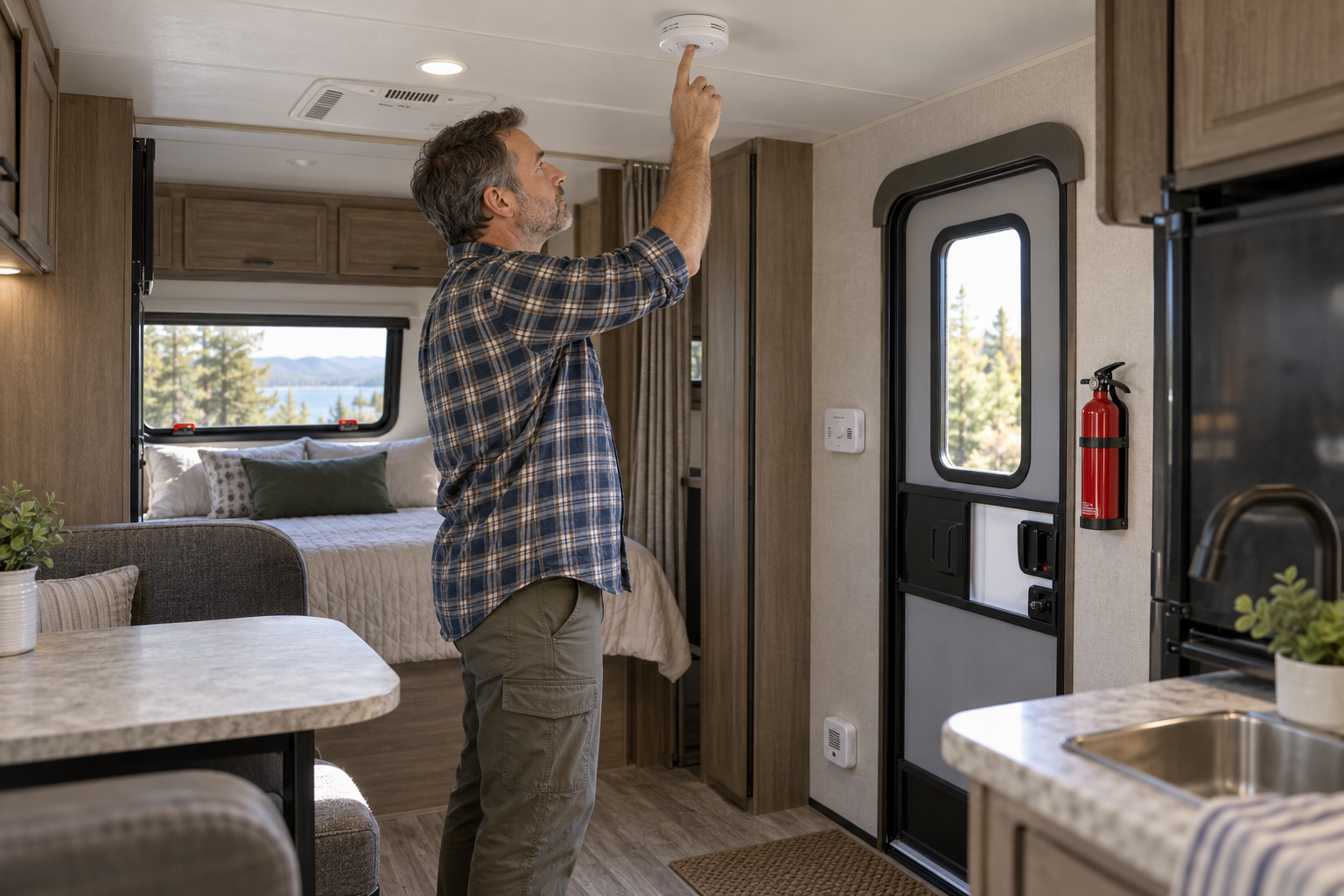
RV fire safety matters because an RV combines fuel-burning appliances, electrical equipment, batteries, cooking facilities, and confined sleeping areas in a relatively small space. If smoke, propane, or carbon monoxide enters the living area, conditions can become dangerous quickly.
Working alarms, an accessible fire extinguisher, and a practised escape plan provide critical protection. These devices require regular inspection, and most alarms have a limited service life even if they still respond when the test button is pressed.
This guide covers basic owner-level inspections and emergency planning. Always follow the instructions printed on each alarm, extinguisher, appliance, and RV. Installation requirements, replacement intervals, and approved locations vary by product and jurisdiction.
Know What Each Alarm Detects
RVs commonly contain three different types of safety alarms. They perform separate functions and should not be treated as interchangeable.
A smoke alarm responds to particles produced by a fire. Depending on its sensing technology and location, it may react differently to fast-flaming and smouldering fires.
A carbon-monoxide alarm detects carbon monoxide, an invisible and odourless gas produced by incomplete combustion. Possible sources include furnaces, water heaters, generators, engines, portable heaters, cooking appliances, and equipment operating near the RV.
A propane-gas alarm detects propane that has entered the living area. Propane is heavier than air, which is why an RV propane alarm is commonly installed near the floor. Its location must follow the alarm and RV manufacturers’ requirements.
Some units combine two alarm functions, but one combination device does not automatically replace every alarm required by the RV manufacturer. Check the label to confirm exactly what each unit detects.
Find and Record Every Alarm
Locate every smoke, carbon-monoxide, and propane alarm in the RV. Record the following information:
- Alarm type
- Manufacturer and model
- Manufacturing or installation date
- Replacement or end-of-life date
- Power source
- Battery type, if replaceable
- Test procedure
- Meaning of each warning signal
- Location in the RV
The alarm may use a sequence of chirps, indicator lights, display messages, or spoken alerts to distinguish an emergency from a low battery, sensor fault, or end-of-life warning.
Keep the instructions with the RV records. If the manual is missing, obtain the correct instructions using the exact manufacturer and model number rather than relying on directions for a similar-looking alarm.
Test the Alarms Regularly
Use the alarm’s test button and follow its instructions. Test every alarm before the beginning of the camping season, before an extended trip, after the RV has been stored, and at the interval specified by the manufacturer.
Many safety authorities recommend monthly testing for residential smoke and carbon-monoxide alarms. The RV alarm manufacturer may specify additional testing because an RV is exposed to vibration, temperature changes, dust, humidity, and periods without power.
During the test:
- Warn everyone nearby that an alarm will sound.
- Confirm the RV has the power required by the alarm.
- Press and hold the test button as instructed.
- Listen for the complete alarm pattern.
- Confirm any indicator lights or display messages operate.
- Check interconnected devices if the system includes them.
- Investigate any alarm that fails, sounds weak, or displays a fault.
A test button generally confirms that portions of the device’s electronics and sounder work. It does not extend the sensor’s service life or override an end-of-life warning.
Do not test a smoke alarm with an open flame. Do not release propane, engine exhaust, cigarette smoke, or another hazardous substance inside the RV to test an alarm. Use only an approved test method identified by the manufacturer.
Never Disable an Alarm to Stop Nuisance Alerts
Cooking vapour, shower humidity, dust, aerosols, and a weak battery can sometimes trigger or disturb an alarm. Do not solve repeated alarms by removing the battery, disconnecting the wiring, covering the sensor, or relocating the device without approval.
First determine whether the alarm is warning of a genuine hazard. Ventilate only after everyone is safe and the source has been evaluated. Clean the alarm and correct its location only as the manufacturer permits.
If cooking regularly activates the smoke alarm, use the range hood, open an appropriate vent, and avoid leaving food unattended. Do not remove the smoke alarm while cooking.
A repeated propane or carbon-monoxide alarm requires immediate attention. Treat it as real until the RV and its appliances have been checked.
Replace Batteries Correctly
Replace user-serviceable batteries with the exact type specified by the manufacturer. Do not mix old and new batteries or substitute a different voltage, size, or chemistry.
After installing a battery:
- Confirm its orientation.
- Close the battery compartment securely.
- Test the alarm.
- Record the replacement date.
- Dispose of the old battery appropriately.
Some alarms use sealed batteries that are not intended to be replaced. When the sealed battery reaches the end of its service life, replace the complete alarm according to its instructions.
Hardwired alarms may still contain a backup battery. Disconnecting shore power does not necessarily disable them, and restoring power does not correct a dead backup battery or expired sensor.
Understand Alarm Service Life
Safety alarms do not last indefinitely. The sensor can reach the end of its rated life even if the casing looks new and the test button still produces a sound.
Smoke alarms are often replaced after approximately ten years, but the date printed on the device and the manufacturer’s instructions control. Carbon-monoxide and propane alarms can have different, sometimes shorter, service lives depending on their sensors and designs.
Check for:
- A printed replacement date
- Manufacturing date
- End-of-life light or display message
- A chirp pattern identified as an end-of-life warning
- Discolouration, cracks, contamination, or physical damage
Replace an alarm when it reaches its stated replacement date, gives an end-of-life signal, fails a test, has been damaged, or no longer operates reliably. Do not install a household device in an RV unless it is approved for that environment and application.
Write the replacement date where it can be found easily and add it to the RV maintenance calendar.
Keep Alarms Clean and Unobstructed
Dust, insects, grease, paint, and cleaning residue can affect an alarm. Inspect its openings without removing covers or entering sealed components.
Clean the alarm only as directed by its manufacturer. Some permit gentle vacuuming around the openings, while others specify a different method.
Do not:
- Paint an alarm
- Spray cleaner or lubricant into it
- Cover it with decorations
- Block it with bedding or stored belongings
- Install a cabinet or curtain over it
- Place tape over the sounder
- Move it to a more convenient location without approval
Maintain clearance around each device. Check the alarms after storage because insects, dust, and moisture can enter an unused RV.
Respond to a Smoke Alarm
If a smoke alarm sounds or anyone sees or smells smoke:
- Alert everyone in the RV.
- Leave immediately using the nearest safe exit.
- Help children, guests, and anyone requiring assistance.
- Move a safe distance from the RV.
- Call emergency services.
- Do not re-enter the RV.
Do not delay evacuation to search for the fire or collect belongings. Smoke can obstruct the narrow route to the entry door rapidly.
If the exit is blocked, use the designated emergency exit. Once outside, remain outside until emergency personnel determine that it is safe to return.
Respond to a Carbon-Monoxide Alarm
Carbon monoxide cannot be identified by smell, sight, or taste. Symptoms can include headache, dizziness, nausea, weakness, confusion, chest discomfort, or unusual fatigue, but an alarm may sound before anyone notices symptoms.
When a carbon-monoxide alarm activates:
- Move everyone into fresh air immediately.
- Call emergency services or the appropriate local emergency number.
- Seek medical assistance for anyone experiencing symptoms.
- Do not re-enter the RV until it has been evaluated and declared safe.
- Have the suspected appliance or source inspected before using it again.
Do not silence the alarm and go back to sleep. Opening a window does not prove that the source has been corrected.
Remember that carbon monoxide can enter from outside. A neighbouring generator, an idling vehicle, or the RV’s own generator exhaust can enter through windows, roof vents, doors, or floor openings. For more on propane and CO safety, see our RV Propane System and Appliance Safety guide.
Respond to a Propane Alarm or Propane Odour
If the propane alarm sounds or propane is suspected:
- Do not operate switches, appliances, phones, or anything else inside the RV that could produce a spark.
- Extinguish open flames only if it can be done immediately and safely.
- Evacuate everyone from the RV.
- Shut off the propane supply at the container only if it is safe to approach and you know how.
- Move away from the RV.
- Contact emergency services, the propane supplier, or a qualified RV technician.
- Do not return or restore the propane supply until the system has been inspected.
Propane is deliberately odorized, but a person’s ability to smell it can be reduced by illness, sleep, age, medication, or prolonged exposure. Rust, water, and other materials may also reduce the strength of the odour. A working propane alarm remains essential.
Inspect the Fire Extinguisher
Most RVs carry at least one portable fire extinguisher near the entry door. It should be visible, secured against travel movement, and reachable without moving toward a fire.
Follow the extinguisher manufacturer’s inspection instructions. Check:
- The extinguisher is approved for the hazards and location.
- The pressure gauge or indicator is in its operable range, if equipped.
- The safety pin is present.
- The tamper seal is intact.
- The hose or nozzle is unobstructed.
- The handle and body are undamaged.
- There is no severe rust, corrosion, leakage, or residue.
- The label remains readable.
- The mounting bracket holds it securely.
- The service or replacement date has not passed.
Some extinguishers are rechargeable and require periodic professional servicing. Others are disposable and must be replaced after use, damage, loss of pressure, or the manufacturer’s stated service life.
An extinguisher that has discharged even briefly may not retain enough agent or pressure for future use. Have it serviced or replaced.
Know When to Use an Extinguisher
A portable extinguisher is intended for a small, contained fire—not for fighting a fire that is spreading through an RV.
Attempt to use one only when:
- Everyone else is leaving or has left.
- Emergency services have been called.
- The fire is small and contained.
- Smoke is not filling the RV.
- The correct extinguisher is available.
- You have a clear escape route behind you.
- You know how to operate the extinguisher.
Use the method printed on the extinguisher. A common approach is to pull the pin, aim at the base of the fire, squeeze the handle, and sweep from side to side. Follow the product’s actual directions.
If the fire does not go out immediately, the extinguisher empties, smoke increases, or the escape route becomes threatened, leave at once. RV construction materials and stored fuels can allow fire to spread quickly.
Never allow an extinguisher to create false confidence. Evacuation remains the priority.
Inspect Emergency-Exit Windows
Sleeping areas commonly have a designated emergency-exit window. It may use red handles, latches, or identification labels.
Locate every emergency exit and confirm that everyone travelling in the RV knows where it is. Inspect:
- Handles and latches
- Hinges
- Screens
- Window seals
- Identification labels
- Clearance inside and outside
- Furniture or belongings beneath the opening
- Any retaining prop or release mechanism
Open the emergency exit only according to its manufacturer’s instructions. Some screens or window assemblies can fall, detach, or be difficult to reinstall. Support the window when required and avoid damaging the seal or hinge.
Never block an emergency exit with pillows, clothing, storage containers, or permanently installed accessories. Keep the path from each sleeping position to an exit clear.
An emergency window can be high above the ground. Consider how each occupant would exit and move away without returning for a ladder or other equipment stored elsewhere.
Practise an RV Escape Plan
An RV fire may block the main entry door, so every occupant should know an alternate route.
Before a trip:
- Identify the primary and secondary exits.
- Explain how the emergency window operates.
- Choose a meeting place away from the RV.
- Assign an adult to assist children or anyone with limited mobility.
- Decide who will call emergency services.
- Keep footwear and essential mobility aids accessible.
- Confirm pets can be released without delaying evacuation.
- Practise moving toward the exits in low light.
A practise session does not need to include climbing out of a high window if doing so could cause injury. Occupants should still operate or review the release mechanism as appropriate and discuss how the exit would be used.
Once outside during a real fire, do not return for pets, belongings, propane valves, or firefighting equipment.
Reduce Cooking Fires
Cooking is a common source of RV smoke and fire. The limited counter space and nearby combustible surfaces increase the importance of careful habits.
When cooking:
- Remain in the RV and attend the appliance.
- Keep towels, paper products, packaging, and curtains away from heat.
- Turn pan handles inward without placing them over another burner.
- Clean grease from the range, hood, and surrounding surfaces.
- Use the exhaust fan.
- Confirm burners are off after use.
- Allow appliances to cool before installing travel covers.
- Keep children and pets away from hot surfaces.
Never apply water to a grease fire. If a small pan fire occurs and it can be done safely, turn off the heat and cover the pan with a suitable metal lid. Do not carry a burning pan outside.
If there is any doubt, evacuate and call emergency services.
Use Fuel-Burning Appliances Safely
Operate furnaces, water heaters, refrigerators, ranges, and other fuel-burning equipment only as their manufacturers direct.
Keep exterior vents and exhaust openings clear of debris, snow, insect nests, and stored items. Do not modify appliance vents or use the RV if an exhaust system is damaged.
Never use the range or oven to heat the RV. Do not operate a portable fuel-burning heater inside unless it is specifically approved for the location and used exactly as directed.
Have an appliance inspected if it produces soot, unusual odours, delayed ignition, repeated shutdowns, abnormal flame appearance, or evidence of overheating.
Prevent Electrical Fires
Inspect shore-power cords, plugs, adapters, inlets, extension cords, outlets, and electrical-management equipment for heat damage, looseness, corrosion, and discolouration.
Stop using an electrical connection if it becomes hot, buzzes, smells burnt, trips repeatedly, or shows melted material. Do not bypass a breaker, fuse, ground connection, or protective device.
Use replacement fuses with the specified type and rating. A larger fuse does not correct an overloaded or damaged circuit; it can allow wiring to overheat.
Keep combustible items away from converters, inverters, batteries, transfer switches, breaker panels, and other equipment that requires ventilation. Do not use electrical compartments as general storage spaces. For more on how your RV’s electrical system works, see our Understanding RV Electrical Systems guide
Manage Battery and Charging Risks
Battery installations should remain secure, ventilated where required, and protected from accidental short circuits. Inspect cables, terminals, fuses, disconnects, and hold-downs.
Look for:
- Loose or damaged cables
- Corroded terminals
- Swollen or cracked battery cases
- Overheating
- Melted insulation
- Unusual odours
- Improvised connections
- Combustible material stored against electrical equipment
Use charging equipment compatible with the battery type. Lead-acid and lithium batteries have different requirements and hazards. Do not change battery chemistry without confirming that the converter, inverter/charger, solar controller, wiring, overcurrent protection, and battery-management system are suitable.
A hot, swollen, smoking, or hissing battery requires immediate action. Move away, contact emergency services when appropriate, and do not touch or disconnect it unless trained to do so safely. For more on battery testing and care, see our RV Battery Maintenance guide.
Operate Generators With Exhaust in Mind
Never operate a portable generator inside an RV, compartment, garage, enclosed shelter, or beneath an enclosed awning. Position it outdoors according to the generator manufacturer’s instructions, with exhaust directed away from the RV and neighbouring campsites.
Keep generator exhaust away from:
- Open windows
- Doors
- Roof vents
- Furnace and water-heater openings
- Air-conditioner openings
- Slide-out seals
- Other occupied RVs
Do not assume that closing one nearby window eliminates the danger. Wind can redirect exhaust, and carbon monoxide can enter through openings that are not obvious.
Inspect a built-in generator’s exhaust system and mounting before use. Stop operation if exhaust components are damaged or fumes enter the RV.
RV Fire Safety: Complete Check
Before each trip and periodically while the RV is occupied, confirm:
- Smoke, carbon-monoxide, and propane alarms are present.
- Every alarm passes its manufacturer-approved test.
- No alarm is expired, damaged, disconnected, covered, or displaying a fault.
- Replacement dates are recorded.
- Spare replaceable batteries are available.
- The fire extinguisher is accessible and secured.
- Its pressure indicator, pin, seal, hose, and body are serviceable.
- Everyone knows the primary and secondary exits.
- Emergency windows are identified and unobstructed.
- Cooking and heating appliances are clean and operating normally.
- Exterior appliance vents and exhaust openings are clear.
- Shore-power equipment shows no heat damage.
- Battery compartments are secure and free of combustible storage.
- Generator exhaust cannot enter the RV or nearby occupied spaces.
- The campground address, site number, and emergency contact information are available.
Repeat the alarm and exit checks whenever new guests stay in the RV. For a printable version of the maintenance checklist, see our RV Checklists page.
When the RV Should Not Be Occupied
Do not sleep in or continue using the RV when:
- A required alarm is missing, expired, disconnected, or inoperative.
- A propane or carbon-monoxide alarm has activated and the cause is unknown.
- Propane can be smelled.
- Soot or exhaust fumes are entering the living area.
- A fuel-burning appliance is malfunctioning.
- Wiring, outlets, plugs, batteries, or electrical equipment are overheating.
- A fire extinguisher is discharged, damaged, or inaccessible.
- Emergency exits are blocked or cannot be opened.
- Fire or smoke damage has not been professionally evaluated.
Correct the problem before the RV is occupied again.
Fire-safety equipment is easy to overlook because it usually remains quiet. That silence is useful only when every alarm is within its service life, every exit works, and every occupant knows what to do when a warning sounds. Regular testing and a simple escape plan can prevent a minor incident from becoming a tragedy. For more industry safety guidance, see the RV Safety & Education Foundation.