
RV boondocking power is one of the most important things to understand before camping without electrical, water, or sewer hookups. Boondocking opens up remote campsites, reduces campground costs, and lets you stay in places that are otherwise inaccessible.
But boondocking also demands that you understand and manage your power. Without hookups, every light, fan, and appliance draws from the battery bank. Managing that supply well is the difference between a comfortable week off-grid and a dead battery on day two.
This guide explains the basics of RV boondocking power: how the system works, what draws power, how to conserve it, and how to size a system for your needs. It is not a substitute for the manufacturer’s manuals, but it helps you understand the system and make better decisions.
What Powers an RV When Boondocking
When you’re not connected to shore power, the RV’s 12-volt DC system becomes the primary power source. It runs on the house battery bank and supplies:
- Interior and exterior lights
- Water pump
- Furnace blower and controls
- Vent fans
- Refrigerator control board
- Safety detectors
- USB outlets
- Awning and slide-out motors
- Tank monitors
- Thermostat and control systems
The 12-volt system does not directly power 120-volt AC appliances like a microwave, air conditioner, or residential refrigerator. Those require an inverter, a generator, or a substantial battery-and-inverter system.
Most RVs also have a converter that charges the batteries when connected to shore power or a generator. When boondocking, the converter is not producing power — the batteries are being drained. Because every device draws from the same battery bank, understanding consumption matters.
The Core Components
House batteries. Store energy for the 12-volt system. Typically lead-acid, AGM, or lithium. The battery bank’s capacity determines how long you can stay off-grid.
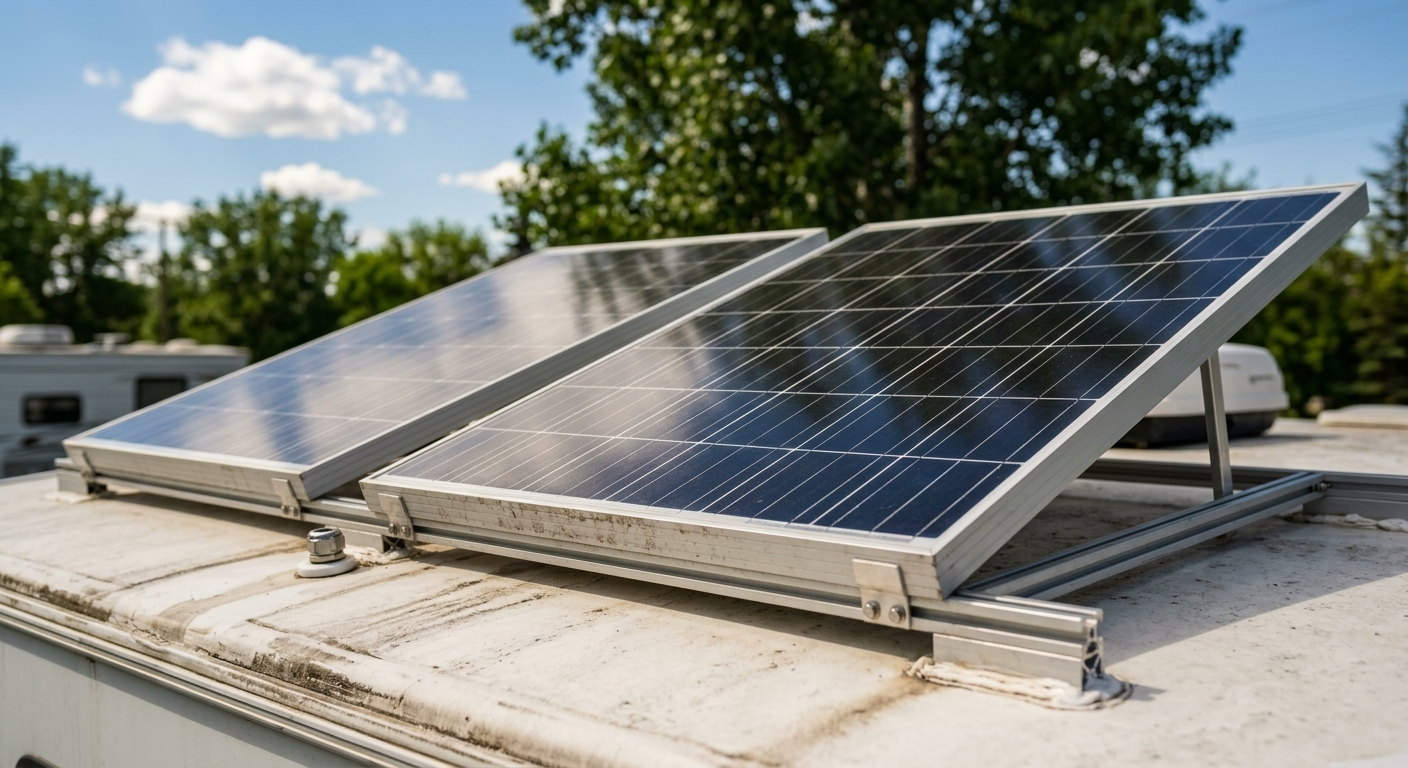
Solar panels. Produce DC electricity from sunlight. A solar charge controller regulates that power into the batteries.
Charge controller. Regulates charging from the solar panels and protects the batteries from overcharging.
Inverter. Converts 12-volt DC power into 120-volt AC power for specific appliances.
Generator (optional). Produces 120-volt AC power and charges the batteries when solar is insufficient.
Battery monitor. Tracks current flowing in and out of the battery bank, providing an accurate state-of-charge reading.
Understanding how these components work together is the key to a reliable boondocking system. If any one component is undersized, the whole system underperforms.
How Much Power Do You Actually Use?
Before sizing a system, estimate what you use.
Typical 12-volt loads:
| Device | Approximate draw |
|---|---|
| LED interior light | 0.3–1.5 A |
| Water pump | 5–10 A (intermittent) |
| Furnace blower | 5–10 A (when running) |
| Vent fan | 1–3 A |
| Refrigerator control board | 0.2–0.5 A |
| Propane detector | 0.1 A |
| USB outlet | 0.5–2 A |
Typical 120-volt loads (through an inverter):
| Device | Approximate draw from 12V battery |
|---|---|
| TV | 5–10 A |
| Laptop charger | 5–10 A |
| Microwave (brief use) | 100–150 A |
| Coffee maker | 80–120 A |
| Hair dryer | 100–150 A |
| Air conditioner | 100–150 A (continuous) |
The 120-volt loads are where most boondocking systems get overwhelmed. A microwave may be within the inverter’s rating but still drain the battery bank quickly.
Estimate your daily use:
- List every 12-volt device you use.
- Note how many hours per day.
- Multiply amps × hours to get amp-hours.
- Add 120-volt appliances converted through an inverter (amps × hours, plus inverter losses).
That total — in amp-hours per day — tells you how much battery capacity you need. Before sizing a system, estimate consumption so the components match your actual needs.
Battery Capacity and Depth of Discharge
Battery capacity is measured in amp-hours. A 100 Ah battery can theoretically supply 1 amp for 100 hours.
But not all capacity is usable.
- Lead-acid (flooded or AGM): usable capacity is roughly 50% of rated. Discharging below 50% shortens battery life.
- Lithium (LiFePO4): usable capacity is typically 80–90% of rated.
So a 200 Ah lead-acid bank provides about 100 Ah of usable capacity. The same physical size in lithium might provide 180 Ah usable.
Example:
If you use 60 amp-hours per day:
- A lead-acid bank would need roughly 120 Ah rated capacity for one day, or 240 Ah for two days.
- A lithium bank would need roughly 70 Ah rated for one day, or 140 Ah for two days.
Real-world use is usually higher than estimates. Plan for margin. Because lead-acid batteries provide only about half their rated capacity, plan for more storage than a lithium system would require. For more on battery types and care, see our RV Battery Maintenance guide.
Solar: How Much Do You Need?
Solar output depends on:
- Panel wattage
- Sunlight hours per day
- Panel angle and shading
- Season and latitude
- Panel temperature
- Charge controller efficiency
Rule of thumb: A solar panel produces roughly 4–6 hours of equivalent full output per day in most North American locations, depending on season and conditions.
So a 400-watt solar array might produce roughly 1,600–2,400 watt-hours per day — about 130–200 amp-hours at 12 volts, minus system losses.
For a modest boondocking setup:
- 200 watts — maintains batteries, light use
- 400 watts — typical two-person setup with modest appliance use
- 600–800 watts — heavier use, including some 120-volt appliances through an inverter
- 1,000+ watts — larger systems, higher-demand appliances
Panels should be:
- Mounted where they receive direct sunlight
- Angled toward the sun if adjustable
- Kept clean
- Not shaded by vents, antennas, or AC units
Even partial shade on one panel can reduce the whole array’s output. If panels are shaded or dirty, output drops significantly and the batteries may not recharge fully. For more on solar systems, see our RV Solar Charging System guide.
Inverter Size
The inverter converts 12-volt DC to 120-volt AC. It must be sized for the appliances it will run.
Check:
- Continuous rating — wattage it can supply indefinitely
- Surge rating — brief higher output for motor or compressor startup
A 1,000-watt inverter may run a TV, laptop, and small appliances. A 2,000-watt inverter may run a microwave or coffee maker briefly. An air conditioner usually requires 2,000–3,000 watts or more, plus a large battery bank.
Key point: The inverter’s wattage does not determine how long you can run appliances. The battery bank does. Although a large inverter can run high-demand appliances, the battery bank must be able to support the load.
For more on how inverters and converters differ, see our RV Converter vs Inverter guide.
What Boondocking Can and Cannot Power
Easily powered:
- LED lights
- Water pump
- Vent fans
- Furnace (short cycles in mild weather)
- Phone and laptop charging
- Small electronics
- Refrigerator control board
Powered with attention:
- TV
- Coffee maker (briefly)
- Microwave (briefly)
- Hair dryer (briefly)
- Small blender or appliance
Difficult or impossible without a large system:
- Air conditioner (requires large battery bank + inverter + generator or substantial solar)
- Electric water heater
- Electric space heater
- Residential refrigerator for extended periods
- Induction cooktop
If air conditioning is essential, most boondockers use a generator or avoid hot climates.
Conserving Power While Boondocking
Conservation is often more effective than adding capacity.
Lighting:
- Use LED lights
- Turn off lights in unused areas
- Use battery-powered lanterns for outdoor light
Heating:
- Use the propane furnace efficiently (it uses 12-volt power for the blower)
- Improve insulation and seal air leaks
- Use blankets and warm clothing before turning up the heat
- Avoid electric space heaters
Refrigeration:
- Run the refrigerator on propane if it’s an absorption model
- Keep the door closed
- Pre-chill food before boondocking
- Avoid opening the refrigerator unnecessarily
Water:
- Use less water to reduce pump use
- Take shorter showers
- Use the sink sparingly
Electronics:
- Charge devices during peak solar hours
- Use DC chargers instead of AC adapters where possible
- Turn off devices rather than leaving them in standby
Cooking:
- Cook with propane, not electricity
- Use the stovetop instead of the microwave
- Cook outside when practical
Small habits add up. A modest system can support longer stays when use is managed carefully. Because small habits add up, conservation often works better than adding capacity.
Monitoring Your System
A battery monitor is one of the most valuable additions to a boondocking system. It tracks:
- Current flowing into and out of the battery bank
- State of charge (as a percentage)
- Amp-hours consumed
- Time remaining at current draw
A simple voltage reading is not enough. Voltage drops under load and rises during charging, which makes it unreliable for estimating state of charge.
Target state of charge:
- Lead-acid: recharge before dropping below 50%
- Lithium: recharge before dropping below 20%
- Ideally, top up daily with solar
If you are consistently discharging below these levels, you need more capacity, more solar, or less consumption.
Generator Use
A generator is useful when solar cannot keep up — during cloudy weather, in heavy use, or when running high-demand appliances.
Use a generator to:
- Recharge batteries when solar is insufficient
- Run the air conditioner or other high-demand appliances briefly
- Provide backup power during extended cloudy periods
Generator limitations:
- Requires fuel
- Produces noise and exhaust
- Requires maintenance
- Not permitted in all locations
- Cannot be run inside or in enclosed spaces
Never operate a generator inside an RV, garage, or enclosed area. Carbon monoxide is a serious hazard. If solar cannot keep up, a generator provides backup until conditions improve. For generator care and safety, see our RV Generator Maintenance and Troubleshooting guide.
Planning a Boondocking System
When planning a system, work backward from your needs:
- Estimate daily amp-hour use.
- Decide how many days you want to stay off-grid.
- Calculate required battery capacity (accounting for usable capacity).
- Calculate required solar output to recharge daily or over several days.
- Size the inverter for the largest loads you will run.
- Consider a generator for backup or high-demand use.
- Add a battery monitor to track performance.
Do not buy components in isolation. A large solar array with a small battery bank will not provide more usable power. A large inverter with a small battery bank will drain it quickly.
The system must be balanced: generation, storage, and consumption must match.
Safety Considerations
Boondocking power systems involve real hazards.
- Batteries can deliver enormous current. Never short terminals.
- High-current cables must be properly sized and fused.
- Inverters produce dangerous AC voltage. Do not open them.
- Solar panels produce voltage whenever light reaches them. Cover them when working on wiring.
- Ventilation is required for flooded lead-acid batteries.
- Lithium batteries require compatible charging equipment and low-temperature protection.
- Generators produce carbon monoxide. Never operate inside or near openings.
If you are unsure about wiring, fusing, or system design, consult a qualified RV electrician or solar installer. If you are unsure about wiring or fusing, consult a qualified RV electrician before installing anything. For more industry safety guidance, see the RV Safety & Education Foundation.
RV Boondocking Power: Checklist
Before a boondocking trip, confirm:
- House batteries are fully charged.
- Battery terminals are clean and tight.
- Solar panels are clean and unobstructed.
- Charge controller shows normal operation.
- Inverter is off if not needed.
- Battery monitor shows expected state of charge.
- Propane supply is adequate for furnace and cooking.
- Water tank is full and holding tanks are empty.
- Generator (if carried) has fuel and runs correctly.
- High-demand appliances are limited to what the system can support.
- You have a plan for cloudy weather and heavy use.
RV Boondocking Power: Key Takeaways
Boondocking power comes down to matching three things: how much you generate, how much you store, and how much you use. Get those in balance, and you can stay off-grid comfortably for days or weeks.
Solar is the most common source of power while boondocking, but it is not the only one. A well-designed system combines solar, adequate battery capacity, an inverter sized for your needs, and — where necessary — a generator for backup.
Start with honest estimates of your consumption, plan for margin, and monitor your system regularly. Boondocking rewards preparation.