
RV appliance maintenance matters because these units operate in a demanding environment. They endure vibration, temperature changes, dust, moisture, storage, uneven campsites, changing electrical supplies, and frequent movement. Some appliances use propane, electricity, or both, while others depend on the RV’s plumbing and ventilation systems.
Regular cleaning and inspection can prevent many problems, but internal propane, combustion, refrigerant, and high-voltage repairs require qualified service. Always identify the appliance and follow its manufacturer’s instructions before performing maintenance.
Stop using any appliance that produces a propane odour, soot, smoke, sparks, overheated wiring, an abnormal flame, a recurring fault, or an unexplained fluid leak.
Record Appliance Information
Create a list containing the manufacturer, model number, serial number, fuel type, and manual for each appliance.
Common RV appliances include:
- Refrigerator
- Range and oven
- Microwave
- Furnace
- Air conditioner or heat pump
- Water heater
- Washer and dryer
- Dishwasher
- Ice maker
- Fireplace
- Vent fans
Model and serial labels may be inside doors, behind access panels, beneath covers, or on exterior service compartments. Photograph the labels and keep the information with the RV records.
Exact model information is essential when ordering filters, seals, control boards, burners, heating elements, and other replacement parts.
General Appliance Safety
Before cleaning or inspecting an appliance:
- Turn it off
- Allow hot components to cool
- Disconnect electrical power when instructed
- Shut off propane when required
- Keep ignition sources away
- Use only approved cleaners and replacement parts
- Maintain required ventilation openings
- Keep children and pets away from the work area
Do not remove a cover simply because it is accessible. Some compartments contain live electrical connections, gas fittings, capacitors, hot surfaces, sharp metal, or moving parts.
Never bypass a detector, fuse, breaker, thermal limit, flame sensor, ventilation requirement, or safety switch. Because appliance repairs can involve propane, electricity, or both, stop and seek qualified help when uncertain.
Electrical Supply
Many apparent appliance failures begin with the RV’s electrical supply. Before assuming an appliance is defective, confirm that the RV has the correct power source and adequate voltage.
Check:
- Shore-power connection
- Pedestal breaker
- RV main breaker
- Branch-circuit breaker
- GFCI receptacles
- Battery state of charge
- Battery disconnect switch
- Applicable fuses
- Inverter or energy-management status
- Appliance controls and operating mode
A microwave, air conditioner, fireplace, or electric water-heater element can draw substantial power. Operating several high-demand appliances at once may exceed the available service.
Do not repeatedly reset a breaker that continues to trip. Recurring trips may indicate an overloaded circuit, damaged wiring, loose connection, or appliance fault. If an appliance loses power, confirm the source before assuming the unit has failed.
Propane Supply
Propane appliances depend on proper pressure, airflow, ignition, combustion, and exhaust.
Stop immediately if you smell propane. Do not operate electrical switches, create a flame, or attempt to locate the leak with a match or lighter. Leave the RV, shut off the propane supply only if it can be done safely, and arrange qualified service.
Inspect accessible appliance vents for soot, heat damage, insect activity, and obstructions. Never seal or cover a combustion-air opening or exhaust vent.
Propane-system pressure testing and internal gas-valve repairs should be completed by a qualified RV propane technician. If you smell propane, leave the RV and do not operate any switches.
RV Refrigerator Maintenance
Identify whether the refrigerator is an absorption or compressor model, follow its manual, keep the door gasket and travel latch sound, and verify food-compartment temperature with a thermometer. A powered display does not prove that food is cold enough.
For ventilation, levelling, cooling faults, storage care, and the safe owner-level checks, see RV Refrigerator Maintenance and Troubleshooting Basics. Stop using a unit with soot, heat damage, an ammonia-like odour, or yellow residue, and arrange qualified service.
Range and Oven Maintenance
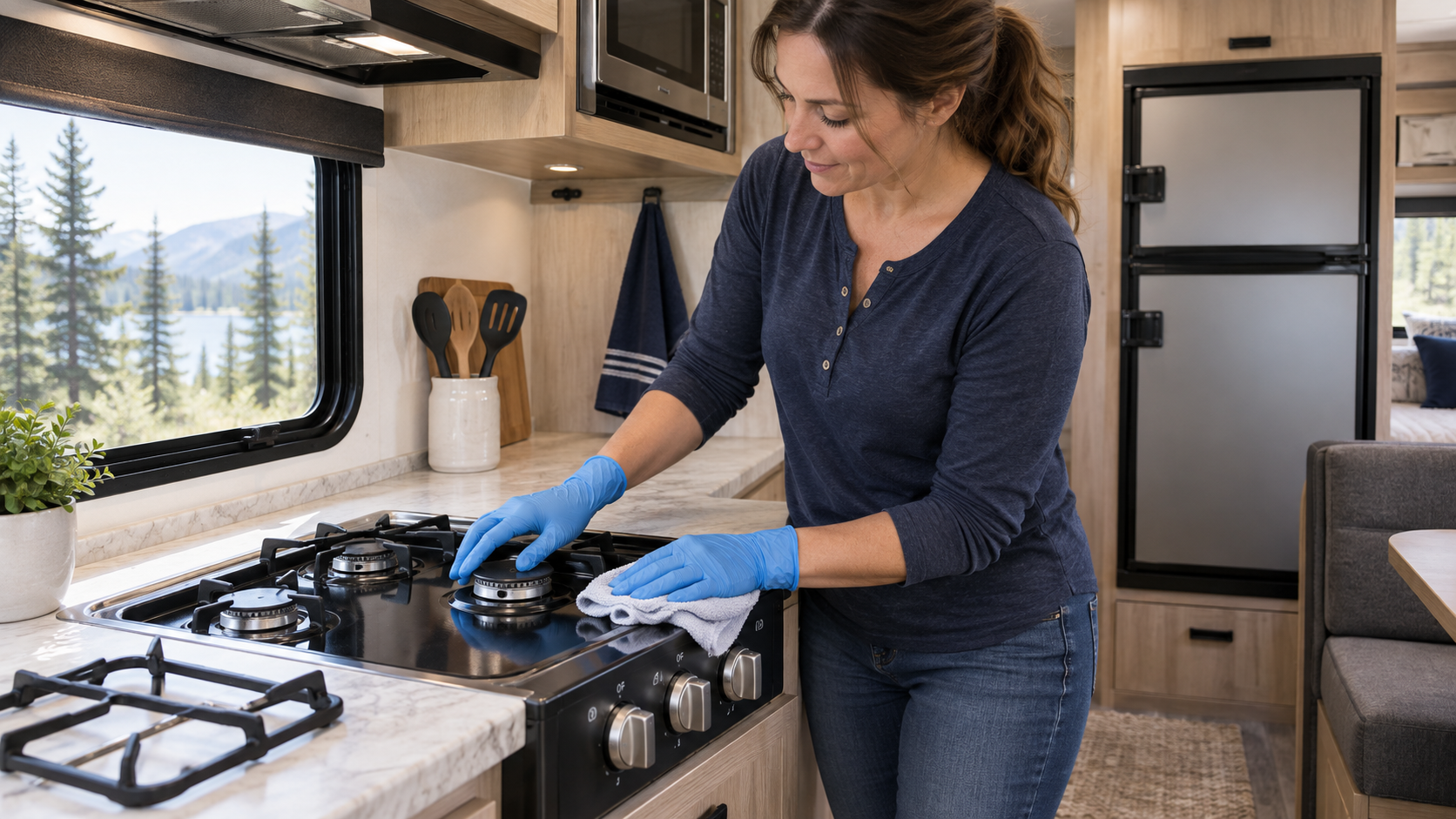
Keep the cooktop free of grease, crumbs, and food residue. Spills can obstruct burner openings, interfere with ignition, and create smoke or odours.
Before cleaning:
- Turn every control to off.
- Allow the appliance to cool completely.
- Shut off propane when directed.
- Remove grates and burner covers only as permitted.
- Use a cleaner approved for the surface.
- Dry all components before reassembly.
Do not enlarge burner openings with wire, drill bits, or sharp tools. Damaged burner ports can affect flame shape and combustion.
A properly operating propane burner generally produces a controlled blue flame, although appearance can vary during ignition and with the appliance design. Persistent yellow flames, soot, delayed ignition, popping, or flame lifting require qualified inspection.
Never use the range or oven to heat the RV. Cooking appliances are not designed for space heating and can create dangerous heat, moisture, fire, and carbon-monoxide conditions.
Confirm that the range cover is secured before travel and that loose grates cannot move. Even if the burner looks normal, keep the cooktop clean and free of grease.
Microwave Maintenance
Keep the microwave interior clean, especially around the door, latch, and sealing surfaces. Food buildup can cause odours, smoke, and uneven operation.
Inspect:
- Door alignment
- Latch operation
- Turntable and support
- Interior coating
- Ventilation openings
- Mounting hardware
- Power cord where accessible
Do not operate a microwave with a damaged door, loose hinge, failed latch, exposed metal, arcing, or burned interior surface.
A microwave that loses power may be affected by the pedestal, RV breaker, GFCI circuit, inverter, or energy-management system. Do not remove the microwave cabinet. Internal high-voltage components can remain dangerous after power is disconnected. Although a microwave may seem simple, internal high-voltage parts remain dangerous after power is off.
Furnace Maintenance
Keep interior return-air openings and heat registers unobstructed. Rugs, furniture, storage, and pet hair can restrict airflow and cause poor heating or overheating.
Inspect the exterior furnace vent for:
- Mud-dauber or insect nests
- Leaves and debris
- Soot
- Rust
- Heat damage
- Damaged screens
- Loose fasteners
Use only insect screens approved for the furnace. An incorrect or restrictive screen can interfere with airflow and combustion.
When starting the furnace after storage, listen for normal blower operation and confirm that warm air reaches the registers. Shut it down if you notice propane odour, soot, repeated ignition attempts, scraping, unusual vibration, or an abnormal exhaust appearance.
Burner cleaning, gas-pressure testing, combustion diagnosis, and internal furnace repair require qualified service. If the furnace shuts down repeatedly, have it inspected before the next trip.
Check out the complete RV Furnace Maintenance and Troubleshooting guide for step-by-step instructions.
Air-Conditioner Maintenance
A dirty air-conditioner filter restricts airflow and reduces cooling performance. Clean or replace filters at the interval specified by the manufacturer and more often in dusty conditions or when travelling with pets.
Inspect:
- Interior filters
- Air-return opening
- Ceiling assembly
- Supply vents
- Condensate drainage
- Exterior shroud
- Mounting condition
- Visible wiring
- Signs of water entry
Do not block return-air or supply vents. Avoid operating the air conditioner with heavily soiled filters.
Water dripping inside may result from a blocked drain path, frozen coil, dirty filter, improper installation, damaged gasket, or an RV that is outside the permitted level range.
Roof access and air-conditioner service can involve fall hazards, capacitors, refrigerant, and heavy equipment. Coil service, refrigerant repairs, electrical diagnosis, and gasket replacement may require a qualified technician. Because dirty filters reduce cooling, clean them before each trip in dusty conditions.
Check out the How to Maintain Your RV Air Conditioner for step-by-step instructions.
Water-Heater Maintenance
Before operating a tank-style water heater, confirm that the tank is completely filled and air has been purged from the hot-water lines. Energizing an empty tank can destroy the electric heating element.
Routine care may include:
- Inspecting the exterior compartment
- Checking for soot, corrosion, or leaks
- Draining and flushing the tank
- Inspecting or replacing the anode rod where equipped
- Cleaning the burner area as permitted
- Checking the pressure-relief valve according to the manual
- Inspecting bypass valves
- Protecting the system from freezing
Tankless water heaters have different descaling, draining, and winterizing procedures. Follow the exact manual. If the tank is empty, never energize the heater until it is full.
Check out the complete RV Water Heater Maintenance and Troubleshooting guide for step-by-step instructions.
Exterior Appliance Vents
Refrigerators, furnaces, and water heaters may use exterior vents or access panels. Inspect them regularly and after storage.
Look for:
- Insect nests
- Spider webs
- Leaves
- Soot
- Corrosion
- Heat damage
- Loose panels
- Missing fasteners
- Cracked covers
- Failed sealant around the frame
Do not block, modify, or seal required ventilation openings. Decorative covers and unapproved insect screens can restrict airflow.
Soot around a propane-appliance vent is not normal dirt. Shut down the appliance and have the combustion system inspected before using it again.
Washer, Dishwasher and Ice-Maker Care
Water-using appliances require special attention before freezing weather.
Inspect accessible hoses and connections for:
- Cracks
- Bulges
- Abrasion
- Loose fittings
- Corrosion
- Slow leaks
- Water staining
Clean filters, strainers, and drain areas according to the appliance instructions. Do not overload an RV washer or operate it when the RV is outside the manufacturer’s levelling requirements.
Winterizing procedures may require draining pumps, valves, lines, filters, traps, and internal reservoirs. Simply pumping antifreeze through the main plumbing system may not protect every appliance. Because water can remain in internal parts, winterize each appliance before freezing weather.
Preparing Appliances for Travel
Before moving the RV:
- Secure refrigerator doors
- Lock microwave and oven doors where required
- Remove loose items
- Secure range grates and covers
- Turn appliances off as required
- Confirm that exterior access panels are latched
- Follow all propane travel restrictions
- Check for unusual odours or leaks
Travel rules for propane appliances vary by location, ferry, tunnel, fuel station, and facility. Follow posted restrictions and applicable laws.
Seasonal Start-Up
At the beginning of the season:
- Inspect appliance vents and access panels.
- Confirm that winterizing materials have been removed correctly.
- Fill the water heater before energizing it.
- Restore water and check for leaks.
- Confirm battery and shore-power condition.
- Test detectors.
- Test each appliance separately.
- Watch for abnormal heat, odours, soot, noise, or fault codes.
- Record any repairs required.
Do not start every appliance simultaneously. Testing one at a time makes unusual operation easier to identify and avoids placing an immediate heavy load on the electrical system.
Preparing Appliances for Storage
Before storage:
- Clean and dry appliance interiors
- Remove food
- Defrost the refrigerator
- Position refrigerator doors for ventilation as directed
- Clean the range and oven
- Empty crumbs and grease
- Turn appliances off
- Shut off propane when required
- Winterize all water-bearing appliances
- Clean or replace air filters
- Keep exterior vents unobstructed
- Record unresolved problems
Never energize an empty water heater. Periodically inspect the stored RV for leaks, pests, moisture, and appliance damage. Because stored appliances can attract pests, inspect them periodically during the off-season.
Common Appliance Problems
The appliance has no power
Confirm the required power source, battery disconnect, fuse, breaker, GFCI, inverter, and appliance controls. Stop if protection devices repeatedly trip.
A propane appliance will not ignite
Confirm that propane is available and that required valves are open. After cylinder changes, air in the line may delay ignition. Do not continue repeated ignition attempts if propane odour develops.
The appliance repeatedly displays a fault
Record the exact fault code and operating conditions. Consult the manual rather than clearing the code repeatedly. Recurring faults require diagnosis.
An appliance produces an unusual odour
Turn it off. Propane, electrical-burning, ammonia-like, exhaust, or overheating odours can indicate serious problems. Ventilate and leave the RV when necessary.
The appliance works poorly in hot or cold weather
Check the operating-temperature and levelling limits. Inspect airflow, vents, filters, power supply, and environmental conditions. Do not modify ventilation to force better performance. If an appliance behaves unpredictably, stop using it and note the symptoms before seeking service.
RV Appliance Maintenance: Routine Schedule
Before each trip
- Secure appliance doors and loose components
- Confirm required appliances are off
- Inspect for propane odour and visible leaks
- Check exterior panels and vents
Monthly during use
- Clean refrigerator and range surfaces
- Inspect door seals
- Clean air-conditioner filters
- Check furnace registers
- Inspect appliance vents
- Look for soot, heat damage, moisture, and damaged wiring
At the beginning of the season
- Test each appliance
- Check power and propane operation
- Fill the water heater before energizing
- Inspect hoses, vents, seals, and controls
- Record faults and arrange service
Before storage
- Clean and dry appliances
- Remove food
- Winterize water-bearing equipment
- Shut down fuel and power sources as directed
- Leave refrigerator doors ventilated where recommended
For a printable version of the maintenance schedule, see our RV Checklists page.
When to Contact a Qualified Technician
Arrange professional service for:
- Propane odours or suspected leaks
- Persistent yellow flames or soot
- Delayed ignition
- Smoke, sparks, or overheated wiring
- Repeated breaker or fuse operation
- Burned electrical connections
- Refrigerant or hydraulic leaks
- Refrigerator ammonia odour or yellow residue
- Internal combustion-system cleaning
- Gas-pressure testing
- Appliance removal
- Recurring fault codes
- Significant water leaks
- Damage near electrical or propane components
When the cause of a problem is uncertain, stop using the appliance. Repeatedly resetting or restarting it can worsen the fault and create a safety hazard. For more industry safety guidance, see the RV Safety & Education Foundation.
RV Appliance Maintenance: Key Takeaways
RV appliance maintenance begins with clean surfaces, clear ventilation, stable power, safe propane operation, and attention to changes in performance.
Identify each appliance, follow its manual, and document maintenance. Owners can perform many routine inspections and cleaning tasks, but combustion, propane, refrigerant, and internal electrical repairs belong with qualified technicians.