
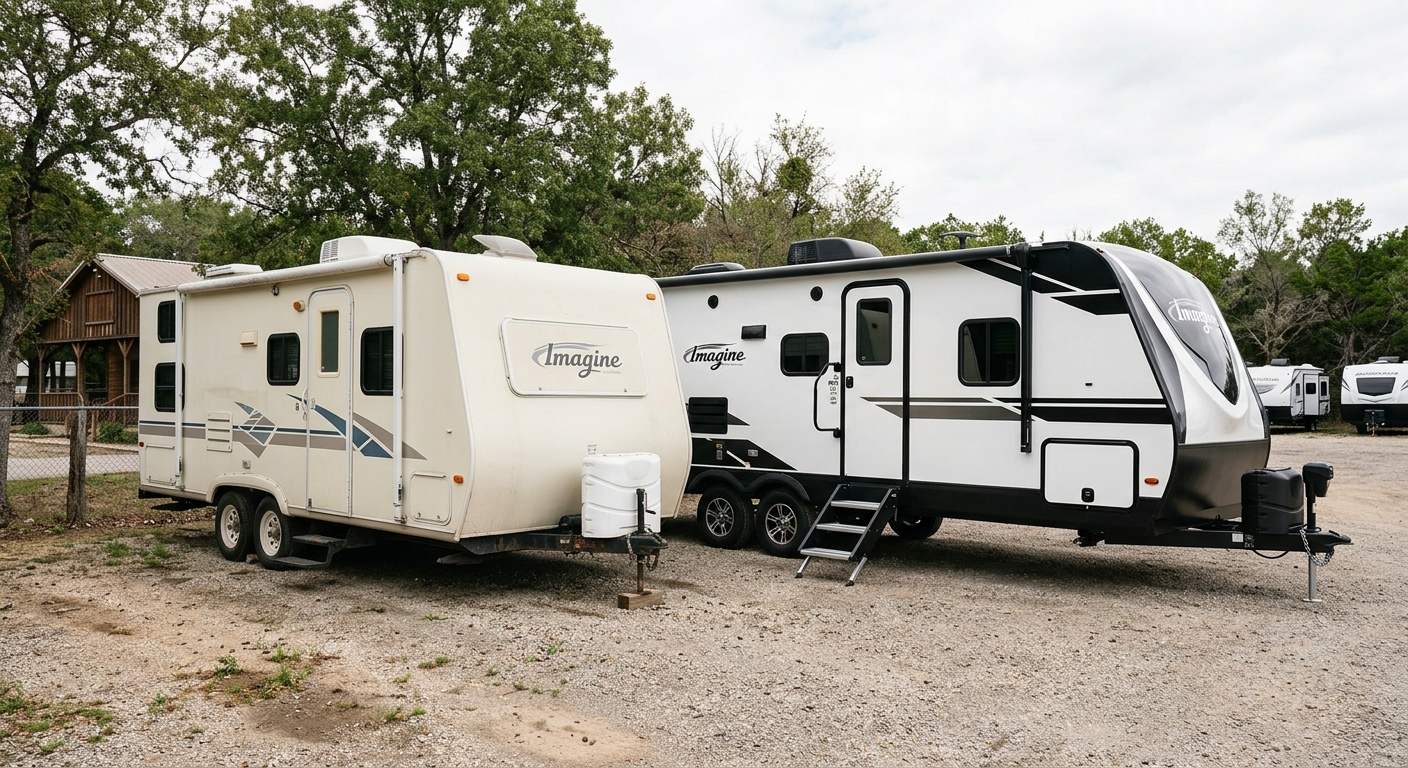
New vs used RV is one of the first decisions a buyer faces. Both have real advantages and real drawbacks. The right choice depends on your budget, tolerance for repair work, plans for use, and how much you value warranty coverage versus lower upfront cost.
This guide compares new and used RVs across the factors that matter most: cost, depreciation, warranty, condition, financing, and long-term ownership. It is not a recommendation for one over the other — it is a framework for deciding which fits your situation.
The Case for Buying New
A new RV offers several clear advantages.
Warranty coverage. A new RV comes with the manufacturer’s warranty, typically covering structural components, workmanship, and appliances. If something fails early, the manufacturer repairs it. This is the single biggest reason many buyers choose new.
Known history. Nobody has used the RV before you. You know exactly how it has been stored, maintained, and treated since the day it left the factory. There are no hidden problems from previous owners.
Latest features. New RVs include current safety systems, updated appliances, modern electronics, and the latest floor plans. If you want solar pre-wiring, lithium-compatible charging, or newer climate-control systems, new is often the only way to get them.
Choice of floor plan and options. You can order the exact configuration you want rather than searching for a used model that happens to match.
Financing is often easier. New RV loans usually have lower interest rates and longer terms than used RV loans.
Fewer immediate repairs. A new RV should not need significant work in the first year, aside from warranty adjustments and normal break-in items.
Downsides:
- Highest upfront cost
- Immediate depreciation — often 15–25 percent in the first year
- First-year issues are common; “new” does not mean “trouble-free”
- Warranty work can take weeks at a dealership, especially in peak season
- Exterior sealant and adjustments may only be covered for 90 days
The Case for Buying Used
A used RV offers a different set of advantages.
Lower purchase price. Depreciation has already done its work. A used RV that is 2–5 years old may cost 30–50 percent less than the same model new.
Less depreciation going forward. The steepest depreciation has already happened. If you sell in a few years, you may lose far less value than a new buyer would.
More RV for the money. At a given budget, a used RV often gets you a larger, better-equipped, or higher-quality model than a comparable new one.
Known issues may have been resolved. A well-maintained used RV has already had its first-year warranty adjustments and any early failures fixed.
Upgrades already installed. Many used RVs come with solar, lithium batteries, upgraded suspension, or other modifications the previous owner paid for.
Downsides:
- Limited or no warranty coverage
- Unknown history — depends on how the previous owner maintained it
- Hidden problems are possible, especially water damage
- Immediate maintenance and repair costs may be needed
- Financing rates are usually higher
- Floor plan and options are whatever is available, not what you would choose
For a full inspection guide, see our Buying a Used RV post.
Cost Comparison: The Real Numbers
The purchase price is only part of the picture. Consider the total cost of ownership over the first several years.
| Cost factor | New RV | Used RV |
|---|---|---|
| Purchase price | Highest | Lower |
| First-year depreciation | 15–25% | Already absorbed |
| Warranty | Full coverage | Limited or none |
| Immediate repairs | Warranty work, minor | Possible significant repairs |
| Insurance | Higher (based on value) | Lower |
| Financing rate | Usually lower | Usually higher |
| Sales tax | On higher price | On lower price |
| Upgrades needed | Usually none | Possibly solar, batteries, tires |
A used RV that saves you $30,000 upfront but needs $8,000 of work in the first year may still be the better financial choice. A new RV that costs more but comes with full warranty coverage and predictable reliability may be worth the premium. The math depends on your situation.
Depreciation: Why It Matters
Depreciation is the difference between what you paid and what the RV is worth when you sell it. It is a real cost, even though it is not paid at the time of purchase.
- New RVs often lose 15–25 percent of their value in the first year, and continue to depreciate from there.
- Used RVs still depreciate, but the steepest drop has already happened.
If you plan to keep the RV for many years, depreciation matters less. If you plan to upgrade or sell within a few years, buying used is usually the better financial move. For more industry guidance on RV values and standards, see the RV Industry Association.
Warranty and Service
Warranty coverage is a significant factor for many buyers.
New RVs typically come with:
- Manufacturer warranty on structure and workmanship
- Separate warranties on appliances and chassis
- 90-day coverage on sealant and adjustments
Used RVs typically come with:
- Remaining transferable warranty (if any)
- Appliance warranties that may have expired
- No manufacturer coverage on most components
If the used RV is still within its original warranty period, you may be able to transfer the remaining coverage. This varies by manufacturer and may require a transfer fee.
Many used RVs sold by dealers come with a limited dealer warranty or a short service contract. These are often narrow and should not be compared to a manufacturer warranty.
Condition and Inspection
New RVs are not always problem-free. The first year often includes:
- Warranty adjustments
- Appliance repairs
- Slide-out adjustments
- Sealant issues
- Minor electrical problems
These are covered but can be inconvenient, especially if the dealer is far away or busy.
Used RVs require a thorough inspection before purchase. Problems to watch for:
- Water damage or delamination
- Worn tires and suspension components
- Expired safety detectors
- Aging appliances
- Hidden plumbing leaks
- Neglected sealant
A professional pre-purchase inspection is almost always worth the cost for a used RV. For a new RV, the manufacturer warranty replaces some of that need — but a careful walkthrough before signing is still important. For full coverage details, see our RV Warranty Coverage guide
Financing
New RV loans often have:
- Lower interest rates
- Longer terms
- Higher loan amounts
Used RV loans often have:
- Higher interest rates
- Shorter terms
- Limits based on the RV’s age and condition
Some lenders will not finance older RVs or will offer terms that make the monthly payment higher than expected. Check financing options before you start shopping.
Insurance
Insurance premiums are generally based on the RV’s value. New RVs cost more to insure than used ones. However, agreed-value coverage may be easier to obtain for newer RVs. For older RVs, actual cash value coverage is more common and can leave you underinsured after a loss.
Check whether your insurer offers agreed-value coverage for used RVs and how the policy handles older units.
Reliability and Repair Costs
A new RV is not automatically more reliable than a used one. Some manufacturers have better quality control than others, and some used RVs have been maintained to a higher standard than average.
New RVs may have:
- Early reliability issues covered by warranty
- Predictable service intervals
- Easier access to dealer support
Used RVs may have:
- Unknown reliability
- Higher chance of immediate repairs
- Limited parts availability on older models
A used RV from a reputable manufacturer, maintained by a careful owner, is often more reliable than a poorly built new RV. Condition and history matter more than age alone.
Which Makes Sense for You?
Consider buying new if:
- You want full warranty coverage
- You prefer not to handle repairs yourself
- You want the latest features and floor plans
- You plan to keep the RV for many years
- Financing terms matter more than the purchase price
- You value a known history and full documentation
Consider buying used if:
- You want to maximize value at a given budget
- You are comfortable with some repair work
- You are willing to inspect carefully or pay for an inspection
- The steepest depreciation has already happened
- You plan to upgrade or sell within a few years
- You want a larger or better-equipped RV than new prices allow
Buying a certified pre-owned (CPO) RV can offer a middle ground if you want some of both. Some manufacturers and dealers offer CPO programs that include an inspection, a limited warranty, and sometimes roadside assistance. If you are still choosing an RV, see our Choosing Your First RV guide.
A New vs. Used Comparison Checklist
Before deciding, confirm:
- Your realistic budget, including ongoing costs
- Whether warranty coverage is important to you
- Whether you are comfortable handling or paying for repairs
- How long you plan to keep the RV
- Whether financing terms differ meaningfully
- What insurance coverage is available
- Whether you want specific features only available in new RVs
- Whether you are willing to inspect a used RV thoroughly
- Whether a certified pre-owned program is available
When to Get Help
Professional advice may be useful when:
- Comparing financing options
- Evaluating a used RV
- Understanding warranty transferability
- Choosing between specific models
- Assessing the true cost of ownership
A financial advisor, RV inspector, or dealer may help — but you should not rely on any single party’s recommendation. Compare options independently.
New vs Used RV: Key Takeaways
There is no universally better choice. A new RV offers warranty coverage and a known history at a higher upfront cost. A used RV offers lower cost and less depreciation but requires more diligence.
The right decision depends on your budget, tolerance for repair work, plans for use, and how much value you place on warranty coverage. Whichever you choose, inspect carefully, weigh honestly, and plan for ongoing maintenance rather than assuming the RV will be trouble-free.